Facts
The judgment concerned execution proceedings initiated to enforce arbitral awards against the judgment-debtors in four connected matters.
Source reference: pp.1–2The arbitrators had been appointed before 23 October 2015, the date from which Section 12(5), the Fifth Schedule and the Seventh Schedule of the Arbitration and Conciliation Act, 1996 (“1996 Act”) were brought into force.
Source reference: pp.3–6The judgment-debtors contended that, in light of the Supreme Court’s decision in Bhadra International (India) Pvt. Ltd. v. Airport Authority of India, unilateral appointment of arbitrators was inherently invalid and that the resulting awards were void and incapable of execution, even though the appointments pre-dated 23 October 2015 and the awards had not been successfully challenged.
Source reference: pp.7–9The decree-holders argued that the 2015 amendments were prospective and that objections to the arbitrator’s appointment could not be raised for the first time during execution after the judgment-debtors had participated in the arbitration and failed to challenge the awards.
Source reference: pp.24–26The Execution Court framed two questions concerning the validity of pre-23 October 2015 unilateral appointments and the power of the executing court to examine their effect in the absence of a challenge to the award.
Source reference: para.1Issues
1. Whether the unilateral appointment of an arbitrator before 23 October 2015 was without jurisdiction, thereby rendering all proceedings arising from that appointment void ab initio?
Source reference: para.1(i); pp.2–32. If such appointment was invalid, whether the executing court could examine its effect despite the absence of a challenge to the arbitral award?
Source reference: para.1(ii); p.23. Whether the legal position differed between (a) an appointment pursuant to a contractual clause naming an arbitrator or authorising one party to appoint an arbitrator, and (b) an appointment made unilaterally without any such contractual authority or consent?
Source reference: paras.17–18; pp.27–28Law Applied
The Court applied Sections 7, 11, 12, 13, 16 and 18 of the 1996 Act as they stood before the 2015 amendment, under which parties could agree upon the appointment procedure, an arbitrator could be challenged for circumstances giving rise to justifiable doubts as to independence or impartiality, and parties were required to be treated equally.
Source reference: paras.19–21; pp.27–34Section 12(5), read with the Seventh Schedule, introduced an express statutory disqualification from appointment, but was prospective from 23 October 2015 and could not be applied retrospectively to pre-existing arbitral proceedings.
Source reference: paras.25, 28–32; pp.36–41The Court relied on Dharma Prathishthanam v. Madhok Construction (P) Ltd., which held that where an arbitration clause neither named an arbitrator nor authorised a party to appoint one, a unilateral appointment without the other party’s consent was invalid.
Source reference: paras.39–42; pp.48–49, 68–69Conversely, Datar Switchgears Ltd. v. Tata Finance Ltd., ACE Pipeline Contracts (P) Ltd. v. Bharat Petroleum Corporation Ltd. and Indian Oil Corporation Ltd. v. Raja Transport Pvt. Ltd. recognised, subject to the pre-amendment law and available challenges for bias or partiality, appointments made pursuant to an agreed contractual procedure.
Source reference: paras.20–23; pp.28–35The Court also followed Aravali Power Co. (P) Ltd. v. Era Infra Engineering Ltd., Rajasthan Small Industries Corporation Ltd. v. Ganesh Containers Movers Syndicate, S.P. Singla Construction Pvt. Ltd. v. State of Himachal Pradesh and Parmar Construction Co. v. State of Haryana, which held that Section 12(5) did not retrospectively invalidate pre-23 October 2015 appointments.
Source reference: paras.29–31; pp.39–40Bhadra International was confined to appointments made contrary to Section 12(5) after the amendment and was not treated as overruling the earlier pre-amendment authorities.
Source reference: paras.22–24, 35, 43; pp.34–35, 42–51Failure to challenge an appointment or award under the statutory remedies could amount to waiver under Section 4 of the 1996 Act, preventing a collateral challenge at the execution stage, except where the appointment was inherently non-consensual and void.
Source reference: paras.25–26, 33–34; pp.36–38, 41–42Reasoning
The Court distinguished three forms of unilateral appointment: appointment of an evidently interested or connected person; appointment by one party where the arbitration agreement expressly conferred that power; and appointment by one party where the agreement neither named an arbitrator nor conferred any appointment power.
Source reference: para.18; p.27For proceedings commenced before 23 October 2015, the Court held that the 2015 statutory disqualifications could not be retrospectively imposed.
Source reference: paras.25, 32–34; pp.36–42The pre-amendment Act already provided mechanisms under Sections 12, 13, 16 and 34 to challenge independence, impartiality, jurisdiction or the award; therefore, an unchallenged appointment made in accordance with the parties’ agreed procedure did not automatically become void merely because the 2015 amendment later clarified the neutrality requirements.
Source reference: paras.25, 32–34; pp.36–42The Court read Bhadra International in its factual and statutory context: it involved a post-23 October 2015 invocation and an appointment contrary to Section 12(5), whereas Dharma Prathishthanam involved a fundamentally non-consensual appointment unsupported by any contractual appointment mechanism.
Source reference: paras.39–43; pp.48–51Accordingly, only the latter category—an appointment made without contractual authority and without the other party’s consent—was void for want of jurisdiction.
Source reference: paras.39–43; pp.48–51Where the judgment-debtor had participated in the arbitration, failed to challenge the tribunal or award, or had unsuccessfully pursued such a challenge, the executing court could not use execution proceedings to reopen the adjudication.
Source reference: paras.47–50; pp.53–55Holding
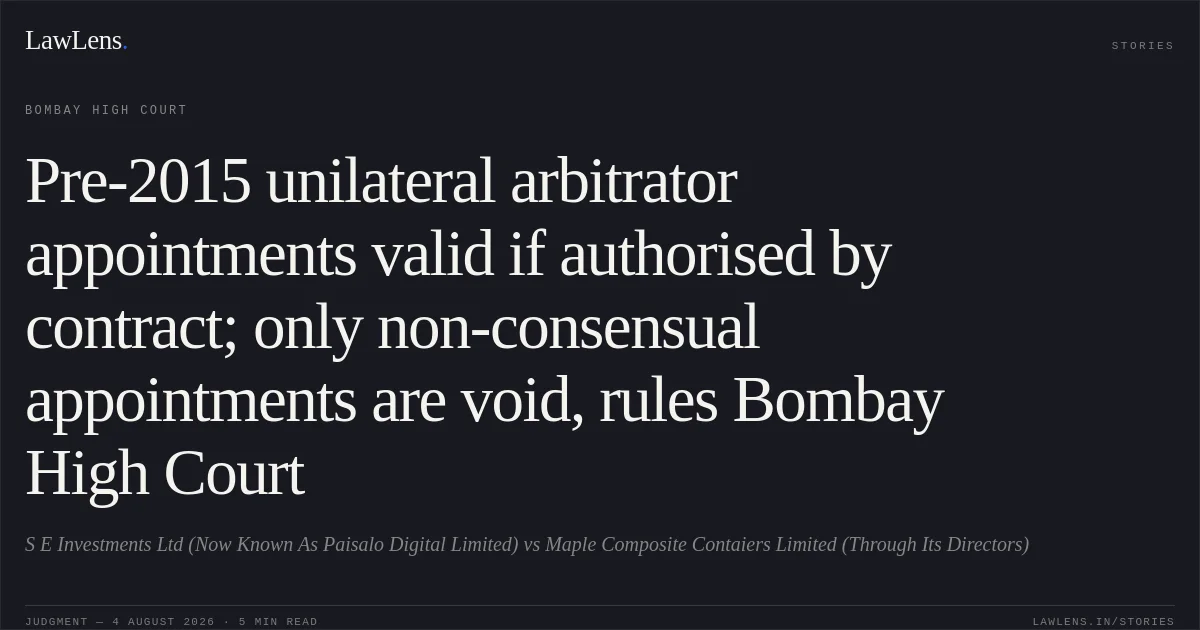
The Court answered the first issue by holding that a pre-23 October 2015 appointment made pursuant to an arbitration clause naming an arbitrator, identifying the appointing authority/designation, or authorising one party to appoint an arbitrator was not, by that fact alone, without jurisdiction, and proceedings arising from it were not void ab initio.
However, where the agreement contained no such contractual mechanism and one party appointed the arbitrator without the other party’s consent, the appointment and resulting proceedings were void.
Source reference: para.54; pp.69–70The second issue did not generally arise; nevertheless, in the case of a genuinely non-consensual appointment, the executing court could treat the award as void, unless the appointment had already been challenged unsuccessfully.
Source reference: para.54; p.70The Court therefore rejected the judgment-debtors’ broad reliance on Bhadra International to invalidate all pre-2015 unilateral appointments and directed that the connected execution matters be listed for further consideration on 15 September 2026.
Source reference: para.55; p.71Original Court PDF
S E Investments Ltd (Now Known As Paisalo Digital Limited)vsMaple Composite Contaiers Limited (Through Its Directors)
Click to open original judgment
Original judgment, available to read, download and summarize on LawLens.in