01Facts
On 15 May 2020, Rutvikbhai Mukeshbhai Lathiya, aged approximately 21 years, was travelling in an Innova car driven by Respondent No. 1. The vehicle allegedly overturned due to rash and negligent driving, causing fatal injuries to the deceased.
¶ 2 · p. 2His legal representatives instituted M.A.C.P. No. 91 of 2020 before the Motor Accident Claims Tribunal, Bhavnagar, claiming compensation on the basis that the deceased was engaged in business and earned substantial income.
¶ 2 · p. 2The Tribunal partly allowed the claim petition and awarded ₹16,44,000 with interest at 9% per annum from the date of filing of the claim petition.
¶ 1, 3 · pp. 1–2The claimants appealed, challenging the award only on the issue of quantum, particularly the assessment of the deceased’s income.
¶ 4 · p. 3Before the High Court, the claimants relied upon income-tax returns for Assessment Years 2019–20 and 2020–21, the balance sheet, profit and loss account, and Chartered Accountant’s certificate.
¶ 6, 9–10 · pp. 3–7The AY 2019–20 return had been filed by the deceased on 26 August 2019, whereas the AY 2020–21 return was filed after his death and had been declared invalid.
¶ 6, 9–10 · pp. 3–702Issues
i.Whether the Tribunal erred in disbelieving the income-tax return for AY 2019–20 and in assessing the deceased’s monthly income at ₹10,000?
¶ 6, 9–11 · pp. 3–7ii.Whether the deceased’s income, future prospects, personal-expense deduction, and multiplier were required to be reassessed for determining loss of dependency?
¶ 11–14 · pp. 7–8iii.Whether the claimants were entitled to enhancement of compensation over and above the amount awarded by the Tribunal?
¶ 15–18 · pp. 8–1003Law Applied
The Court applied the principles governing assessment of compensation under the Motor Vehicles Act, including the requirement to determine just compensation on the basis of proved income and established evidence.
Relying on Malarvizhi v. United India Insurance Co. Ltd., (2020) 4 SCC 228, it held that income-tax returns, being statutory documents, may be considered for assessing the deceased’s income.
¶ 10–14 · pp. 7–8It also relied on New India Assurance Co. Ltd. v. Sonigra Juhi Uttamchand, [2025] 0 INSC 15, for the principle that tax returns may be relied upon where payment of tax is properly proved so that the net income can be calculated.
¶ 10–14 · pp. 7–8The Court applied National Insurance Co. Ltd. v. Pranay Sethi, (2017) 16 SCC 680, granting 40% addition towards future prospects for a deceased below 40 years, deducting 50% towards personal expenses where the deceased was a bachelor, and applying the multiplier of 18 for a deceased aged 21 years.
¶ 10–14 · pp. 7–8The conventional heads of compensation, which were not challenged, were maintained.
¶ 15 · p. 8Provisions in the judgment · 1
Income Tax Act, 1961 Section 44AD
04Reasoning
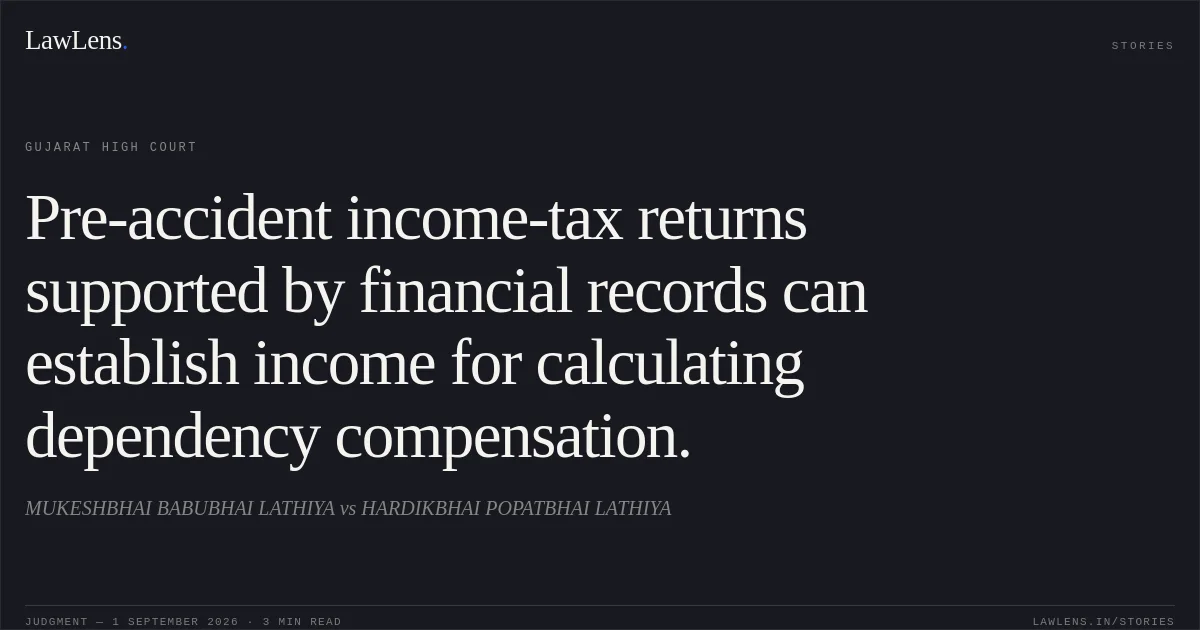
The High Court found the Tribunal’s rejection of the AY 2019–20 income-tax return to be unsupported by the record.
¶ 9 · p. 6The alleged conclusion that the return was filed to obtain bank finance was neither pleaded nor established by either party, and no effective cross-examination was conducted on that aspect.
¶ 9 · p. 6In contrast, the AY 2019–20 return had been filed by the deceased himself before the accident and was corroborated by the balance sheet, profit and loss account, supporting documents, and the Chartered Accountant’s certificate.
¶ 9–11 · pp. 6–7The AY 2020–21 return was correctly excluded because it was filed after the deceased’s death and had been declared invalid.
¶ 9–11 · pp. 6–7The Court therefore accepted a gross annual profit of ₹2,96,881, deducted income tax of ₹2,344, and determined the net annual income at ₹2,94,537.
¶ 10–11 · p. 7Applying 40% future prospects, the annual income became ₹4,12,352; after deducting 50% for personal expenses, the annual loss of dependency was ₹2,06,176.
¶ 12–14 · pp. 7–8Applying the multiplier of 18 resulted in ₹37,11,168 towards future loss of dependency.
¶ 12–14 · pp. 7–8Adding ₹96,000 for loss of consortium, ₹18,000 for loss of estate, and ₹18,000 for funeral expenses produced total compensation of ₹38,43,168.
¶ 15–16 · p. 905Holding
The appeal was partly allowed.
¶ 16 · p. 9The High Court modified the Tribunal’s award by enhancing the total compensation from ₹16,44,000 to ₹38,43,168, resulting in an additional compensation of ₹21,99,168.
¶ 16 · p. 9The enhanced amount was directed to carry interest at 9% per annum from the date of filing of the claim petition until realization, consistent with the Tribunal’s award.
¶ 17 · p. 9Respondent No. 2–Insurance Company was directed to deposit the awarded amount, including the enhancement, within six weeks of receiving the order, after which the Tribunal was to disburse the amount to the claimants subject to verification and deduction of any deficit court fee.
¶ 18 · p. 10No order was made as to costs, and any statutory deposit was directed to be transmitted to the Tribunal.
¶ 19–21 · p. 10Original Court PDF
MUKESHBHAI BABUBHAI LATHIYAvsHARDIKBHAI POPATBHAI LATHIYA
Click to open original judgment
Original judgment, available to read, download and summarize on LawLens.in