01Facts
Nathu Ram, respondent No. 3, joined the Punjab State Co-operative Supply and Marketing Federation Limited (“MARKFED”) as a daily-wage Helper on 01.09.1976.
¶ 3His services were regularised on 22.12.1977.
¶ 3After attaining the age of superannuation in March 2016, he continued in service pursuant to a two-year extension and was relieved on 06.03.2018.
¶ 3He claimed that MARKFED had not paid him the full gratuity payable under the Payment of Gratuity Act, 1972.
¶ 3The Controlling Authority counted his service from 01.09.1976, determined his gratuity at ₹9,80,954, and directed payment of the balance amount of ₹49,048 with 10% annual interest.
¶ 3MARKFED’s statutory appeal under Section 7(7) of the 1972 Act was dismissed, and its writ petition challenging the orders was rejected by the learned Single Judge.
¶ 3MARKFED therefore preferred the present Letters Patent Appeal, contending that the period served as a daily-wage employee before regularisation could not be counted for gratuity.
¶ 2, 402Issues
i.Whether service rendered by an employee on a daily-wage basis prior to regularisation can be counted as “continuous service” for calculating gratuity under the Payment of Gratuity Act, 1972.
¶ 7ii.Whether MARKFED was entitled to exclude the period from 01.09.1976 to 22.12.1977 from the computation of Nathu Ram’s gratuity on the ground that he became a regular employee only upon regularisation.
¶ 4, 803Law Applied
The Court applied the Payment of Gratuity Act, 1972, particularly the concept of “continuous service” under Section 2-A and the appellate remedy under Section 7(7).
¶ 3, 7It relied principally on Netram Sahu v. State of Chhattisgarh, (2018) 5 SCC 430, where the Supreme Court held that once an employee’s services are regularised, the entire period of service rendered before regularisation may be counted for gratuity, provided the statutory requirement of five years’ continuous service is satisfied; the date of formal regularisation is not decisive for determining the total length of service.
¶ 7The Court also noted that MARKFED’s Common Cadre Rules, 1990 had been amended to provide that gratuity would be payable in accordance with the 1972 Act, as amended from time to time.
¶ 8Provisions in the judgment · 2
PAYMENT OF GRATUITY ACT, 1972 Section 7Section 2A
04Reasoning
The Court held that Nathu Ram had rendered uninterrupted service from 01.09.1976 until his retirement and that his services had subsequently been regularised by MARKFED.
¶ 3, 8Applying Netram Sahu, the Court reasoned that regularisation could not be used to deprive an employee of the benefit of the earlier period of service when the employer had accepted and utilised that service.
¶ 7–8Since the 1972 Act applied to MARKFED’s employees and Nathu Ram had clearly completed more than the required five years of continuous service, the period of daily-wage employment was correctly included in the gratuity calculation.
¶ 7–8MARKFED’s argument that gratuity accrued only from the date of regularisation was therefore rejected.
¶ 7–805Holding
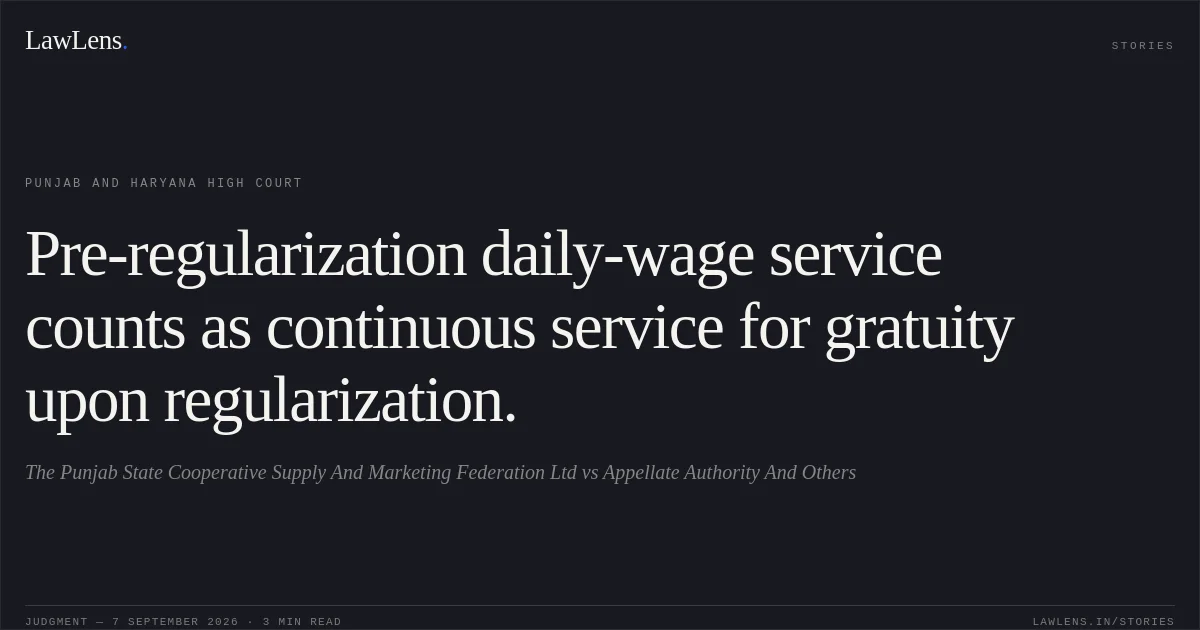
The Court answered the issues against MARKFED and held that Nathu Ram’s daily-wage service preceding regularisation was properly counted as continuous service for calculating gratuity under the Payment of Gratuity Act, 1972.
¶ 8Finding no illegality or perversity in the judgment of the learned Single Judge or in the orders of the gratuity authorities, the Court dismissed all three connected Letters Patent Appeals, with no order as to costs.
¶ 9Pending miscellaneous applications, if any, were also disposed of.
¶ 10Original Court PDF
The Punjab State Cooperative Supply And Marketing Federation LtdvsAppellate Authority And Others
Click to open original judgment
Original judgment, available to read, download and summarize on LawLens.in