Facts
The respondents were initially engaged by the Punjab School Education Board (“PSEB”) between 1993 and 1996 as clerks and peons on contract, ad hoc, daily-wage, or work-charge terms, generally through successive 89-day engagements. Their services continued intermittently due to administrative and operational exigencies.
Source reference: paras. 2–5After prolonged litigation concerning regularisation, the PSEB adopted, mutatis mutandis, the Punjab Government’s regularisation policy dated 23.01.2001 as a one-time measure. Pursuant thereto, appointment letters were issued to the respondents from August 2004, and they were placed on regular pay scales.
Source reference: paras. 8–15The respondents subsequently claimed that their pre-regularisation service should count as qualifying service for pension and that, since they had entered service before 01.01.2004, they should be governed by the old pension/GPF scheme rather than the Defined Contributory Pension Scheme introduced from that date.
Source reference: paras. 16–18The PSEB referred the issue to the Punjab Government, which rejected the claim on the ground that the respondents were regularised after 01.01.2004. The Single Judge and the Division Bench of the Punjab and Haryana High Court allowed the respondents’ claims, holding that the substance of their engagement amounted to regularisation and that their earlier service was pensionable. The PSEB appealed to the Supreme Court.
Source reference: paras. 17–19Issues
1. Whether the respondents’ appointments in August 2004 constituted fresh appointments or regularisation of their pre-existing contractual, ad hoc, daily-wage, and work-charge service?
Source reference: paras. 21–252. Whether the respondents’ pre-regularisation service was required to be counted as qualifying service for retiral and pensionary benefits under the Punjab School Education Board (Employees’ Pension, Provident Fund and Gratuity) Regulations, 1991?
Source reference: paras. 26–303. Whether, having initially entered service before 01.01.2004, the respondents were governed by the old GPF/pension scheme rather than the Defined Contributory Pension Scheme?
Source reference: paras. 28–334. Whether the respondents’ claims were barred by res judicata because of earlier litigation concerning their regularisation?
Source reference: para. 21Law Applied
The Court applied Regulations 3, 5(i), and 8(2) of the Punjab School Education Board (Employees’ Pension, Provident Fund and Gratuity) Regulations, 1991, under which pension is available to employees holding substantively permanent posts, “qualifying service” generally includes periods spent on duty without interruption, and pensionary benefits are determined by reference to qualifying service and emoluments.
Source reference: para. 26It applied the principle that the substance of an employment arrangement prevails over its nomenclature, particularly where the employer’s conduct demonstrates regularisation rather than fresh recruitment.
Source reference: paras. 22–25Relying on D.S. Nakara v. Union of India, the Court reiterated that pension is deferred wages for past service and is not a bounty or ex gratia payment.
Source reference: para. 27It further relied on Harbans Lal v. State of Punjab, affirmed by this Court, and the Full Bench decision in Kesar Chand v. State of Punjab, for the rule that continuous pre-regularisation daily-wage service may count as qualifying service and that an employee who entered service before 01.01.2004 is not excluded from the old pension regime merely because regularisation occurred later.
Source reference: paras. 28–30Artificial, notional, or court-related breaks in service are to be disregarded where the underlying service relationship remained continuous.
Source reference: para. 30Reasoning
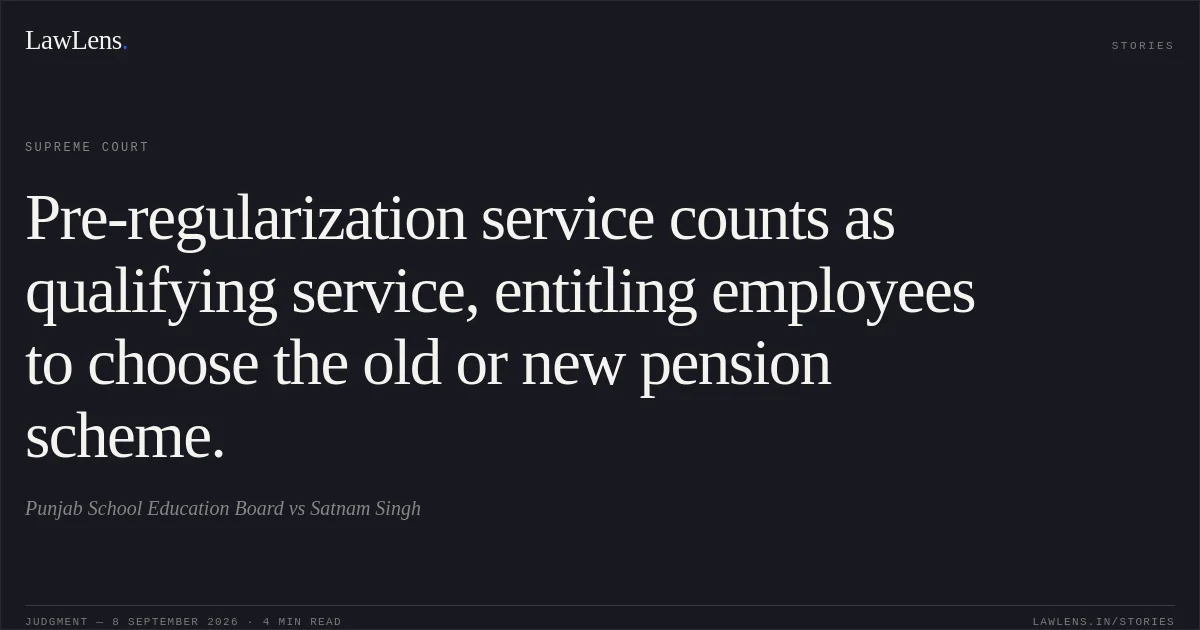
The Court held that the respondents’ August 2004 appointments were, in substance, regularisation. The PSEB had adopted the 23.01.2001 policy, resolved to appoint existing workers against permanent vacancies on a regular basis, and issued a public notice directed to those already working for the Board rather than to the general public.
Source reference: paras. 22–23The PSEB’s own 20.10.2011 communication described the employees as having been “regularised” after long service and acknowledged that their demand for the old pension policy appeared genuine. Accordingly, the use of the word “appointment” in the letters could not convert the regularisation into fresh recruitment.
Source reference: paras. 24–25Applying Regulations 5(i) and 8(2), together with the principles in D.S. Nakara, Harbans Lal, and Kesar Chand, the Court concluded that the respondents’ long and substantially continuous pre-regularisation service had to be counted as qualifying service. The breaks were artificial, administrative, or occasioned by court proceedings and therefore could not defeat pensionary entitlement.
Source reference: paras. 26–30The PSEB’s autonomous status did not alter the result because it had voluntarily adopted the Government’s regularisation policy mutatis mutandis.
Source reference: para. 31The earlier proceedings concerned entitlement to regularisation, whereas the present case concerned the pensionary consequences of the regularisation subsequently granted; therefore, res judicata did not apply.
Source reference: para. 21Holding
The Supreme Court dismissed the appeal and upheld the judgments of the High Court.
It held that the respondents had been regularised, not freshly appointed, in August 2004; that their pre-regularisation service was to be treated as continuous qualifying service for retiral and pensionary benefits; and that they were to be treated as having entered service before 01.01.2004.
Source reference: paras. 30–33Consequently, they were entitled to the old GPF/pension scheme, while retaining the discretion to opt for the new Defined Contributory Pension Scheme if they so chose.
Source reference: para. 33There was no order as to costs.
Source reference: para. 34Acts & Sections Cited
1 provisions across 1 statute referred to in this judgment. Linked provisions open on LawLens.
Punjab School Education Board Act, 19691
Original Court PDF
Punjab School Education BoardvsSatnam Singh
Click to open original judgment
Original judgment, available to read, download and summarize on LawLens.in