Facts
The respondent-plaintiff instituted a suit for specific performance of an agreement to sell dated 10 December 2019, alleging that the petitioner-defendant had agreed to sell the suit land for ₹1,60,000, had received ₹1,50,000, and that ₹10,000 remained payable.
Source reference: para. 2In her written statement, the petitioner denied execution of the agreement and asserted that she had borrowed ₹1,00,000 from the respondent.
Source reference: para. 3Before commencement of trial, she sought amendment of the written statement under Order VI Rule 17 read with Section 151 CPC to elaborate her defence and plead that the loan transaction involved ₹1,50,000.
Source reference: para. 4The petitioner challenged that order under Article 227 of the Constitution.
Source reference: para. 1Issues
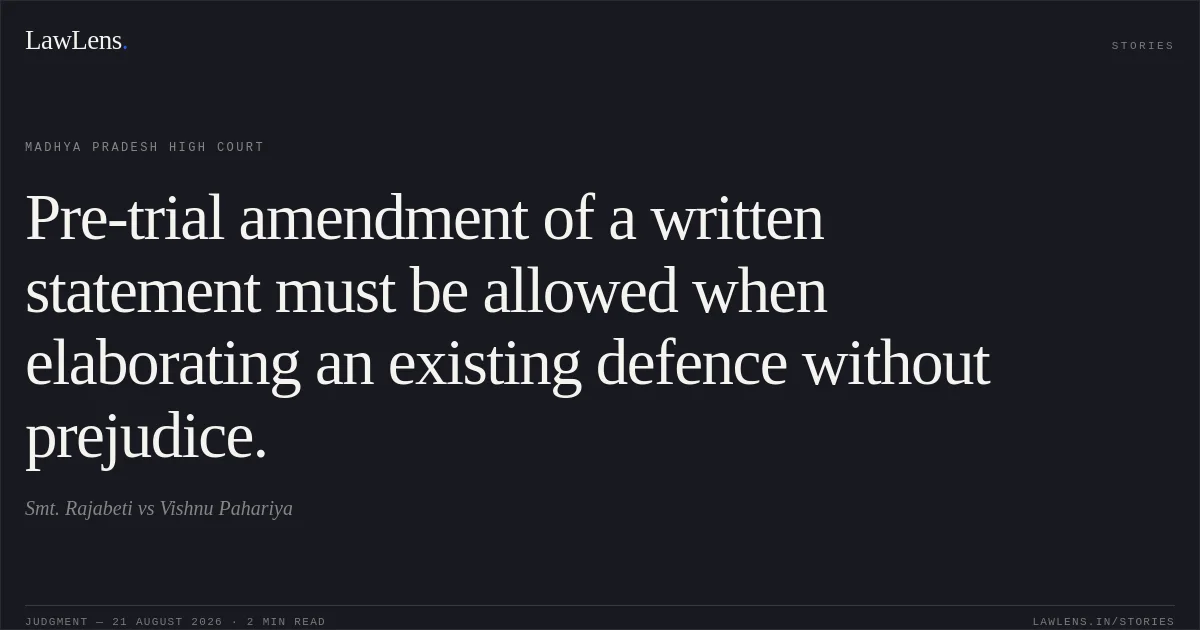
Whether the petitioner’s application to amend her written statement under Order VI Rule 17 read with Section 151 CPC, filed before commencement of trial, was liable to be allowed where the amendment allegedly elaborated an existing defence without changing its nature.
Source reference: paras. 4, 8Whether the proposed amendment would withdraw a clear admission or cause prejudice to the respondent so as to justify rejection of the application.
Source reference: paras. 4–5, 8Law Applied
The Court applied Order VI Rule 17 CPC, under which amendments necessary for determining the real questions in controversy should ordinarily be allowed, provided they do not cause injustice or prejudice to the opposite party.
Source reference: para. 7Relying on Life Insurance Corporation of India v. Sanjeev Builders (P) Ltd., (2022) 16 SCC 1, the Court held that amendments should be permitted when necessary for effective adjudication, avoidance of multiplicity of proceedings, or clarification of the real dispute; however, an amendment may be refused if it introduces a time-barred claim, changes the nature of the suit or cause of action, is mala fide, withdraws a clear admission conferring a right on the opposite party, or deprives the opposite party of a valid defence.
Source reference: para. 7Where the amendment is sought before commencement of trial, the court should adopt a liberal approach, particularly where the opposite party can meet the amended case and suffers no irreparable prejudice.
Source reference: para. 7Reasoning
The High Court found that the amendment was sought at the pre-trial stage and did not alter the petitioner’s fundamental defence that the transaction between the parties was a loan rather than an agreement to sell.
Source reference: para. 8Although the proposed amendment altered the alleged loan amount from ₹1,00,000 to ₹1,50,000, it was treated as an elaboration of the existing defence, not as withdrawal of a clear admission or introduction of an entirely new case.
Source reference: para. 8Applying the liberal approach mandated for pre-trial amendments, the Court held that the respondent would have an adequate opportunity to answer the amended defence, including by seeking consequential amendment of the plaint; therefore, no irremediable prejudice would result.
Source reference: para. 8Holding
The Court held that the trial court was not justified in rejecting the amendment application.
The order dated 22 July 2024 was set aside, and the petitioner’s application under Order VI Rule 17 CPC was allowed.
Source reference: para. 9The respondent was granted liberty to seek consequential amendment of the plaint before the trial court, if so advised.
Source reference: para. 10The miscellaneous petition was accordingly allowed, and any pending applications were disposed of.
Source reference: paras. 11–12Acts & Sections Cited
1 provisions across 1 statute referred to in this judgment. Each provision opens on LawLens.
Code of Civil Procedure, 19081
Original Court PDF
Smt. RajabetivsVishnu Pahariya
Click to open original judgment
Original judgment, available to read, download and summarize on LawLens.in