Facts
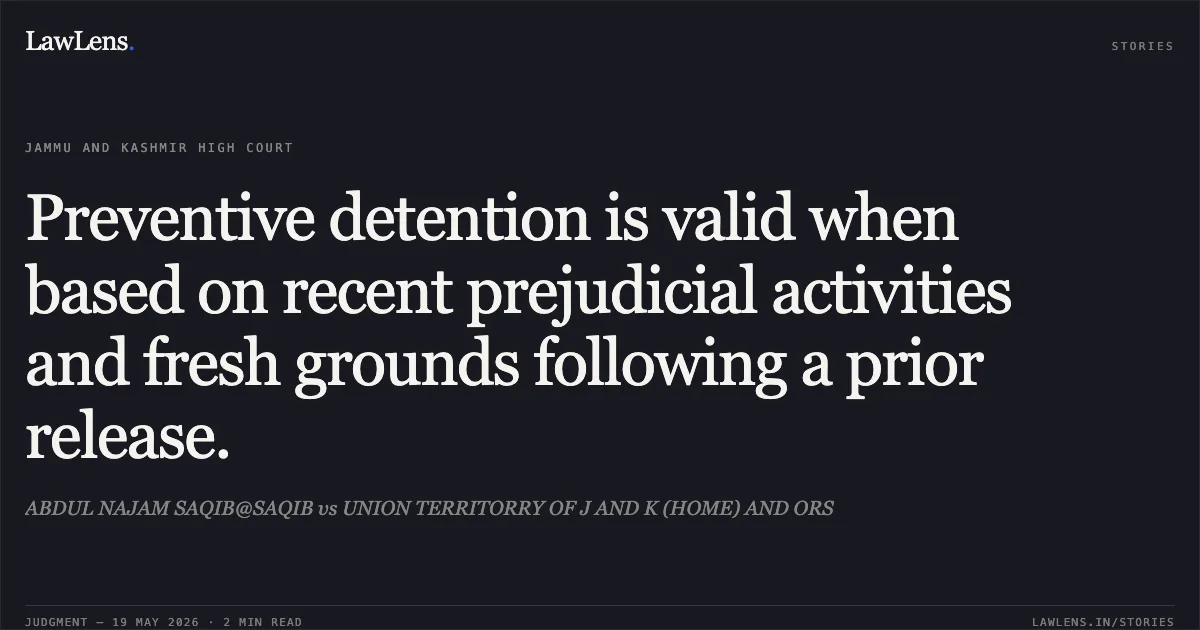
The petitioner challenged the detention order (No. DMS/PSA/29/2024) dated 11.10.2024 issued by the District Magistrate, Srinagar, under the J&K Public Safety Act.
Source reference: p.1The petitioner had a history of involvement in FIR Nos. 51/2017 and 52/2017 and was previously detained in 2022.
Source reference: para. 6, 8Following his release from the prior detention, authorities alleged he continued prejudicial activities, leading to his being "bound down" on 14.09.2024 under Sections 126/170 of the Bharatiya Nagarik Suraksha Sanhita (BNSS).
Source reference: para. 6The detaining authority cited recent intelligence suggesting the petitioner was in contact with a Pakistan-based "TRF" (The Resistance Front) handler to recruit youth for terrorist activities.
Source reference: para. 9The petitioner contended the grounds were vague, stale, and a mere replica of previous detention grounds.
Source reference: para. 2, 5Issues
1. Whether there existed a proximate and live link between the petitioner’s activities and the necessity of the detention order.
Source reference: para. 5(I)2. Whether the detention order was invalid due to being a "replica" of previous grounds of detention.
Source reference: para. 5(II)3. Whether the allegations in the grounds of detention were too vague to allow for an effective representation.
Source reference: para. 5(III)Law Applied
The court applied the principles of preventive detention under the J&K Public Safety Act, emphasizing the "subjective satisfaction" of the detaining authority regarding activities prejudicial to the security of the State.
Source reference: para. 1, 6It utilized the procedural safeguards of the Bharatiya Nagarik Suraksha Sanhita (BNSS), specifically Sections 126 and 170 regarding the binding down of individuals to prevent breaches of peace.
Source reference: para. 6The court also relied on the principle that the "past conduct" of a detenu can be considered to establish a pattern of behavior, provided there are fresh, proximate incidents to justify a new detention order.
Source reference: para. 6, 8Reasoning
The court rejected the petitioner's argument regarding the lack of a "live link," noting that while the 2017 FIRs were old, they were cited only to establish past conduct; the actual trigger for detention was the recent "binding down" in September 2024 and recent contacts with foreign handlers.
Source reference: para. 6Regarding the "replica" argument, the court observed that the current grounds contained significant subsequent events—specifically activities following his release from the 2022 detention—which were not present in the earlier order.
Source reference: para. 8The court found the allegations were not vague but specific, citing the petitioner's use of encrypted messaging applications to communicate with "Ahmad Khalid," a TRF handler, for recruitment purposes. This specific information was deemed sufficient for the petitioner to frame an effective representation.
Source reference: para. 9Holding
The court answered all issues in the negative, holding that the detention order was based on fresh, proximate, and specific allegations that established a clear link to the security of the State.
The court found no procedural or substantive bridge of the law and dismissed the petition, refusing to interfere with the impugned detention order. The court directed the return of detention records to the respondents.
Source reference: para. 10, 11Acts & Sections Cited
2 provisions across 1 statute referred to in this judgment. Each provision opens on LawLens.
Bharatiya Nagarik Suraksha Sanhita, 20232
Original Court PDF
ABDUL NAJAM SAQIB@SAQIBvsUNION TERRITORRY OF J AND K (HOME) AND ORS
Click to open original judgment
Original judgment, available to read, download and summarize on LawLens.in