01Facts
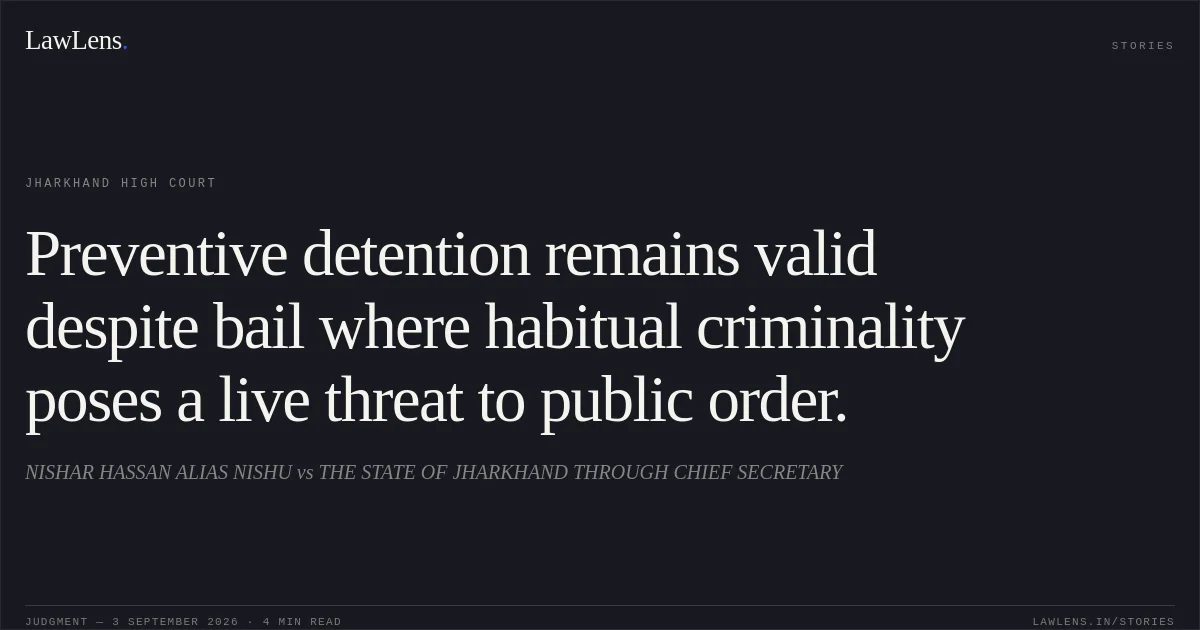
The petitioner challenged his preventive detention under Section 12 of the Jharkhand Control of Crimes Act, 2002 (“the Act”), imposed by the District Magistrate-cum-Deputy Commissioner, East Singhbhum, by order dated 07.10.2025.
¶ 1–3, 63The detention was successively extended for three-month periods by orders dated 19.12.2025, 19.03.2026 and 25.06.2026, and confirmed by the State Government through orders dated 15.10.2025, 24.12.2025, 26.03.2026 and 02.07.2026.
¶ 1–3, 63The detention proposal relied upon six criminal cases involving allegations of murder, attempt to murder, extortion, offences under the Arms Act and the Explosive Substances Act, together with ten sanhas recorded in different police stations.
¶ 22–25The petitioner contended that he had been granted bail in all six criminal cases, that the authorities had failed to independently verify the cases and bail orders, and that the grounds and materials relied upon had not been properly communicated to him.
¶ 4The State maintained that the petitioner was a habitual and organised offender whose activities continued through associates even while he was in custody and were prejudicial to public order.
¶ 602Issues
i.Whether the petitioner’s alleged criminal activities brought him within the definition of an “anti-social element” under Section 2(d) of the Jharkhand Control of Crimes Act, 2002?
¶ 9(i)ii.Whether the detaining authorities had arrived at the requisite subjective satisfaction while passing and extending the detention orders?
¶ 9(ii)iii.Whether the petitioner’s release on bail in the pending criminal cases constituted a ground for setting aside the preventive detention?
¶ 9(iii)iv.Whether the petitioner was denied the statutory and constitutional safeguards relating to communication of the grounds of detention and the opportunity to make a representation?
¶ 58–6103Law Applied
Section 2(d)(i) of the Act defines an “anti-social element” as a person who, individually or as a member or leader of a gang, habitually commits, attempts to commit or abets offences punishable under Chapters XVI or XVII of the Indian Penal Code.
¶ 13The term “habitually” requires repeated, persistent and similar acts demonstrating continuity, rather than isolated or dissimilar incidents, as explained in Vijay Narayan Singh v. State of Bihar, (1984) 3 SCC 14.
¶ 16–17Section 12 permits preventive detention where the competent authority is satisfied that detention is necessary to prevent conduct prejudicial to public order and that such activities cannot otherwise be prevented by immediate arrest.
¶ 18–20Preventive detention requires genuine subjective satisfaction based on relevant, rational and proximate material, with due application of mind and adherence to statutory timelines and procedural safeguards, as summarised in Ameena Begum v. State of Telangana, (2023) 9 SCC 587.
¶ 32The grant of bail does not by itself invalidate preventive detention where the detaining authority reasonably concludes that the detenu is likely to resume prejudicial activities and ordinary criminal law is insufficient; the Court relied on D.M. Nagaraja v. State of Karnataka, (2011) 10 SCC 215.
¶ 49–51Article 22(5) of the Constitution requires communication of the grounds of detention to enable an effective representation.
¶ 4(xvi)Provisions in the judgment · 15 · Linked ones open on LawLens
Indian Penal Code, 1860 Section 34Section 302Section 307Section 387Section 506
Arms Act, 1959 Section 25Section 26Section 27Section 28Section 29
Bharatiya Nyaya Sanhita, 2023 Section 3Section 61Section 109
04Reasoning
The Court held that the six criminal cases, involving murder, attempt to murder, extortion and arms-related offences, disclosed a continuing and similar pattern of criminal conduct sufficient to characterise the petitioner as a habitual offender under Section 2(d)(i).
¶ 24–28The ten recent sanhas, together with the authorities’ reports that the petitioner was allegedly operating an organised gang and extorting businessmen through associates even while in custody, supplied a live and proximate link between his past conduct and the perceived threat to public order.
¶ 37–43, 52–56The Court found that the detaining authority had considered the police proposal, the criminal antecedents, the sanhas, the alleged atmosphere of fear, and the petitioner’s alleged activities from custody; therefore, the detention was not based on stale or extraneous material.
¶ 36–43The petitioner’s bail in the six criminal cases did not negate the detention because the preventive detention order was founded on the apprehension that he would resume criminal activities and that ordinary criminal proceedings would not adequately prevent them.
¶ 47–56As to procedural safeguards, the Court noted that the detention order had been served on the petitioner and found that his allegation regarding non-communication of the grounds and refusal to forward his representation was unsupported by specific pleadings or documentary evidence.
¶ 58–6105Holding
The Court answered all substantive issues against the petitioner. It held that he qualified as an “anti-social element,” that the detaining authority had recorded valid subjective satisfaction based on relevant and proximate material, and that his release on bail did not warrant termination of preventive detention.
¶ 28, 43, 57The Court also rejected the challenge based on alleged non-communication of the grounds and denial of representation.
¶ 59–61Accordingly, the detention order dated 07.10.2025, all subsequent extension orders, and the corresponding State confirmation orders were upheld, and the writ petition was dismissed.
¶ 62–65Pending interlocutory applications, if any, were also disposed of.
¶ 62–65Original Court PDF
NISHAR HASSAN ALIAS NISHUvsTHE STATE OF JHARKHAND THROUGH CHIEF SECRETARY
Click to open original judgment
Original judgment, available to read, download and summarize on LawLens.in