Facts
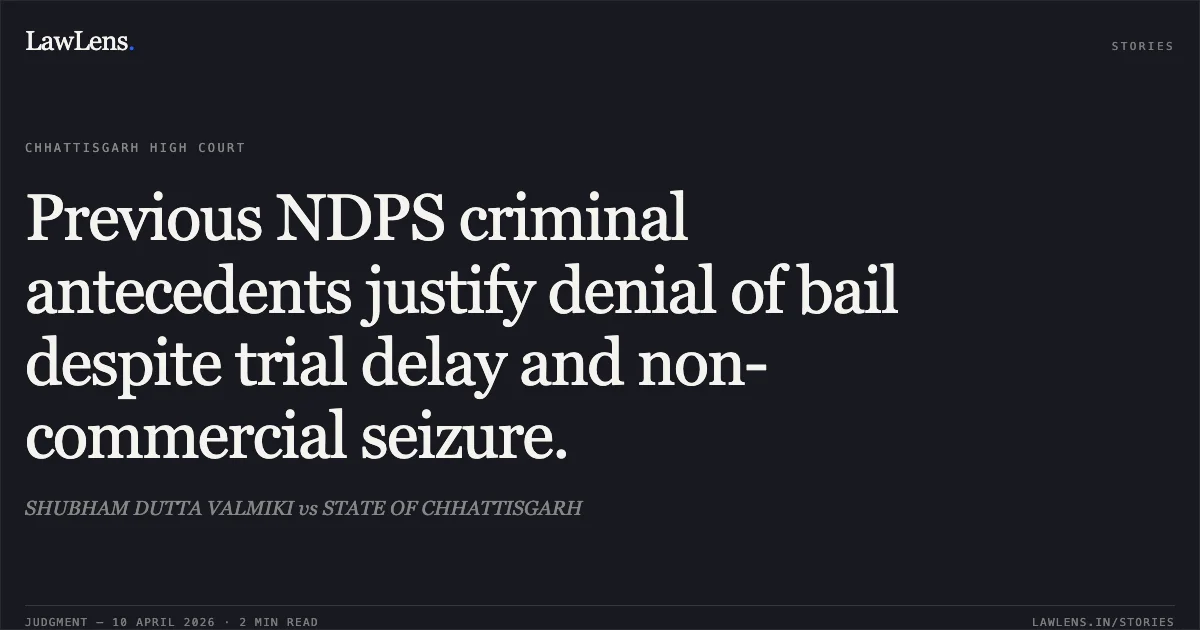
The applicant filed a second bail application under Section 483 of the Bharatiya Nagarik Suraksha Sanhita (BNSS) for offences under Sections 21 and 29 of the Narcotic Drugs and Psychotropic Substances (NDPS) Act.
Source reference: para. 1On May 14, 2025, police recovered 7.620 grams of MDMA from a co-accused, Pradeep.
Source reference: para. 3Pradeep's memorandum statement implicated the applicant, alleging the applicant provided the contraband on April 28, 2025.
Source reference: para. 3The applicant, already in custody for a separate NDPS case (Crime No. 327/2025) since May 17, 2025, was formally arrested in the present case on July 5, 2025.
Source reference: para. 3The applicant's first bail application was rejected on October 6, 2025, due to a prior criminal antecedent under the NDPS Act.
Source reference: para. 2The applicant moved this second application citing the release of the co-accused on bail, the lack of direct recovery from the applicant, and the slow progress of the trial, where only one out of eighteen witnesses had been examined.
Source reference: para. 4Issues
1. Whether the applicant is entitled to regular bail on the grounds of parity with the co-accused and the prolonged duration of his pretrial detention
Source reference: para. 4 & 72. Whether the existence of a criminal antecedent under the NDPS Act serves as a sufficient ground to deny a second bail application despite the lack of direct recovery from the applicant
Source reference: para. 7Law Applied
The court primarily applied Section 483 of the BNSS regarding the grant of regular bail.
Source reference: para. 1It considered Sections 21 and 29 of the NDPS Act, which penalize the possession and abetment/criminal conspiracy related to psychotropic substances.
Source reference: para. 1Furthermore, the court relied on the principle established by the Supreme Court in Deepak Yadav v. State of Uttar Pradesh & Another (2022) 8 SCC 559, which mandates that the criminal antecedents of an accused are a critical factor in determining bail eligibility and can justify the denial or cancellation of bail.
Source reference: para. 7Reasoning
The court evaluated the applicant's contentions regarding the delay in trial (ten months in custody) and the fact that the seizure from the co-accused was of a "less than commercial" quantity.
Source reference: para. 4 & 7The court emphasized that the applicant's involvement in a previous NDPS case (Crime No. 327/2025) demonstrated that he is a habitual offender.
Source reference: para. 5 & 7The court reasoned that while the co-accused had been enlarged on bail, the applicant's specific history of drug-related offences distinguished his position.
Source reference: para. 7Applying the Deepak Yadav precedent, the court determined that the presence of criminal antecedents outweighed the arguments regarding the lack of direct recovery and the sluggish pace of the trial.
Source reference: para. 7The court found that the "new grounds" presented in the second application did not mitigate the risk posed by the applicant's habitual involvement in narcotics.
Source reference: para. 7Holding
The court answered the issues in the negative and rejected the second bail application, holding that the applicant's status as a habitual offender under the NDPS Act rendered him unfit for regular bail.
The court directed the trial court to proceed with and conclude the trial expeditiously.
Source reference: para. 9The Office was ordered to communicate this decision to the concerned trial court for compliance.
Source reference: para. 10Acts & Sections Cited
3 provisions across 2 statutes referred to in this judgment. Each provision opens on LawLens.
Bharatiya Nagarik Suraksha Sanhita, 20231
Narcotic Drugs and Psychotropic Substances Act, 19852
Original Court PDF
SHUBHAM DUTTA VALMIKIvsSTATE OF CHHATTISGARH
Click to open original judgment
Original judgment, available to read, download and summarize on LawLens.in