Facts
The petitioner, a corporate insurance agent holding an IRDAI licence, entered into agreements dated 23 September 2008 and 24 March 2009 with Golden Trust Financial Services (“GTFS”) for provision of infrastructure, branch facilities and network-related services.
Source reference: paras. 1, 5On 19 March 2012, the petitioner received a show-cause notice dated 14 March 2012 under Section 45A of the Employees’ State Insurance Act, 1948 (“ESI Act”), proposing recovery of contribution and interest by treating payments made to GTFS as wages.
Source reference: paras. 2–3By order dated 24 May 2012, the ESI authority determined arrears of contribution at Rs. 3,03,36,698.
Source reference: para. 19The petitioner challenged the show-cause notices and the order under Article 226 of the Constitution.
Source reference: paras. 6–9Issues
Whether the writ petition was maintainable despite the alternative statutory remedies under Sections 45AA and 75 of the ESI Act.
Source reference: paras. 8–9Whether the ESI authority validly treated the payments made by the petitioner to GTFS under the service arrangement as wages liable to ESI contribution.
Source reference: paras. 13, 17–22Whether GTFS could be treated as an “immediate employer” and the petitioner as the “principal employer” in respect of GTFS’s employees under Sections 2(9), 2(13) and 2(17) of the ESI Act.
Source reference: paras. 20–28Whether the determination of contribution on an ad hoc basis, in the absence of detailed particulars of the persons receiving incentives, was legally sustainable.
Source reference: paras. 19, 27–28Law Applied
The Court applied Section 2(9) of the ESI Act, which includes persons employed through an immediate employer on work connected with, or ordinarily forming part of, the principal establishment’s business; Section 2(13), defining “immediate employer” to include a contractor undertaking such work; and Section 2(17), under which the person responsible for supervision and control of an establishment is the “principal employer”.
Source reference: paras. 23–26Section 2(22), defining “wages” as remuneration paid or payable in cash to an employee, was applied to determine whether the payments represented wages.
Source reference: para. 13The Court held that the principal employer may be proceeded against even without first proceeding against the immediate employer, where the statutory relationship under Section 2(9)(ii) is established.
Source reference: paras. 27–28On maintainability, the Court relied on the earlier admission order and accepted that the writ jurisdiction was not entirely excluded in the circumstances of the case.
Source reference: paras. 6–9The Court also considered the principles concerning alternative statutory remedies and reasoned administrative orders reflected in Commissioner of Income Tax v. Chhabil Dass Agarwal, Whirlpool Corporation v. Registrar of Trade Marks, Mohinder Singh Gill v. Chief Election Commissioner, Royal Talkies, Hyderabad v. Employees’ State Insurance Corporation and other authorities cited by the parties.
Source reference: paras. 8, 11–16Reasoning
The Court held that the earlier order admitting the writ petition had specifically addressed maintainability and had not been challenged by the respondents; therefore, the respondents could not reopen that objection at the final hearing.
Source reference: para. 9On merits, the Court examined the agreement and found that GTFS had provided services and infrastructure for the petitioner’s insurance business, while its employees were engaged in work connected with that business.
Source reference: paras. 17–20Although GTFS was described as a “pure agent” and possessed an independent ESI code, the Court treated it as an immediate employer because it had undertaken work forming part of, or incidental to, the petitioner’s establishment.
Source reference: paras. 22–28The petitioner, being responsible for the establishment and the business for which the services were rendered, was treated as the principal employer.
Source reference: paras. 22–28The Court accepted the authority’s conclusion that the service charges and operating expenses could represent remuneration paid through the immediate employer.
Source reference: para. 19It further held that the authority had allowed deductions for GTFS’s profit margin, infrastructure expenses and statutory overheads before applying the contribution rate, and therefore the determination was not irrational or unsupported merely because it was made on an ad hoc basis.
Source reference: para. 19Holding
The Court answered the maintainability issue in favour of the petitioner but rejected the challenge on merits.
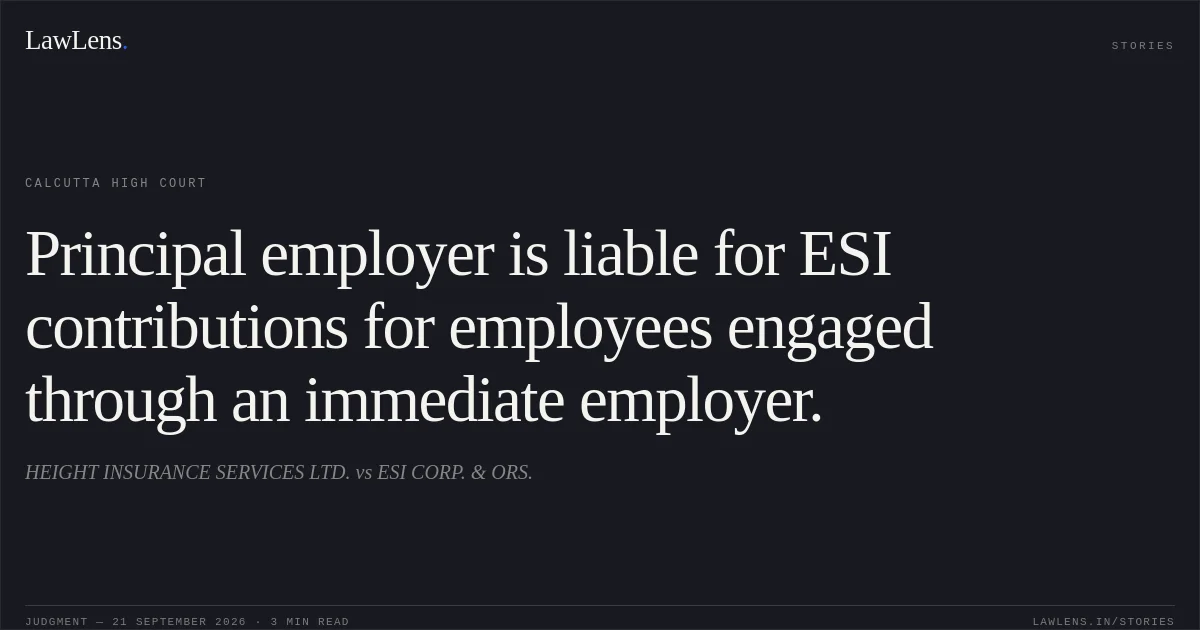
It held that GTFS was an immediate employer, the petitioner was the principal employer, and the petitioner could be proceeded against for ESI contribution relating to employees engaged through GTFS under Sections 2(9)(ii), 2(13) and 2(17) of the ESI Act.
Source reference: paras. 25–28The writ petition, WPA 14289 of 2012, was dismissed, the connected applications were disposed of, and the interim order was vacated.
Source reference: paras. 29–31The petitioner’s subsequent prayer for stay of the judgment was refused.
Source reference: “Later” orderActs & Sections Cited
5 provisions across 1 statute referred to in this judgment. Linked provisions open on LawLens.
Employees5
Original Court PDF
HEIGHT INSURANCE SERVICES LTD.vsESI CORP. & ORS.
Click to open original judgment
Original judgment, available to read, download and summarize on LawLens.in