Facts
Nine consumers had received electricity at premises No. 30/1 Kajipara Lane, Howrah, until CESC disconnected supply on 26 April 2024.
Source reference: para. 1One former consumer, Sk. Rajob Ali, was the petitioner’s father.
Source reference: para. 1The petitioner applied for a new connection, claiming to be the authorised occupier.
Source reference: para. 2After inspection, CESC refused the connection unless outstanding dues were paid, asserting that the petitioner had a nexus with all nine former consumers.
Source reference: para. 2The assessed claim under Section 126 of the Electricity Act, 2003, was ₹8,27,007.
Source reference: para. 3The petitioner accepted a nexus with his father but argued that liability should be limited to the proportionate dues attributable to him.
Source reference: para. 4Issues
Whether the petitioner’s liability for outstanding dues could extend to all nine former consumers, or only to the former consumer with whom a nexus was established under Regulation 13.9 of the 2010 Regulations.
Source reference: paras. 4, 10–12Whether Regulation 4.6.4 of the 2013 Supply Code required payment of all outstanding dues before a new connection could be granted, notwithstanding Regulation 13.9’s nexus requirement.
Source reference: paras. 5–9, 11–13Law Applied
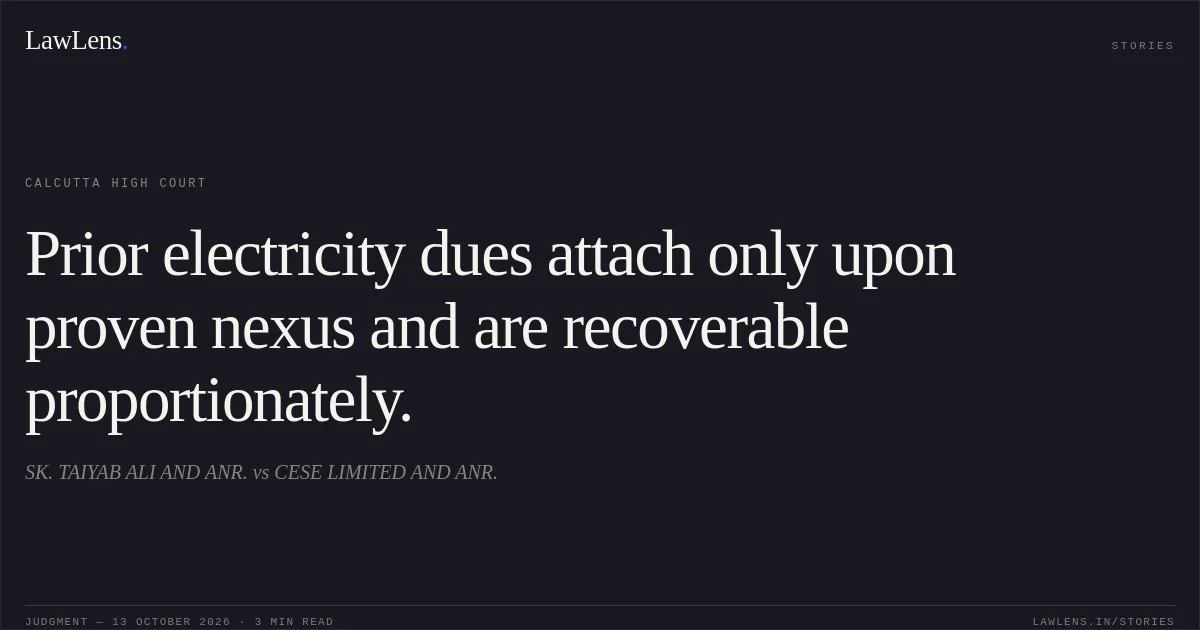
Regulation 13.9 of the West Bengal Electricity Regulatory Commission (Standards of Performance of Licensees Relating to Consumer Services) Regulations, 2010 permits recovery of outstanding charges from an intending consumer where the licensee establishes that the applicant had a nexus with a previous consumer; liability is to be calculated on a pro-rated basis.
Source reference: para. 7Regulation 4.6.4 of the West Bengal Electricity Regulatory Commission (Electricity Supply Code) Regulations, 2013 provides that, following deemed termination of an agreement, a new connection at the same premises is subject to clearance of the deemed-terminated consumer’s outstanding dues and late-payment surcharge.
Source reference: para. 7The Court treated the provisions as governing distinct matters and held that the non-obstante clause in Regulation 4.6.4 does not, by itself, dispense with Regulation 13.9’s requirement to establish nexus.
Source reference: paras. 8–9It relied on Arun Kumar Debnath v. West Bengal State Electricity Distribution Company Limited, WPA No. 20816 of 2021 (28 March 2022), and the Division Bench decisions in West Bengal State Electricity Distribution Company Limited v. Transmission & Distribution (India) Limited, FMA 1083 of 2022 (20 March 2023), and MAT 1883 of 2022 (20 November 2024).
Source reference: para. 8It also referred to Chandavarkar Sita Ratna Rao v. Ashalata S. Guram, (1986) 4 SCC 447, on construing a non-obstante clause within its proper scope.
Source reference: para. 9Reasoning
CESC established a nexus between the petitioner and Sk. Rajob Ali, his father, but its assertion of nexus with the other eight former consumers was unsupported by evidence and amounted to guesswork.
Source reference: para. 10Regulation 13.9 therefore made the petitioner liable only for the pro-rated outstanding charges attributable to the former consumer with whom the nexus was established.
Source reference: paras. 10–12The Court rejected CESC’s argument that Regulation 4.6.4 required payment of the entire assessed amount: that provision concerns deemed termination and the conditions for a new connection at the same premises, while Regulation 13.9 separately governs liability based on nexus.
Source reference: paras. 11–12The non-obstante wording did not eliminate the requirement to prove nexus for the other former consumers.
Source reference: para. 13Holding
The writ petition was disposed of with a direction to CESC to provide a new connection at the premises, subject to the petitioner paying the proportionate amount of the ₹8,27,007 assessed claim attributable to Sk. Rajob Ali, together with the corresponding late-payment surcharge, and complying with other applicable connection formalities.
CESC was directed to complete the work within two weeks after the petitioner’s compliance.
Source reference: para. 17Acts & Sections Cited
1 provisions across 1 statute referred to in this judgment. Each provision opens on LawLens.
Electricity Act, 20031
Original Court PDF
SK. TAIYAB ALI AND ANR.vsCESE LIMITED AND ANR.
Click to open original judgment
Original judgment, available to read, download and summarize on LawLens.in