Facts
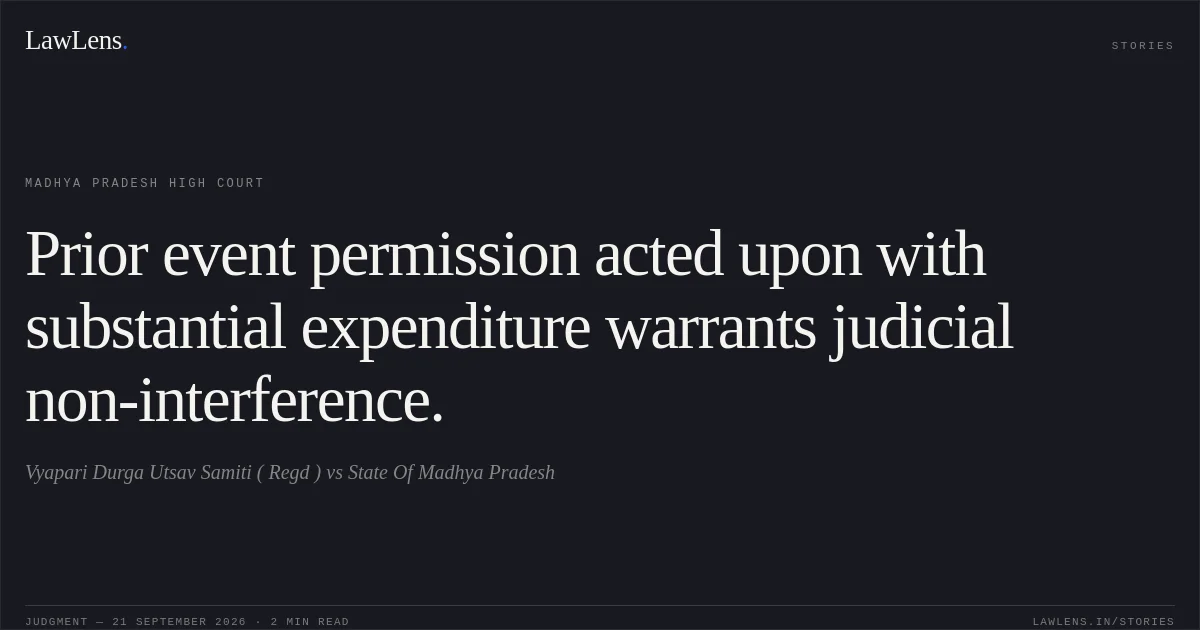
The petitioner-society filed a writ petition under Article 226 of the Constitution challenging the order dated 22.07.2026 issued by the Deputy Commissioner of Police (Intelligence and Security), Bhopal, granting permission/NOC to respondent No. 5 to organise a Durga Utsav Pandal.
Source reference: para. 1The petitioner claimed that it had been organising the Durga Puja/Dussehra event for several years and had itself applied for permission on 15.07.2026, but its application was not considered.
Source reference: para. 2The dispute arose because the validity of the petitioner-society was questioned before the Registrar, Firms and Societies. Although the petitioner subsequently rectified the noted defects, the Assistant Registrar, by order dated 01.09.2026, recognised the validity of both societies.
Source reference: paras. 2, 5Respondent No. 5 contended that it had organised the event in 2025, had obtained permission on 22.07.2026, and had already incurred substantial expenditure in reliance on that permission.
Source reference: paras. 3–4Issues
Whether the permission/NOC dated 22.07.2026 granted to respondent No. 5 for organising the Durga Utsav Pandal should be quashed because the petitioner’s application for permission was not considered
Source reference: paras. 1–2Whether, after the Assistant Registrar recognised the validity of both societies, the petitioner was entitled to a direction permitting it to organise the event from 09.10.2026 to 23.10.2026
Source reference: paras. 1, 5Whether interference with the permission already granted to respondent No. 5 was warranted when respondent No. 5 had altered its position and incurred substantial expenditure in reliance upon that permission
Source reference: paras. 4–6Law Applied
The Court exercised its jurisdiction under Article 226 of the Constitution of India, under which relief by writ is discretionary and may be declined where interference would cause prejudice or injustice to affected parties.
Source reference: paras. 1, 5–6The Court applied the principle that a permission or NOC granted earlier, upon which the recipient has substantially relied and altered its position to its detriment, should not ordinarily be disturbed at a later stage, particularly where the competing parties’ legal status has ultimately been recognised on an equal basis.
Source reference: paras. 5–6Reasoning
The Court noted that respondent No. 5 had obtained permission on 22.07.2026, before the Assistant Registrar’s subsequent order dated 01.09.2026 recognising the validity of both societies.
Source reference: para. 5Since respondent No. 5 had acted upon the permission and incurred a substantial, described as “colossal,” expenditure for organising the event, its position had been altered to its detriment.
Source reference: paras. 4–5In these circumstances, withdrawing or interfering with the existing NOC at that stage would adversely affect respondent No. 5.
Source reference: paras. 5–6The later recognition of both societies did not justify disturbing the earlier permission, particularly as the petitioner had not established a sufficient basis for overriding the prejudice caused to respondent No. 5.
Source reference: paras. 5–6Holding
The High Court held that interference with the NOC dated 22.07.2026 would adversely affect respondent No. 5, which had already incurred substantial expenditure in reliance on the permission.
The writ petition was consequently dismissed, and no direction was issued requiring the respondents to grant permission to the petitioner to organise the Durga Puja event.
Source reference: para. 7Original Court PDF
Vyapari Durga Utsav Samiti ( Regd )vsState Of Madhya Pradesh
Click to open original judgment
Original judgment, available to read, download and summarize on LawLens.in