Facts
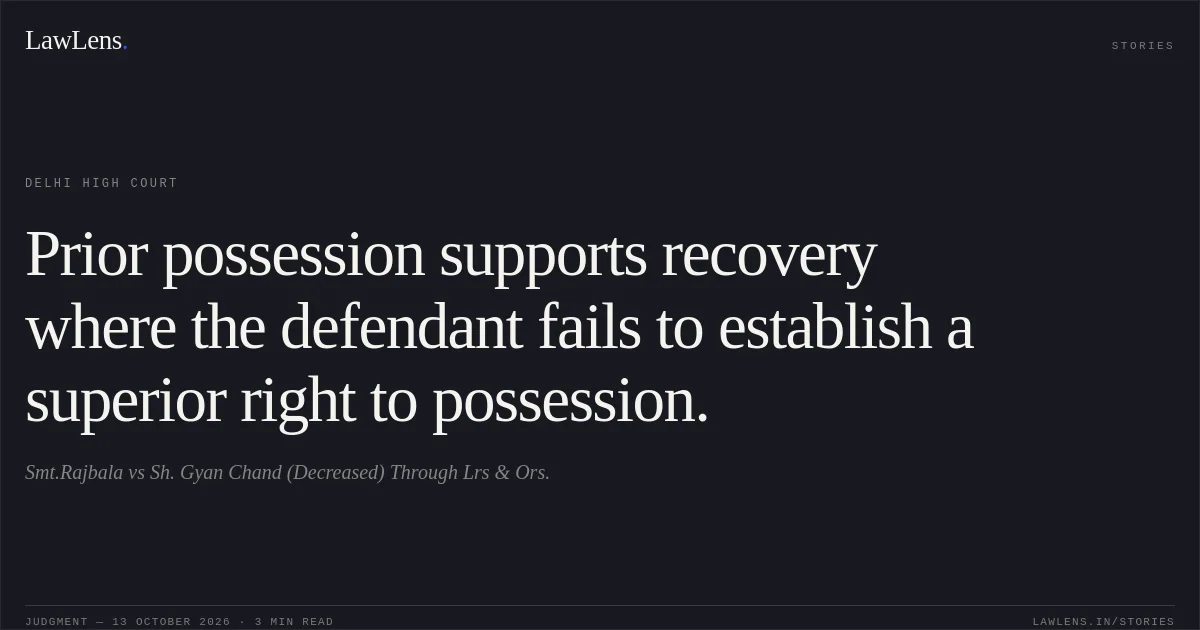
Gyan Chand sued Rajbala and another defendant for possession, injunctions and mesne profits, claiming prior possession of the 150-square-yard suit property and alleging that Rajbala forcibly occupied it in 2007.
Source reference: para. 1–3Rajbala claimed that her husband had purchased the property from Gyan Chand in 1987.
Source reference: para. 1–3The trial court decreed possession and permanent injunction, but rejected the claims for mesne profits and mandatory injunction.
Source reference: para. 1–3Rajbala appealed, challenging, among other things, reliance on Gyan Chand’s untested testimony, the substitution of his legal representatives, and the rejection of her claimed right to the property.
Source reference: para. 1–3She also sought to introduce additional documents under Order XLI Rule 27 CPC. The appeal was filed 200 days late; the delay was condoned.
Source reference: para. 1–3, 38–43, 49, 56–57, 65–68Issues
1. Whether Gyan Chand’s examination-in-chief could be considered despite his death before cross-examination was completed
Source reference: para. 48–552. Whether the decree was invalid because Gyan Chand’s legal representatives had not been formally substituted under Order XXII Rule 3 CPC
Source reference: para. 56–573. Whether Rajbala established a better right to possession, including through her husband’s alleged 1987 purchase, sufficient to defeat Gyan Chand’s claim based on prior possession
Source reference: para. 58–64, 72–764. Whether Rajbala satisfied the requirements for admitting additional evidence under Order XLI Rule 27 CPC
Source reference: para. 65–71Law Applied
Section 96 and Order XLI CPC govern first appeals; Order XLI Rule 27 permits additional evidence only where the trial court wrongly refused evidence, despite due diligence it could not have been produced earlier, or the appellate court requires it to pronounce judgment or finds another substantial cause.
Source reference: para. 65–67Under Order XXII Rule 3 CPC, a deceased plaintiff’s legal representatives may be brought on record by application.
Source reference: para. 57A witness’s examination-in-chief does not become inadmissible solely because the witness dies before cross-examination; the absence of cross-examination affects weight, assessed with due caution and in the circumstances of the case (Krishan Dayal v. Chandu Ram).
Source reference: para. 52–53Section 53A of the Transfer of Property Act, 1882, was considered in relation to the 1981 documents and the protection of possessory rights.
Source reference: para. 33Under Articles 64 and 65 of the Limitation Act, a claimant may sue on prior possession or title; a plaintiff relying on prior possession must establish that right and identify the property, while a defendant may defeat the claim by proving a better legal right. The court relied on Nair Service Society Ltd. v. Rev. Father K.C. Alexander, Smriti Debbarma v. Prabha Ranjan Debbarma, Poona Ram v. Moti Ram and Rame Gowda v. M. Varadappa Naidu.
Source reference: para. 72–75Sections 90 and 68 of the Indian Evidence Act, 1872, were also applied by the trial court when assessing the 1981 documents and the unproved Will.
Source reference: para. 31Reasoning
The Court found that Rajbala had received repeated opportunities to cross-examine PW-1 but had not done so before his death; his testimony was therefore not inadmissible, and could be considered cautiously alongside the documentary evidence.
Source reference: para. 49–55The record showed that the legal representatives had applied under Order XXII Rule 3 CPC and were brought on record by order dated 10 September 2014, defeating the substitution challenge.
Source reference: para. 57Rajbala produced no trial evidence proving the alleged 1987 sale, its consideration, or the identity of the portion supposedly transferred to her husband. Her electricity, residence and family documents could support occupation, but did not establish the alleged transfer or a proprietary right in the specific property.
Source reference: para. 61–71The Court accordingly found that the trial court had rightly relied on Gyan Chand’s earlier possessory right.
Source reference: para. 72–76The additional-evidence application was rejected because the documents were available to Rajbala at trial and her explanation of inadvertence by former counsel did not establish due diligence or another basis under Rule 27.
Source reference: para. 65–70Holding
The Court dismissed the appeal and upheld the decree for possession and permanent injunction. It rejected the application to adduce additional evidence and found no ground to interfere with the trial court’s refusal of mesne profits.
Rajbala was directed to vacate within three months; if she failed to do so, she was required to pay the respondents occupation charges of ₹5,000 per month until delivery of vacant possession.
Source reference: para. 81Acts & Sections Cited
6 provisions across 4 statutes referred to in this judgment. Each provision opens on LawLens.
Code of Civil Procedure, 19082
Code of Criminal Procedure, 19732
Indian Succession Act, 19251
Limitation Act, 19631
Original Court PDF
Smt.RajbalavsSh. Gyan Chand (Decreased) Through Lrs & Ors.
Click to open original judgment
Original judgment, available to read, download and summarize on LawLens.in