Facts
The Petitioner, an Assistant Commissioner of the Municipal Corporation of Greater Mumbai (MCGM), was named as an accused in Private Complaint No. 75 of 2005 filed by Respondent No. 2.
Source reference: para. 2The complaint alleged irregularities concerning a Slum Rehabilitation Scheme.
Source reference: para. 7On May 11, 2005, the Special Judge, Sessions Court for Greater Mumbai, acting under Section 156(3) of the Cr.P.C., directed the Anti-Corruption Bureau (ACB) to register an FIR.
Source reference: para. 2Consequently, FIR No. 17/2005 was registered for offences under Section 13(1)(d) of the Prevention of Corruption Act, 1988 (P.C. Act) and Sections 465, 468, 471, 420, 120(B), and 109 of the IPC.
Source reference: para. 2The Petitioner moved the High Court to quash the order and the FIR, contending that as a public servant, he was protected by mandatory sanction requirements.
Source reference: para. 4It was undisputed that the alleged acts were committed in the discharge of official duties and that no prior sanction had been obtained.
Source reference: paras. 4-6, 15Issues
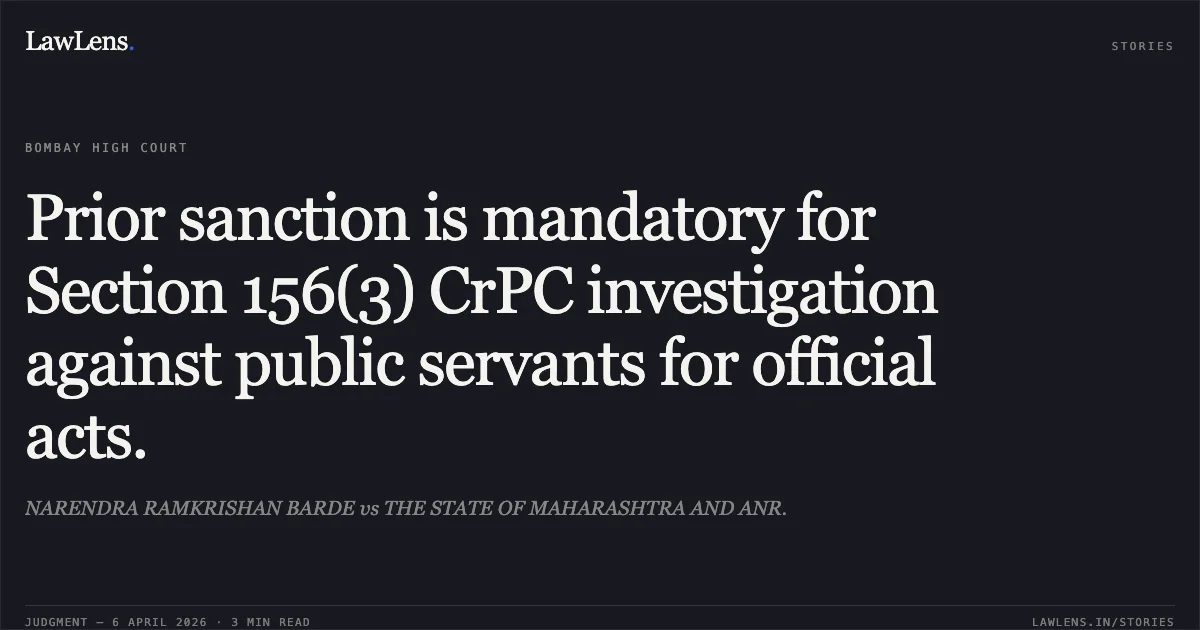
Whether, in the absence of prior sanction under Section 197 of the Cr.P.C. and Section 19 of the P.C. Act, 1988, a Special Judge/Magistrate has the jurisdiction to direct the registration of an FIR under Section 156(3) of the Cr.P.C. against a public servant for acts committed in the discharge of official duties?
Source reference: para. 10Law Applied
Section 197 of the Cr.P.C., which prohibits courts from taking cognizance of offences alleged against public servants acting in their official capacity without prior government sanction.
Source reference: para. 11Section 19 of the Prevention of Corruption Act, 1988, which creates a mandatory protective shield requiring prior sanction for prosecution under Sections 7, 11, 13, and 15 of the Act.
Source reference: para. 11The court relied on the precedent set in Anil Kumar Ors. v. M.K. Aiyappa (2013), which established that a Magistrate cannot refer a matter for investigation under Section 156(3) against a public servant without a valid sanction.
Source reference: para. 10The Division Bench decision in Debashish Chakrabarty v. State of Maharashtra (2015), which affirmed that prior sanction is a condition precedent for orders under Section 156(3).
Source reference: para. 13-14Reasoning
The court observed that the Petitioner’s status as a "public servant" was uncontested.
Source reference: para. 12Upon reviewing the private complaint, the court found that the allegations specifically pertained to acts committed by the Petitioner while discharging his official functions as Assistant Commissioner.
Source reference: para. 12Applying the ratio from Debashish Chakrabarty, the court reasoned that the statutory protection afforded to public functionaries is intended to prevent vexatious prosecutions and ensure efficient administration.
Source reference: para. 11, 14Since the requirement for sanction is mandatory and goes to the root of the court's jurisdiction, the Special Judge could not have exercised power under Section 156(3) of the Cr.P.C. without such sanction being in place.
Source reference: para. 14, 16Consequently, the order directing the FIR and the subsequent registration of the FIR were held to be void of legal authority.
Source reference: para. 16Holding
The court held that without a prior valid sanction under Section 197 of the Cr.P.C. and Section 19 of the P.C. Act, the Special Judge lacked jurisdiction to pass the impugned order.
The High Court allowed the Writ Petition and made the rule absolute, quashing the order dated May 11, 2005, FIR No. 17/2005 registered by the ACB, and Private Complaint No. 75/2005 as against the Petitioner.
Source reference: para. 19The court left open the right of Respondent No. 2 to pursue other legal remedies, such as approaching the High Power Committee regarding the Slum Rehabilitation Scheme.
Source reference: para. 18, 20Acts & Sections Cited
26 provisions across 3 statutes referred to in this judgment. Each provision opens on LawLens.
Code of Criminal Procedure, 19735
Prevention of Corruption Act, 19887
Original Court PDF
NARENDRA RAMKRISHAN BARDEvsTHE STATE OF MAHARASHTRA AND ANR.
Click to open original judgment
Original judgment, available to read, download and summarize on LawLens.in