Facts
The appellant alleged that, following disputes with business associates, police officials unlawfully apprehended him, seized and accessed his electronic devices, detained him, and coerced him into executing documents relinquishing his partnership and shares.
Source reference: paras. 6–14He further alleged that the police acted in collusion with private individuals and threatened him with further criminal prosecution.
Source reference: paras. 6–14After his complaints to the police and senior police authorities allegedly yielded no effective action, he filed a private complaint under Section 200 CrPC alleging offences under Sections 211, 220, 417, 420, 506, 342, 347 and 348 read with Section 34 IPC, and Sections 66B and 66C of the Information Technology Act, 2000.
Source reference: paras. 15–16The jurisdictional Magistrate directed investigation under Section 156(3) CrPC, pursuant to which FIR Crime No. 73 of 2022 was registered.
Source reference: para. 17The Karnataka High Court quashed the Section 156(3) order and FIR insofar as the respondent police officials were concerned, holding that prior sanction under Section 197 CrPC was required and that the appellant had not complied with the safeguards in Priyanka Srivastava v. State of Uttar Pradesh.
Source reference: paras. 18–19Issues
Whether prior sanction under Section 197 CrPC is required before a Magistrate directs registration of an FIR and investigation under Section 156(3) CrPC?
Source reference: paras. 20–28Whether alleged non-compliance with the procedural safeguards in Priyanka Srivastava justified quashing the Section 156(3) order and consequential FIR?
Source reference: paras. 29–34Whether the High Court was justified in quashing the proceedings at the threshold instead of permitting investigation into the allegations against the police officials?
Source reference: paras. 22, 34–36Law Applied
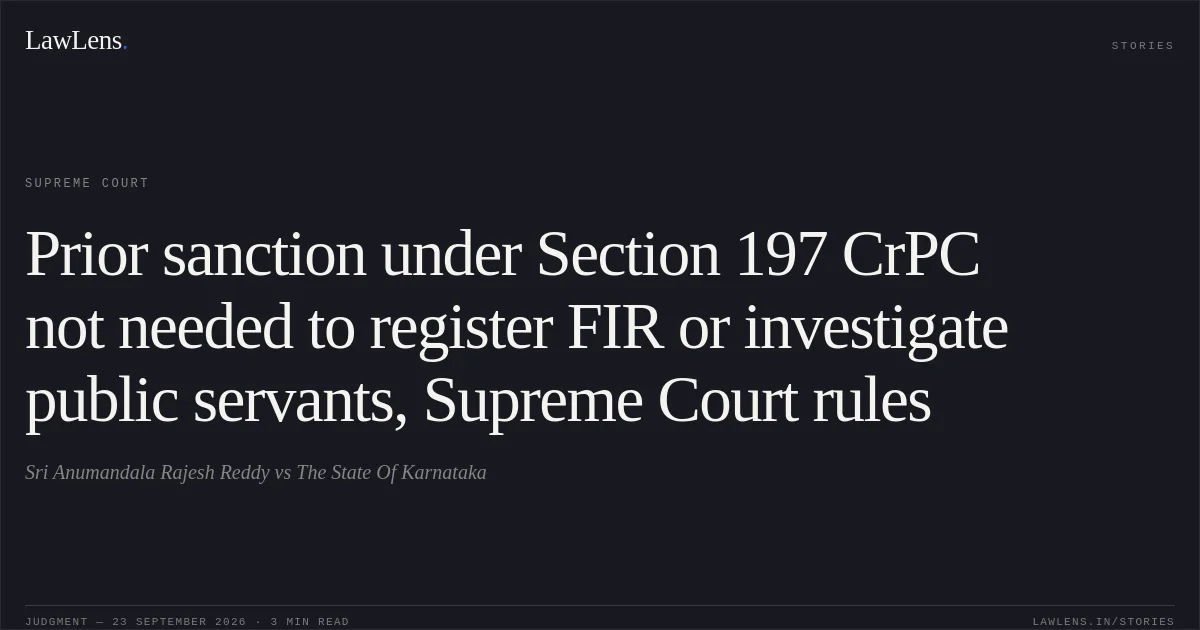
Section 197(1) CrPC requires previous governmental sanction only before a court takes cognizance of an offence allegedly committed by a protected public servant while acting or purporting to act in the discharge of official duty; it does not bar registration of an FIR or investigation at the pre-cognizance stage.
Source reference: paras. 26–28An order under Section 156(3) CrPC directing registration and investigation is a pre-cognizance order and does not amount to taking cognizance under Section 190 CrPC, as recognised in State of Karnataka v. Pastor P. Raju and Ashwini Kumar Upadhyay v. Union of India.
Source reference: para. 27Under Priyanka Srivastava v. State of Uttar Pradesh, an application under Section 156(3) should ordinarily be preceded by recourse to Sections 154(1) and 154(3) CrPC, supported by the relevant documents and an affidavit; however, those safeguards must be applied purposively and not as rigid technical formalities where the complainant has substantially approached the police and superior authorities.
Source reference: paras. 29–33The power to quash criminal proceedings under Section 482 CrPC must be exercised cautiously and cannot ordinarily be used to terminate an investigation where the allegations disclose cognizable offences requiring factual examination.
Source reference: paras. 22, 34Reasoning
The Supreme Court held that the High Court incorrectly treated Section 197 CrPC sanction as a prerequisite to registration of the FIR and investigation.
Source reference: paras. 26–28, 37Since the Magistrate’s order under Section 156(3) was pre-cognizance, the sanction requirement could arise only later, if the investigating agency found the offences established and the court was called upon to take cognizance.
Source reference: paras. 26–28, 37The Court also found substantial compliance with Priyanka Srivastava: the appellant had approached the local police, thereafter the DCP and other authorities, and ultimately the Director General and Inspector General of Police after receiving no effective response.
Source reference: paras. 30–33Given that the allegations themselves were directed against local police officials, insisting upon a further formal complaint specifically addressed to the Superintendent of Police would elevate procedural form over substance.
Source reference: para. 32The High Court therefore erred in quashing the proceedings without permitting investigation into allegations of illegal detention, coercion, misuse of police authority and electronic-data tampering.
Source reference: paras. 22, 34–36Holding
The appeals were allowed and the High Court’s order quashing the Section 156(3) order and FIR was set aside.
The Final Report submitted solely as a consequence of the High Court’s quashing order was directed to be reopened, and investigation was ordered to resume from the stage at which the Final Report had been submitted.
Source reference: para. 36The Supreme Court clarified that the Investigating Officer should consider the need for sanction under Section 197 CrPC if, after investigation, the offences are found proved and the alleged acts of the police officials are concluded to have been committed in the discharge of their official duties.
Source reference: para. 37Acts & Sections Cited
29 provisions across 3 statutes referred to in this judgment. Each provision opens on LawLens.
Code of Criminal Procedure, 1973
Indian Penal Code, 1860
Bharatiya Nagarik Suraksha Sanhita, 20232
Original Court PDF
Sri Anumandala Rajesh ReddyvsThe State Of Karnataka
Click to open original judgment
Original judgment, available to read, download and summarize on LawLens.in