Facts
The Petitioners, members of Respondent No. 5 housing society, owned two flats in its former building.
Source reference: pp. 3–5A redevelopment agreement was executed between the developer, the society and 46 of its 48 members; the Petitioners opposed redevelopment and were subsequently directed in proceedings under Section 9 of the Arbitration and Conciliation Act, 1996, to vacate and hand over their flats.
Source reference: pp. 3–5Their appeal was dismissed as withdrawn.
Source reference: pp. 3–5After redevelopment was completed and an Occupation Certificate issued, the Petitioners alleged that the new flats provided to members had less carpet area than promised and that agreed amenities and parking had not been provided.
Source reference: pp. 3–5They sought additional area and compensation from the developer by writ petition
Source reference: pp. 3–5Issues
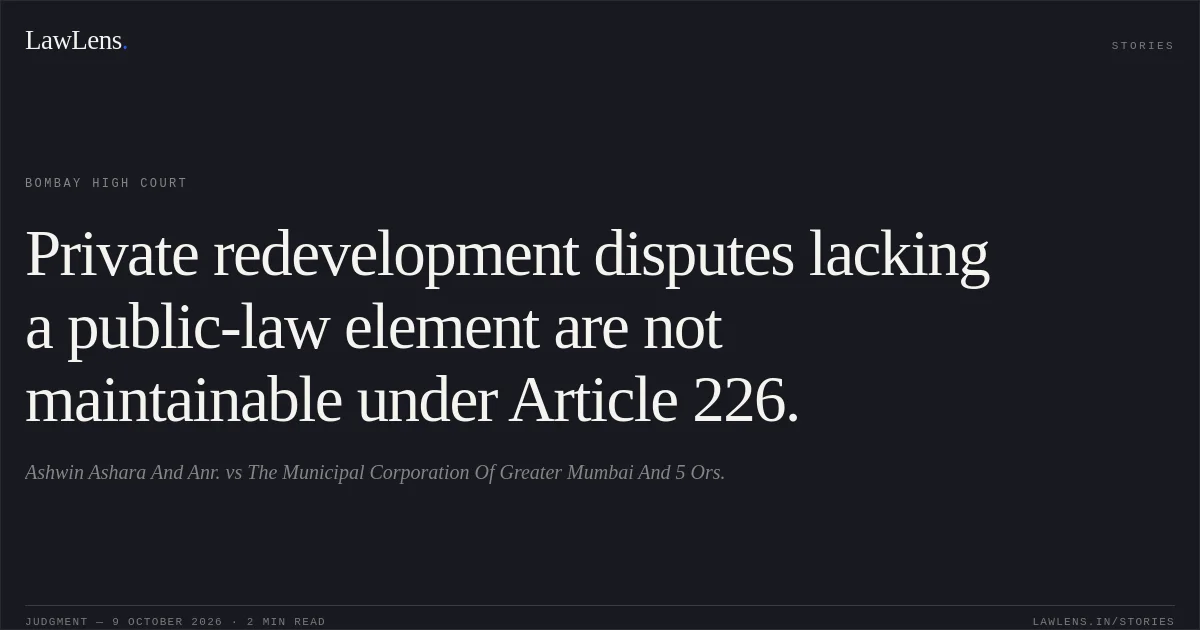
1. Whether a writ petition under Article 226 is maintainable to seek additional area and compensation for alleged breaches of a private redevelopment arrangement, where no breach of statutory duty by the municipal authorities is pleaded
Source reference: pp. 7–82. Whether the precedents relied on by the Petitioners required the Court to exercise its writ jurisdiction in the circumstances of this case
Source reference: pp. 8–9Law Applied
Article 226 confers wide writ jurisdiction, but its existence does not require the Court to exercise it in every case; the Court considers the right asserted, the duty sought to be enforced, the nature of the dispute and the availability of an efficacious remedy
Source reference: p. 8A writ of mandamus does not ordinarily lie against a private person who is not discharging a public duty, and writ jurisdiction cannot be used as a substitute for ordinary civil remedies to resolve private contractual claims
Source reference: p. 7The Court relied on Praga Tools Corporation v. C.A. Imanual, (1969) 1 SCC 585, in support of the principle that disputes rooted in private contracts without a public-law element should be pursued through ordinary civil remedies
Source reference: p. 8It distinguished Hari Krishna Mandir Trust v. State of Maharashtra, (2020) 9 SCC 356, and Rajani Dattaram Tanawade v. Municipal Corporation of Greater Mumbai, 2023 SCC OnLine Bom 2313, on the facts
Source reference: pp. 8–9Reasoning
The Petitioners’ substantive claims concerned additional area, amenities, parking and compensation arising from the redevelopment.
Source reference: pp. 7–9The relief was directed exclusively against the private developer, and the Petitioners did not allege that the municipal respondents had breached a statutory provision or duty.
Source reference: pp. 7–9Their joinder therefore did not create a public-law element.
Source reference: pp. 7–9The redevelopment agreement had been acted upon, construction completed and the Occupation Certificate issued; the Court considered the dispute private in nature and the writ petition an unsuitable substitute for civil remedies.
Source reference: pp. 7–9The cited authorities did not alter that conclusion because the circumstances they addressed were distinguishable
Source reference: pp. 7–9Holding
The Court held that the petition was not maintainable under Article 226, including as a claim for an “appropriate writ,” and dismissed it.
The Rule was discharged, with no order as to costs.
Source reference: pp. 7, 10Acts & Sections Cited
2 provisions across 1 statute referred to in this judgment. Each provision opens on LawLens.
Arbitration and Conciliation Act, 19962
Original Court PDF
Ashwin Ashara And Anr.vsThe Municipal Corporation Of Greater Mumbai And 5 Ors.
Click to open original judgment
Original judgment, available to read, download and summarize on LawLens.in