Facts
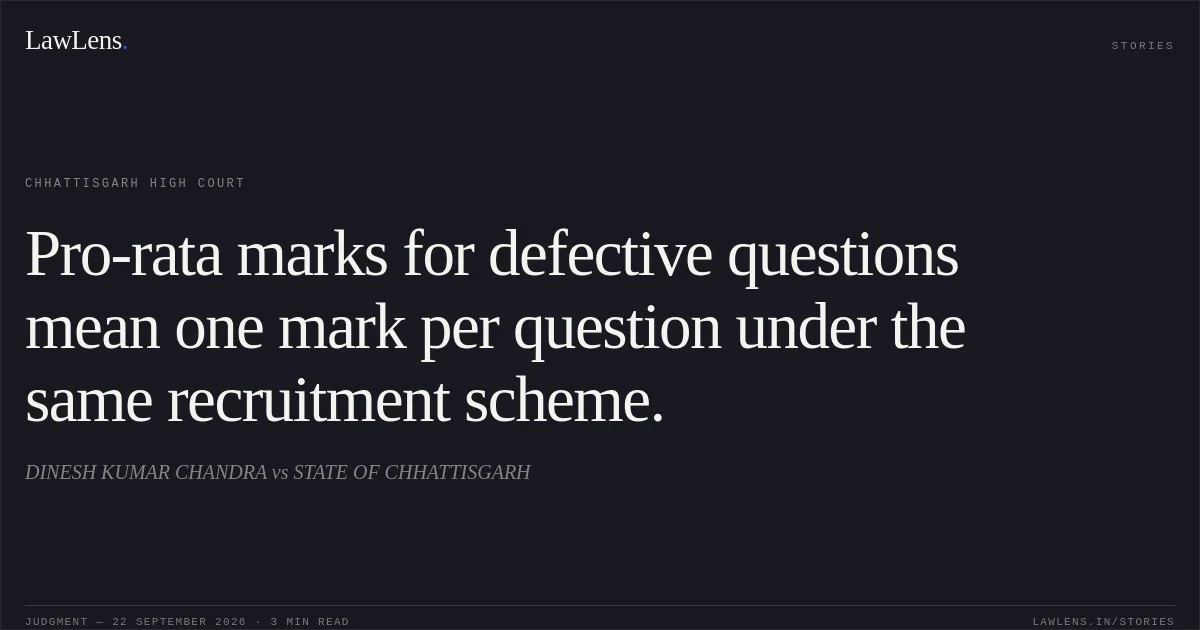
The applicants had filed miscellaneous civil applications seeking modification or clarification of orders dated 4 February 2025 passed in their respective writ petitions. In those orders, the High Court had directed the respondents to award “pro-rata” marks for ten defective questions and, if the applicants crossed the prescribed cut-off, to consider them for appointment.
Source reference: para. 2The applicants contended that, in the same recruitment examination, Questions 54 and 75 had been cancelled and one mark for each question had been awarded to all candidates. They therefore sought clarification that “pro-rata marks” meant one mark for each of the ten defective questions. The respondents opposed the applications, asserting that the earlier orders had already been complied with by applying the methodology referred to in Vikas Pratap Singh v. State of Chhattisgarh. Since the legal issue was identical, the Court disposed of all four applications by a common order, considering the facts of MCC No. 398 of 2026 for convenience.
Source reference: paras. 1, 3–4Issues
Whether the expression “pro-rata marks” in the orders dated 4 February 2025 required application of the mathematical formula adopted in Vikas Pratap Singh, or whether it required awarding one mark for each defective question in accordance with the methodology followed by the respondent-Company in the same recruitment?
Source reference: paras. 2–7Whether the applicants were entitled to re-computation of their marks on the basis of one mark for each of the ten identified defective questions and consequential consideration for appointment if they crossed the prescribed cut-off?
Source reference: paras. 6–11Law Applied
The Court applied the principle that an expression used in a judicial order must be interpreted consistently with the context of that order and the methodology adopted by the recruiting authority in the same examination.
Source reference: para. 7It relied on Vikas Pratap Singh v. State of Chhattisgarh, (2013) 14 SCC 494, where the Supreme Court recognised pro-rata allocation of marks upon deletion of defective questions in accordance with the applicable examination rules; however, the High Court held that the precedent did not itself mandate adoption of a different formula unless specifically directed. The Court also relied on Arunachal Pradesh Public Service Commission v. Hage Mamung, (2023) 18 SCC 710, which upheld the award of marks to all candidates on a pro-rata basis for cancelled questions where the Commission had consciously adopted that method, observing that such treatment avoided penalising candidates for defective questions and preserved the relative merit position.
Source reference: paras. 8–9Reasoning
The Court noted that the earlier orders expressly directed the grant of “pro-rata marks” for ten identified defective questions, but did not direct adoption of the specific calculation formula used in Vikas Pratap Singh.
Source reference: paras. 6–7In the same recruitment, the respondent-Company had cancelled Questions 54 and 75 and awarded one mark for each cancelled question to every candidate. Applying the principle that the expression should be understood in harmony with the recruiting authority’s own treatment of defective questions, the Court held that the reference to Vikas Pratap Singh could not be read as requiring a different mathematical formula not expressly ordered by the Court. The reasoning was also consistent with Hage Mamung, where awarding the marks attached to cancelled questions to all candidates was accepted as a lawful and non-arbitrary method.
Source reference: paras. 7, 9Holding
The Court allowed all four miscellaneous civil applications and clarified that “pro-rata marks” meant one mark for each of the ten defective questions—Questions 81, 83, 85, 86, 87, 88, 89, 90, 98 and 99.
The respondents were directed to recompute the applicants’ marks accordingly and, if they crossed the prescribed cut-off, to consider their cases for appointment in accordance with law. The applications were accordingly allowed and disposed of.
Source reference: paras. 11–12Original Court PDF
DINESH KUMAR CHANDRAvsSTATE OF CHHATTISGARH
Click to open original judgment
Original judgment, available to read, download and summarize on LawLens.in