Facts
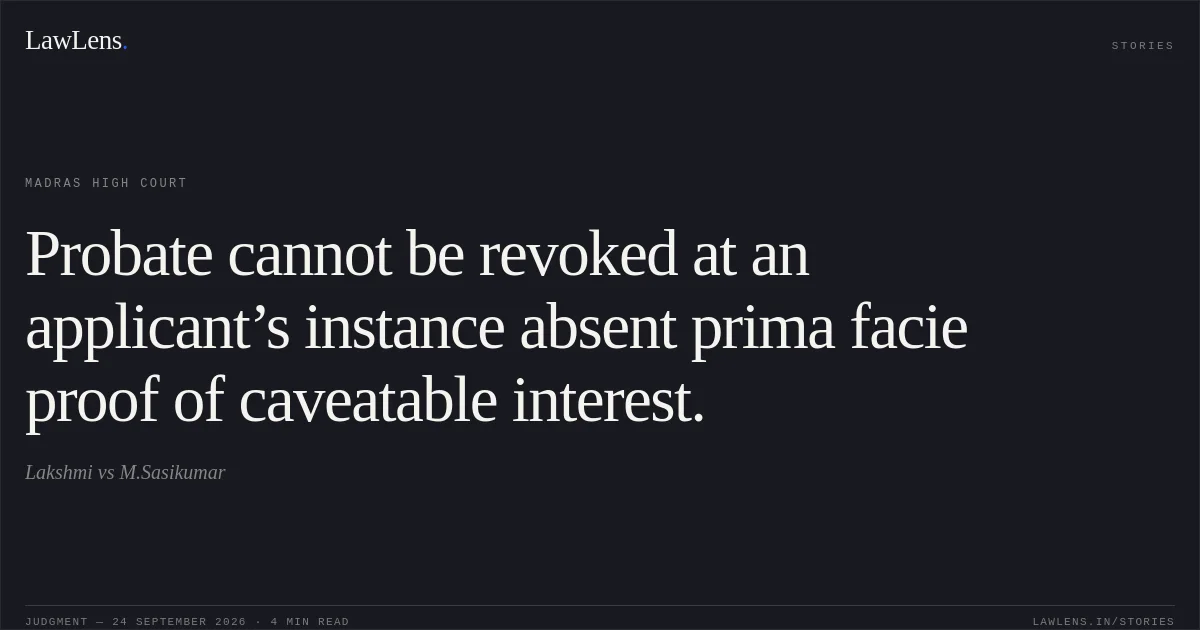
The applicant, Lakshmi, sought revocation under Section 263 of the Indian Succession Act, 1925, of the Letters of Administration with Will annexed granted to the respondent on 20 December 2022 in respect of a registered Will dated 16 August 2019 executed by V. Ramachandran, under which the respondent was the sole beneficiary.
Source reference: para. 1; p. 2The applicant claimed to be the testator’s sister, asserting that she had been adopted by the testator’s parents and was brought up with him.
Source reference: para. 2; p. 2She alleged that the respondent, the natural son of Sankaran, had procured a registered adoption deed dated 8 August 2019 and the Will shortly thereafter, when the testator was elderly and in poor health.
Source reference: para. 4; p. 3The applicant contended that she had not been impleaded or individually cited in the probate proceedings and that the respondent had represented that the deceased left no next of kin or interested person.
Source reference: para. 5; p. 4She also relied on a pending civil suit challenging the adoption deed and the Will, although the suit had subsequently been dismissed for default and restoration proceedings were pending.
Source reference: paras. 5, 10; pp. 4, 7The respondent denied the applicant’s alleged adoption and contended that she had no legal or caveatable interest in the estate.
Source reference: para. 6; p. 4In the original testamentary proceedings, the petitioner and both attesting witnesses had been examined, and the original Will and adoption deed had been produced.
Source reference: para. 8; p. 6Issues
1. Whether the applicant had shown just cause under Section 263 of the Indian Succession Act, 1925, for revocation of the Letters of Administration with Will annexed granted in O.P. No. 457 of 2022.
Source reference: para. 11; p. 72. Whether the applicant had established, at least prima facie, that she was the adopted daughter of the testator’s parents and consequently possessed a caveatable or legal interest in the testator’s estate.
Source reference: paras. 12–16; pp. 7–93. Whether the grant was liable to revocation on the ground that the applicant had not been cited or impleaded and that material facts concerning an interested heir had been suppressed.
Source reference: paras. 5, 20; pp. 4, 11Law Applied
The Court applied Order XIV Rule 8 of the Original Side Rules read with Section 263 of the Indian Succession Act, 1925, under which a probate or Letters of Administration grant may be revoked for “just cause,” including circumstances showing that the proceedings were defective in substance or that a person legally entitled to notice or citation was improperly excluded.
Source reference: paras. 1, 5, 20; pp. 2, 4, 11The Court further applied the principle that a person seeking revocation must demonstrate a caveatable interest or other legal or derivative interest in the estate; a mere assertion of relationship or absence of notice, without establishing such interest, is insufficient.
Source reference: paras. 13–16, 20; pp. 8–11The testamentary court’s enquiry was confined to the due execution and attestation of the Will and did not extend to adjudicating the validity of the alleged adoption, which was a matter for the appropriate civil forum.
Source reference: para. 18; p. 10Reasoning
The applicant’s locus depended on her prima facie establishing that she had been adopted by Veerabathira Naicker and Santhimathi, the testator’s parents.
Source reference: para. 14; p. 8However, she produced no school record, official document, or other prima facie material identifying them as her parents or proving the alleged adoption.
Source reference: para. 14; p. 8Her marriage invitation describing the testator as her brother did not, by itself, establish adoption.
Source reference: para. 15; p. 9The Court also considered the fact that the alleged adoptive parents had settled property upon the testator but had transferred another portion to the applicant by sale deed for consideration, rather than by settlement or gift recognising her as their daughter; this circumstance supported the respondent’s case that she was known to the family but was not treated as an adopted daughter.
Source reference: para. 15; p. 9Since the applicant failed to establish even a prima facie caveatable interest, she could not rely merely on the absence of citation to seek revocation.
Source reference: paras. 16, 20; pp. 9, 11The Court also noted that the earlier testamentary proceedings had included examination of the petitioner and both attesting witnesses and production of the original Will, and that the validity of the respondent’s adoption was not determined in those proceedings because it was outside the proper scope of probate adjudication.
Source reference: paras. 8, 18; pp. 6, 10Consequently, the applicant failed to show either suppression of a person legally entitled to citation or any other just cause under Section 263.
Source reference: para. 20; p. 11Holding
The Court held that the applicant had not prima facie established her alleged adoption by the testator’s parents or any legal or derivative interest in the estate.
She therefore lacked locus standi and could not establish that the grant had been obtained by suppression of a person legally entitled to citation.
Source reference: paras. 16, 20; pp. 9, 11The application for revocation of the Letters of Administration with Will annexed was dismissed, with no order as to costs.
Source reference: para. 21; p. 11Acts & Sections Cited
1 provisions across 1 statute referred to in this judgment. Each provision opens on LawLens.
Indian Succession Act, 19251
Original Court PDF
LakshmivsM.Sasikumar
Click to open original judgment
Original judgment, available to read, download and summarize on LawLens.in