Facts
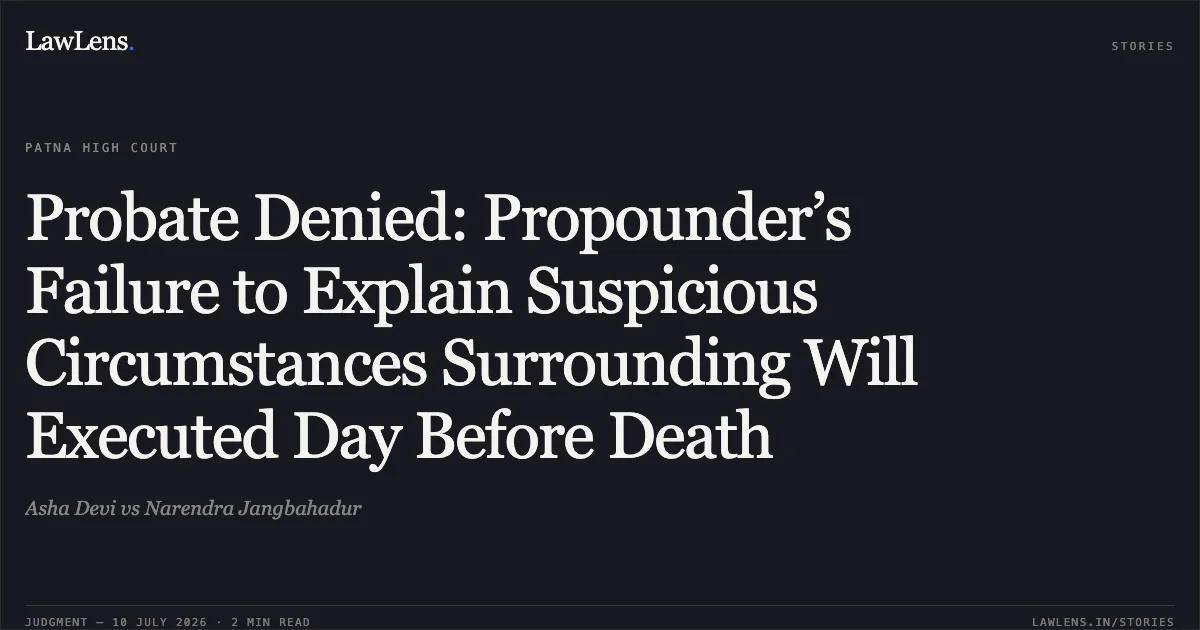
The appellant (Asha Devi) sought probate for an unregistered Will dated 09.09.2009, allegedly executed by her mother-in-law, Rameshwari Devi.
Source reference: p. 2-5The testatrix, aged 94 and suffering from prolonged illness since 2008, died on 10.09.2009—one day after the Will's execution.
Source reference: p. 2-5The Trial Court (3rd ADJ, Bhojpur) dismissed the petition, citing suspicious circumstances: the proximity of death to execution, the testatrix's advanced age/illness, lack of medical evidence regarding mental capacity, and the exclusion of natural heirs (descendants of the second wife).
Source reference: p. 6The appellant challenged this dismissal in the High Court.
Source reference: p. 7Issues
1. Whether the Will dated 09.09.2009 is a genuine, valid, and duly executed testamentary document.
Source reference: p. 4, para. 4(3)2. Whether the propounder (appellant) successfully removed the "suspicious circumstances" surrounding the execution of the Will.
Source reference: p. 113. Whether the Probate Court exceeded its jurisdiction by examining title disputes rather than execution.
Source reference: p. 9, para 12Law Applied
Section 63 of the Indian Succession Act, 1925, which mandates that a Will must be signed by the testator and attested by two witnesses.
Source reference: p. 13Section 67 of the Bharatiya Sakshya Adhiniyam, 2023 (formerly Section 68 of the Evidence Act) regarding the mode of proving a Will.
Source reference: p. 14H. Venkatachala Iyengar v. B.N. Thimmajamma (AIR 1959 SC 443), establishing that if a Will is surrounded by suspicious circumstances, the propounder carries a heavy burden to satisfy the "judicial conscience" of the Court.
Source reference: para. 22, 2511-point test from Meena Pradhan v. Kamla Pradhan (2023 9 SCC 734) regarding the removal of legitimate suspicions like shaky signatures or unnatural dispositions.
Source reference: para. 23Reasoning
The Court noted that while the appellant produced attesting witnesses (PW-1 and PW-2), their testimony failed to dispel "real and germane" suspicions.
Source reference: para. 24, 26The testatrix’s extreme age (94) and death within 24 hours of the alleged execution necessitated rigorous proof of a "sound disposing state of mind," yet no medical evidence was provided.
Source reference: para. 26, 27The Court observed that the active role of the sole beneficiary (the appellant) and the total exclusion of other natural heirs without explanation further intensified the doubt.
Source reference: para. 26It rejected the argument that the burden shifted to the objectors, stating that in probate law, the propounder must stand on their own evidence to remove initial suspicions before forgery needs to be proven by the defense.
Source reference: para. 26, 28The Court found the Trial Court’s scrutiny was limited to the "genuineness of execution" and did not improperly stray into "title disputes".
Source reference: para. 28Holding
The High Court answered the issues against the appellant, holding that the cumulative effect of suspicious circumstances—execution a day before death, ill health, lack of medical proof, and unnatural disposition—rendered the Will invalid.
The Court affirmed the Trial Court's judgment dated 09.12.2019 and dismissed the appeal, ruling that the Will was not proved in accordance with Section 63 of the Indian Succession Act.
Source reference: para. 30, 31Acts & Sections Cited
4 provisions across 3 statutes referred to in this judgment. Each provision opens on LawLens.
Indian Succession Act, 19252
Bharatiya Sakshya Adhiniyam, 20231
Code of Civil Procedure, 19081
Original Court PDF
Asha DevivsNarendra Jangbahadur
Click to open original judgment
Original judgment, available to read, download and summarize on LawLens.in