Facts
On July 3, 2006, the informant was grazing cattle when the accused caught hold of her breasts, attempted to break her salwar drawstring, and threatened to throw her into a gorge
Source reference: p.2An eyewitness, Leelawati (PW3), intervened, causing the accused to flee
Source reference: p.2The informant reported the matter the following day after her husband returned home
Source reference: p.2, 19Medical examination revealed tenderness over both breasts
Source reference: p.3, 21The Trial Court convicted the accused under Sections 354 and 323 of the IPC, sentencing him to six months and three months of simple imprisonment respectively
Source reference: p.4-5The Appellate Court upheld this conviction
Source reference: p.5The accused filed the present revision, alleging material contradictions in witness testimonies, lack of proof of a "blunt weapon" mentioned in the medical report, and seeking the benefit of the Probation of Offenders Act
Source reference: p.6-7Issues
1. Whether the High Court, in its revisional jurisdiction, can interfere with the concurrent factual findings of the lower courts in the absence of perversity
Source reference: p.8 / para. 13-172. Whether the delay in lodging the FIR and minor contradictions in witness statements are fatal to the prosecution's case in a sexual assault matter
Source reference: p.16 / para. 23; p.20 / para. 263. Whether the accused is entitled to the benefit of the Probation of Offenders Act for a conviction under Section 354 IPC
Source reference: p.21 / para. 30Law Applied
The court applied the restricted scope of revisional jurisdiction under Section 397 of the CrPC, as established in Malkeet Singh Gill v. State of Chhattisgarh and Bir Singh v. Mukesh Kumar, which prohibits re-appreciating evidence unless there is a patent jurisdictional error or perversity
Source reference: p.8-12Regarding sexual offences, it relied on State of H.P. v. Prem Singh, ruling that delay in reporting is not fatal due to social factors
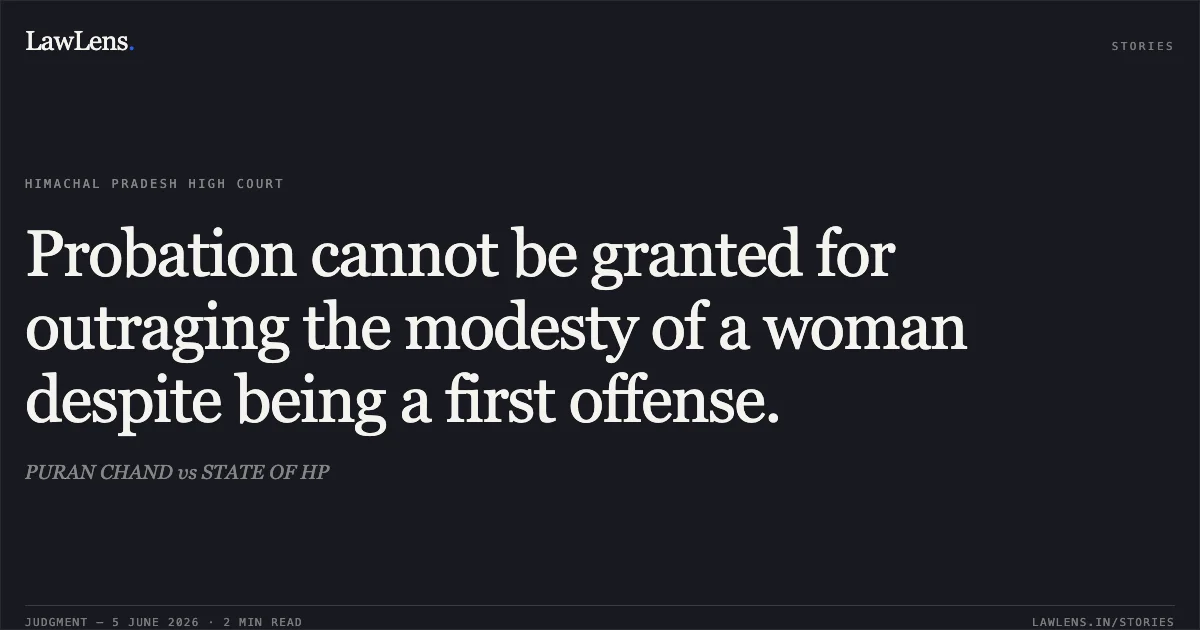
Source reference: p.20For sentencing, it followed State of Rajasthan v. Sri Chand and Ajahar Ali v. State of W.B., which hold that probation should generally be denied in cases involving the outraging of a woman's modesty to maintain social deterrence
Source reference: p.22-24Reasoning
The Court observed that a revisional court is not an appellate court and cannot substitute its own view for concurrent findings unless they are "grossly erroneous"
Source reference: para. 14-17It found that the informant’s testimony (PW1) was consistent with the eyewitness (PW3) and corroborated by medical evidence showing tenderness
Source reference: para. 19-21The Court dismissed the "blunt weapon" argument, noting that human hands constitute a blunt object capable of causing the described injuries
Source reference: para. 25It further ruled that the one-day delay in filing the FIR was reasonably explained by the victim’s fear and the absence of her husband
Source reference: para. 26Minor discrepancies in the location of the witness were deemed insufficient to shake the "core of the testimonies" given the lapse of time
Source reference: para. 23-24Finally, the Court refused to grant probation, reasoning that the accused took advantage of the victim's isolation in a jungle, making the offence too grave for leniency
Source reference: para. 30-31Holding
The High Court answered the issues in the negative, finding no perversity in the lower courts' judgments.
The revision petition was dismissed, and the sentence of six months' simple imprisonment under Section 354 IPC and three months under Section 323 IPC (to run concurrently) was upheld
Source reference: para. 33-35Acts & Sections Cited
10 provisions across 2 statutes referred to in this judgment. Each provision opens on LawLens.
Indian Penal Code, 18603
Code of Criminal Procedure, 19737
Original Court PDF
PURAN CHANDvsSTATE OF HP
Click to open original judgment
Original judgment, available to read, download and summarize on LawLens.in