Facts
The petitioners purchased stamp papers in 2015 for a tripartite agreement between themselves, the developer, and the Noida Authority.
Source reference: para. 8While the petitioners and developer signed, the Noida Authority refused to execute the agreement because the developer defaulted on dues.
Source reference: para. 8The petitioners pursued the matter with the Authority until their claim was rejected as time-barred on May 16, 2024.
Source reference: para. 11, 20This rejection was challenged in a previous writ petition (Writ-C No. 39180 of 2024), where the High Court held on March 6, 2025, that the petitioners were entitled to a refund and that the rejection was based on technicalities.
Source reference: para. 3, 13Despite this, the authorities again rejected the refund claim via an order dated September 25, 2025, citing a 2021 amendment to Rule 218 that imposed an absolute eight-year limitation from the date of purchase.
Source reference: para. 3, 11Issues
1. Whether the limitation period prescribed under Rule 218 prior to the 2017 amendment applies, or whether the amended Rule 218 (2017/2021) governs the refund claim.
Source reference: para. 10(i)2. Whether the authorities could deny the claim on grounds of limitation after the High Court's final judgment dated March 6, 2025, had already granted the benefit of refund to the petitioners.
Source reference: para. 10(ii)Law Applied
The court examined Section 49(d)(4) and Section 50(3) of the Indian Stamp Act, 1899, which provide for allowances for spoiled stamps and prescribed a six-month limitation for executed instruments.
Source reference: para. 6, 7The unamended Rule 218 allowed the State Government to relax the two-year limitation in cases of serious hardship whereas the 2017 and 2021 amendments capped the total period for refund at eight years.
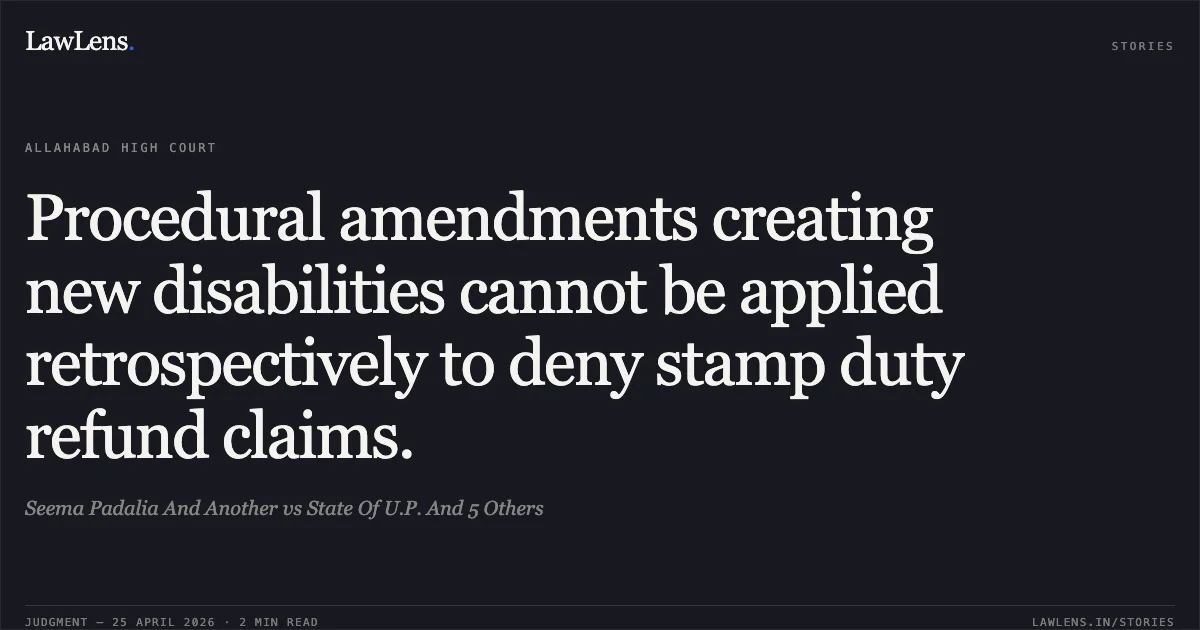
Source reference: para. 4, 14The principle from Hitendra Vishnu Thakur vs. State of Maharashtra establishes that while procedural law (like limitation) is generally retrospective, it should not be applied retrospectively if it creates new disabilities or obligations regarding transactions already accomplished.
Source reference: para. 21, 22Reasoning
The court observed that the petitioners purchased the stamps with a "legitimate expectation" of executing the tripartite agreement, which failed solely due to the developer's inaction and the Authority's subsequent refusal to sign.
Source reference: para. 9, 19Even though the refund application was filed after the 2017/2021 amendments were in place, the court noted that the cause of action (the failure of the agreement) and the pursuit of the matter predated the amendments' restrictive effects.
Source reference: para. 15, 17, 26The court reasoned that applying the eight-year cap would impose a "new disability" on the petitioners for a transaction that was already in progress.
Source reference: para. 24, 25The court emphasized that its previous judgment dated March 6, 2025, had already settled the right to refund between the parties, and the authorities could not circumvent a final judicial finding by re-invoking technical limitation hurdles.
Source reference: para. 21, 26Holding
The court answered that the 2017/2021 amendments cannot be enforced retrospectively against the petitioners to create a disability.
The Court quashed the order dated September 25, 2025, and directed the respondents to refund the stamp duty as per the application dated April 27, 2024, within a period of two months.
Source reference: para. 26Acts & Sections Cited
7 provisions across 1 statute referred to in this judgment. Each provision opens on LawLens.
Indian Stamp Act, 18997
Original Court PDF
Seema Padalia And AnothervsState Of U.P. And 5 Others
Click to open original judgment
Original judgment, available to read, download and summarize on LawLens.in