Facts
The petitioner, a registered contractor, participated in a Public Works Department e-tender for the renovation and expansion of the Press Club at Ambedkar Nagar, estimated at ₹117 lakhs and having a six-month completion period.
Source reference: para. 3After the technical bids were opened on 15 April 2026, she complained that respondent no. 6 had concealed an ongoing Rural Engineering Department work and thereby misrepresented its bid capacity.
Source reference: para. 5The Local Tender Evaluation Committee verified the allegation, treated the complaint as meritorious, and declared respondent no. 6’s bid non-responsive on 22 April 2026.
Source reference: para. 8An Office Memorandum/SOP dated 18 April 2026 introduced a 10% threshold for examining concealed ongoing works.
Source reference: paras. 6, 9, 27The Headquarters Disposal Committee, by report dated 2 May 2026, remanded the matter for reconsideration in light of the SOP.
Source reference: paras. 6, 9, 27On reconsideration, respondent no. 6 was found technically qualified; its financial bid was opened on 2 June 2026, it was declared L-1, and the contract was awarded on 10 June 2026.
Source reference: para. 26The petitioner alleged that the fresh decision was never communicated to her and challenged the remand order, opening of the financial bid, and consequential award.
Source reference: paras. 10–11, 24Issues
1. Whether the SOP dated 18 April 2026 could be applied to the petitioner’s complaint, which had been filed on 17 April 2026 but had not been finally decided when the SOP came into force.
Source reference: paras. 24, 27–322. Whether the application of the 10% threshold under the SOP to respondent no. 6’s concealed ongoing work was arbitrary, irrational, discriminatory, or contrary to public interest.
Source reference: paras. 29–353. Whether the reconsideration of respondent no. 6’s eligibility without communicating a reasoned decision to the petitioner violated the principles of natural justice.
Source reference: para. 344. Whether the petitioner was subjected to discriminatory treatment in comparison with her disqualification in a separate tender.
Source reference: paras. 17, 355. Whether the Court should quash the tender award or restrain execution of the contract notwithstanding the procedural infirmity and the contract’s substantial progress.
Source reference: paras. 36–38Law Applied
The Court applied the settled principle that judicial review in tender matters examines the legality and fairness of the decision-making process, not the commercial merits of the decision itself, and that interference is warranted only in cases of arbitrariness, mala fides, bias, irrationality, discrimination, or violation of statutory provisions.
Source reference: paras. 18–21It relied on Tata Cellular v. Union of India, (1994) 6 SCC 651; Michigan Rubber v. State of Karnataka, (2012) 8 SCC 216; Jagdish Mandal v. State of Orissa, (2007) 14 SCC 517; Uflex Ltd. v. State of Tamil Nadu, (2022) 1 SCC 165; N.G. Projects Ltd. v. Vinod Kumar Jain, (2022) 6 SCC 127; Silppi Constructions Contractors v. Union of India, 2019 SCC OnLine SC 1133; Central Coalfields Ltd. v. SLL-SML (Joint Venture Consortium), (2016) 8 SCC 622; Raunaq International Ltd. v. I.V.R. Construction Ltd., (1999) 1 SCC 492; and Air India Ltd. v. Cochin International Airport Ltd., (2000) 2 SCC 617.
Source reference: paras. 19–20The Court further applied the principle that the tender-authority is ordinarily entitled to determine the essentiality and operationalisation of tender conditions, subject to constitutional review.
Source reference: para. 20The SOP was treated as a procedural and clarificatory measure governing pending proceedings where no right had crystallised.
Source reference: para. 32The Court also applied N.G. Projects and Section 41(ha) of the Specific Relief Act, 1963, cautioning against injunctions that disrupt substantially progressing infrastructure projects.
Source reference: para. 23Reasoning
The Court held that the 10% threshold did not create a new substantive eligibility condition but gave objective content to the pre-existing category concerning disclosure of ongoing works under the Government Order dated 5 December 2023.
Source reference: paras. 28–32Since the petitioner’s complaint remained pending at the evaluation stage and had not attained finality when the SOP was issued, its application was permissible.
Source reference: paras. 28–32The SOP was general, state-wide, and not shown to have been framed to defeat the petitioner’s complaint.
Source reference: para. 35The concealed work attributed to respondent no. 6 was ₹3.72 lakhs, below 10% of the ₹117-lakh tender value, whereas the petitioner had allegedly concealed works worth ₹94.09 lakhs in a separate ₹223-lakh tender, exceeding the applicable threshold.
Source reference: para. 35The Court therefore found no irrationality or unequal treatment.
Source reference: para. 35However, the Court found a genuine procedural infirmity: respondent no. 6’s eligibility was restored on reconsideration without communicating a reasoned order to the petitioner, whose complaint had earlier succeeded.
Source reference: para. 34This deprived her of notice and an opportunity to understand or challenge the reversal, contrary to the audi alteram partem principle.
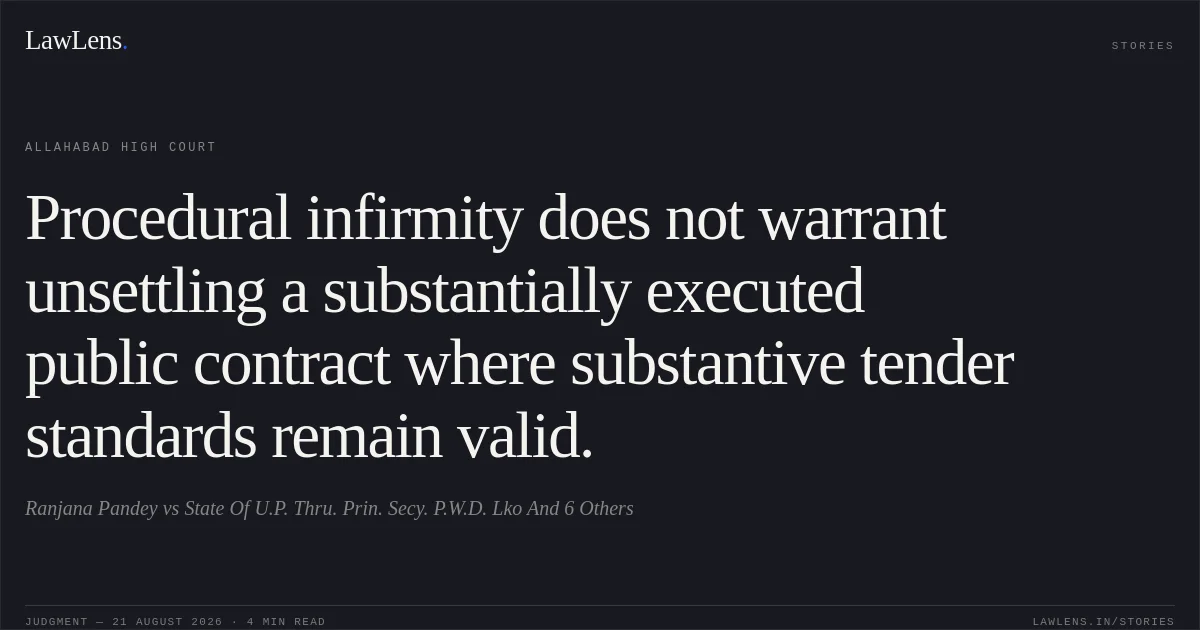
Source reference: para. 34Nevertheless, because the contract had already been awarded, more than two months of the six-month work period had elapsed, and the substantive tender standard was found valid, the public interest in avoiding disruption outweighed the benefit of quashing the award.
Source reference: paras. 36–37Holding
The Court held that the SOP dated 18 April 2026 validly applied to the pending complaint; the 10% threshold was neither arbitrary nor discriminatory; and no case was made out for disturbing respondent no. 6’s technical qualification or the tender award.
Although the reconsideration process was procedurally unfair because no reasoned decision was communicated to the petitioner, the Court declined to quash the Headquarters Committee’s report dated 2 May 2026, the opening of the financial bid, or the contract awarded to respondent no. 6, and declined to restrain further execution of the work.
Source reference: para. 37The State authorities were directed to communicate to the petitioner, within four weeks, a reasoned order setting out the basis on which respondent no. 6 was found eligible on remand.
Source reference: paras. 37–39The petitioner was left at liberty to pursue any available remedy, including a civil claim for damages for an established procedural infraction.
Source reference: paras. 37–39The writ petition was accordingly disposed of without costs.
Source reference: paras. 37–39Acts & Sections Cited
1 provisions across 1 statute referred to in this judgment. Each provision opens on LawLens.
Specific Relief Act, 19631
Original Court PDF
Ranjana PandeyvsState Of U.P. Thru. Prin. Secy. P.W.D. Lko And 6 Others
Click to open original judgment
Original judgment, available to read, download and summarize on LawLens.in