Facts
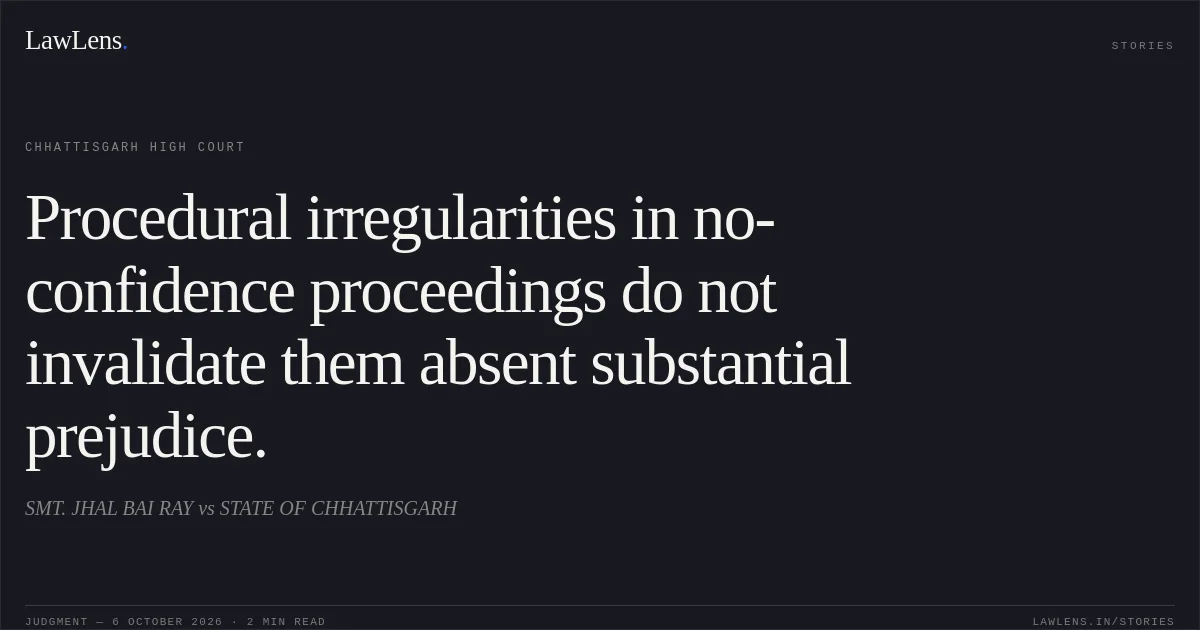
The petitioner, an elected Sarpanch of Gram Panchayat Singhanpur, challenged the SDO’s order dated 24 September 2026 convening a no-confidence meeting for 6 October 2026 at noon.
Source reference: para. 1–4, 7–8She contended that the prescribed authority had not properly recorded its satisfaction under Rule 3 of the 1994 Rules, and that the order-sheet did not specify the meeting’s place or explain the verification of the Panchas’ signatures.
Source reference: para. 1–4, 7–8She also submitted that nine Panchas had applied for the motion; the Court’s account of the record, however, refers to an application by ten Panchas, verified through the CEO of the Janpad Panchayat.
Source reference: para. 1–4, 7–8The SDO appointed the Tahsildar as Presiding Officer.
Source reference: para. 1–4, 7–8Issues
1. Whether the alleged deficiencies in recording satisfaction, verifying the application and specifying the meeting place invalidated the order convening the no-confidence meeting.
Source reference: para. 2–3, 7–82. Whether the alleged procedural irregularities caused substantial prejudice or failure of justice warranting writ-court interference before the meeting.
Source reference: para. 7–11Law Applied
Section 21 of the Chhattisgarh Panchayat Raj Adhiniyam, 1993 governs no-confidence motions against a Sarpanch or Up-Sarpanch, including the statutory bars on bringing a motion and the office-bearer’s right to participate in the meeting.
Source reference: para. 6, 9Rule 3 of the Chhattisgarh Panchayat (Gram Panchayat ke Sarpanch Tatha Up-Sarpanch Ke Viruddh Avishwas Prastav) Rules, 1994 prescribes the procedure for convening such a meeting.
Source reference: para. 6, 9Relying on Smt. Janki Sahu v. State of Chhattisgarh, Bhulin Dewangan v. State of M.P. and Sahasram Jangde v. State of Chhattisgarh, the Court applied the principle that procedural non-compliance does not automatically nullify a no-confidence proceeding; the court must consider whether the defect caused substantial prejudice or failure of justice.
Source reference: para. 6, 9Reasoning
The Court found that the application was made by the requisite number of Panchas and verified through the CEO, after which the SDO appointed a Presiding Officer and fixed the meeting’s date and time.
Source reference: para. 7–11The absence of a detailed recital in the order-sheet about the meeting place or verification process did not, without demonstrated prejudice, invalidate the proceedings.
Source reference: para. 7–11The petitioner had not shown that the motion was barred by Section 21(3), that she was deprived of an effective opportunity to participate, or that the alleged defects caused serious prejudice.
Source reference: para. 7–11Given that the motion was still to be considered, the Court held that intervention on these grounds would stall the democratic process without sufficient justification.
Source reference: para. 7–11Holding
The Court dismissed the writ petition and declined to interfere with the SDO’s order dated 24 September 2026.
It clarified that the petitioner remained entitled to participate in the meeting and exercise her rights under Section 21 of the 1993 Act and the applicable Rules.
Source reference: para. 12–13Acts & Sections Cited
1 provisions across 1 statute referred to in this judgment. Linked provisions open on LawLens.
Chhattisgarh Panchayat Raj Adhiniyam, 19931
Original Court PDF
SMT. JHAL BAI RAYvsSTATE OF CHHATTISGARH
Click to open original judgment
Original judgment, available to read, download and summarize on LawLens.in