Facts
On January 30, 2021, the NCB received secret information regarding the transportation of Ganja from Odisha in a truck (JH09J4421) escorted by a Scorpio (JH09M7100)
Source reference: p. 3On February 2, 2021, the team intercepted the truck at Ara-Chapra More. Appellants Shankar Yadav and Pritam Lakra were on the truck and admitted to carrying contraband
Source reference: p. 3A search at Koilwar Police Station led to the recovery of 96 packets (909.2 kgs) of Ganja
Source reference: p. 4Appellant Nav Kumar Ojha, the owner of both vehicles, was apprehended at Chhapra by a second team
Source reference: p. 15The Trial Court convicted all three under Sections 20(b)(ii)(c), 25, and 29 of the NDPS Act, sentencing them to 15 years of rigorous imprisonment
Source reference: p. 2, 9The Appellants challenged the conviction on grounds of procedural lapses in search, seizure, and the hostility of independent witnesses
Source reference: p. 10-12Issues
1. Whether non-compliance with the procedural safeguards under Sections 42, 52-A, and 67 of the NDPS Act and the hostility of independent witnesses vitiates the conviction
Source reference: p. 112. Whether the recovery and conscious possession were established beyond reasonable doubt despite discrepancies in the place of seizure and lack of production of physical contraband in court
Source reference: p. 12-13Law Applied
The court primarily applied Section 20(b)(ii)(c) (punishment for commercial quantity), Section 25 (allowing premises/vehicle for commission of offence), and Section 29 (punishment for abetment/conspiracy) of the NDPS Act, 1985
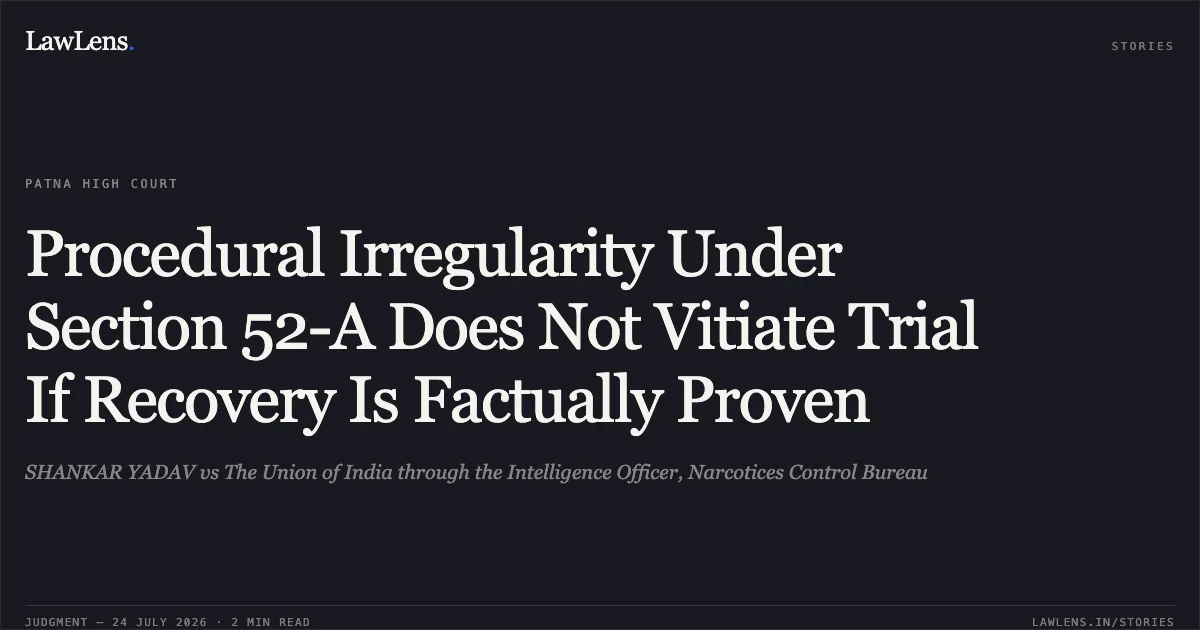
Source reference: p. 2, 5It relied on Section 52-A regarding the disposal and certification of seized narcotics
Source reference: p. 25The court followed the precedents of Narcotics Control Bureau v. Kashif (2024) and Bharat Aambale v. State of Maharashtra (2025), which established that substantial compliance with Section 52-A serves as primary evidence even if original contraband is not produced, and that procedural irregularities do not automatically vitiate a trial unless serious prejudice is proved
Source reference: p. 25-28Reasoning
The High Court found that the prosecution proved the search, seizure, and sampling through reliable official witnesses (PW-1, PW-4, PW-5, and PW-6) whose testimonies remained consistent during cross-examination
Source reference: p. 17-21The court noted that while independent witnesses (PW-2 and PW-3) turned hostile, they admitted their signatures on the seizure list, and the defense failed to challenge the sanctity of the seizure process effectively
Source reference: p. 18-19Relying on Bharat Aambale, the court held that since inventory, photography, and sampling were conducted before a Judicial Magistrate as per Section 52-A (Exhibits P-14, P-42, P-43), these documents constitute primary evidence, negating the need for physical production of the bulk contraband
Source reference: p. 22, 27The court dismissed arguments regarding the place of seizure, noting that moving the vehicle to a police station due to a gathering crowd was a reasonable administrative action that did not prejudice the accused
Source reference: p. 16Holding
The Court upheld the conviction of the Appellants, stating that the prosecution satisfied high standards of proof regarding recovery and conscious possession
Conviction under Sections 20(b)(ii)(c), 25, and 29 of the NDPS Act is maintained; the order of sentence is modified from 15 years to 11 years of rigorous imprisonment, keeping the fine and default sentences intact. Appeals partly allowed
Source reference: p. 30Acts & Sections Cited
12 provisions across 2 statutes referred to in this judgment. Each provision opens on LawLens.
Narcotic Drugs and Psychotropic Substances Act, 1985
Code of Criminal Procedure, 19731
Original Court PDF
SHANKAR YADAVvsThe Union of India through the Intelligence Officer, Narcotices Control Bureau
Click to open original judgment
Original judgment, available to read, download and summarize on LawLens.in