Facts
On the basis of the self-written report of the SHO of Gaunaha Police Station, Gaunaha P.S. Case No. 257 of 2022 was registered against Pappu Dubey, Vicky Sah and co-accused Arvind Kumar under Sections 8, 20(b)(ii)(C), 23(c) and 29 of the NDPS Act.
Source reference: paras. 4–5On 17 December 2022, during vehicle checking following secret information, the police intercepted three persons travelling on two motorcycles.
Source reference: para. 15Ten packets allegedly containing Charas, weighing 5.019 kilograms, were recovered from a black bag hanging from Vicky Sah’s motorcycle, while sixteen packets, weighing 7.535 kilograms, were recovered from a cement sack placed between Pappu Dubey and Arvind Kumar on the second motorcycle.
Source reference: paras. 15–15.1The articles were allegedly seized, weighed and sealed at the spot in the presence of police officials, a BDO, a BAO, two independent witnesses and the accused persons.
Source reference: paras. 15.1, 21(d)–(f)The samples were subsequently drawn before a Judicial Magistrate and sent to the Forensic Science Laboratory, which confirmed that the substance was Charas.
Source reference: para. 19Arvind Kumar was declared a juvenile and his trial was separated.
Source reference: para. 7The Exclusive Special Judge, NDPS, West Champaran, convicted the appellants under Sections 20(b)(ii)(C) and 29 of the NDPS Act and sentenced each to ten years’ rigorous imprisonment with a fine of Rs. 2,00,000/- under each provision, with sentences to run concurrently.
Source reference: paras. 3, 8, 14Issues
Whether the conviction could be sustained despite the non-examination of the independent witnesses, the BDO and the BAO who were allegedly present during the seizure proceedings?
Source reference: paras. 23–25.1Whether alleged non-compliance with the requirements of Section 52A of the NDPS Act, including failure to prepare an inventory and take photographs before a Magistrate, vitiated the prosecution case?
Source reference: paras. 26–26.1Whether Section 50 of the NDPS Act was attracted where the contraband was recovered from bags carried on motorcycles rather than from the appellants’ persons?
Source reference: paras. 27–27.1Whether the absence of the FSL report at the stage of filing the charge-sheet rendered the prosecution and subsequent trial unsustainable?
Source reference: paras. 24–24.1, 28–28.1Whether Section 42 of the NDPS Act applied to the interception and recovery made from motorcycles in transit at an open public place?
Source reference: paras. 29–29.1Whether the absence of a calibration or accuracy certificate for the electronic weighing machine created reasonable doubt regarding the commercial quantity of the recovered contraband?
Source reference: paras. 30–30.1Whether the alleged irregularities in the investigation, including non-examination of material witnesses and doubts regarding the presence of official witnesses, rendered the conviction unsafe?
Source reference: paras. 31–31.1Law Applied
The Court applied Sections 20(b)(ii)(C) and 29 of the NDPS Act concerning possession of commercial quantities of cannabis and criminal conspiracy or abetment, respectively.
Source reference: paras. 3, 32It held that reliable, cogent and consistent police testimony can sustain a conviction even without examination of independent witnesses; official witnesses are not disqualified merely by reason of their status, as recognised in Surinder Kumar v. State of Punjab, Jarnail Singh v. State of Punjab and Jothi @ NagaJothi v. State represented by Inspector of Police.
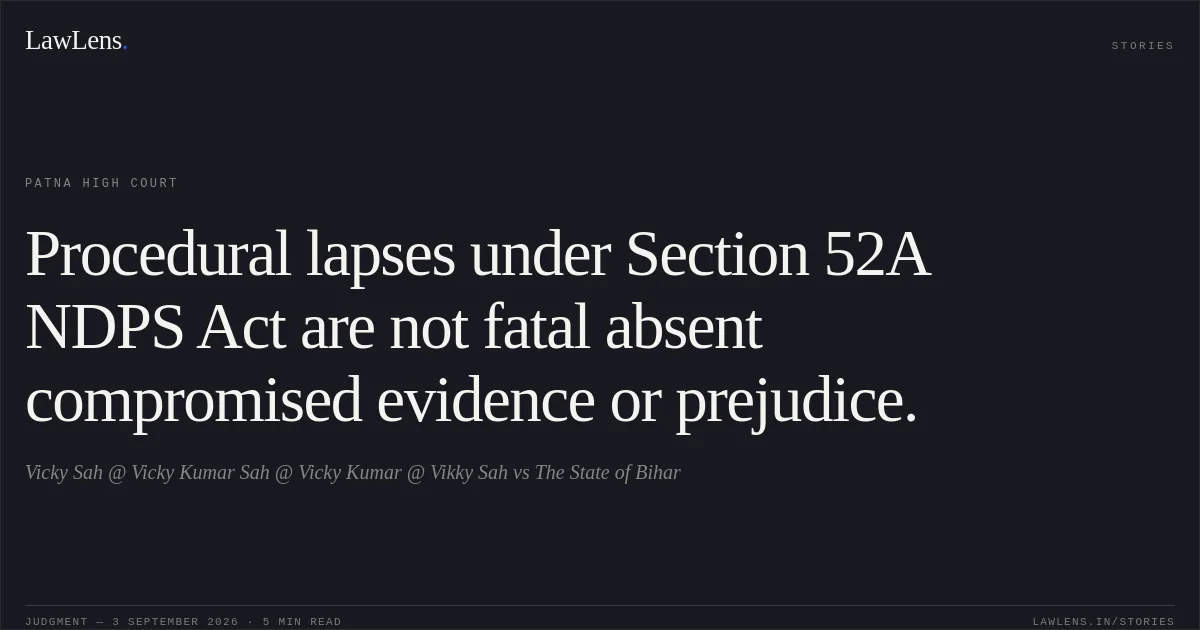
Source reference: paras. 23.1–23.2Regarding Section 52A, the Court relied on Bharat Aambale v. State of Chhattisgarh for the principle that procedural non-compliance is not automatically fatal unless discrepancies in the physical evidence create doubt about the identity or integrity of the seized substance.
Source reference: para. 26.1Section 50 applies to personal searches and is not attracted to recovery from a bag or other container carried separately from the person.
Source reference: para. 27.1Section 42 does not apply to a seizure made during interception of a vehicle in transit at a public place, as explained in State of Haryana v. Jarnail Singh and Narayanswamy Ravishankar v. Assistant Director, Directorate of Revenue Intelligence.
Source reference: para. 29.1The absence of an FSL report when the charge-sheet is filed is not fatal if the substance is subsequently scientifically examined and the report is duly proved.
Source reference: para. 28.1Finally, the Court treated the appellants’ conduct, the manner of transportation and surrounding circumstances as relevant to establishing conscious possession.
Source reference: para. 32Reasoning
The Court found the evidence of PW-1, PW-2, PW-3 and PW-4 materially consistent regarding interception, recovery, weighing, seizure and sealing, while PW-5 established production of the seized articles, sampling before a Magistrate and dispatch to the FSL.
Source reference: paras. 20–21.1Accordingly, the non-examination of the independent witnesses, BDO and BAO was held to be non-fatal because their evidence would have been corroborative and the examined witnesses were found reliable.
Source reference: paras. 23.1–25.1Although the prosecution had not prepared an inventory or taken photographs under Section 52A, samples were drawn before a Magistrate, the sealed bags and packets were produced in court, and no actual tampering or prejudice was demonstrated; the lapse was therefore treated as procedural rather than foundational.
Source reference: para. 26.1Section 50 was held inapplicable because the Charas was recovered from bags placed on or hanging from motorcycles, not from the appellants’ bodies.
Source reference: para. 27.1The later-proved FSL report confirmed that the samples contained Charas, curing the objection based on its non-availability when the charge-sheet was filed.
Source reference: para. 28.1Section 42 was also held inapplicable because the recovery occurred during transit and at an open public place.
Source reference: para. 29.1Although no calibration certificate was produced, the evidence that the weighing machine displayed zero before use, together with the recorded quantity exceeding the commercial-quantity threshold even after allowing for packaging, was considered sufficient.
Source reference: para. 30.1The Court further inferred conscious possession from the appellants’ presence with the bags, their attempt to flee, the mode of transportation and the surrounding circumstances.
Source reference: para. 32Holding
The High Court answered the issues against the appellants.
It held that the prosecution proved recovery of Charas in commercial quantity, conscious possession, proper seizure and sealing, and subsequent forensic confirmation of the substance.
Source reference: para. 32The procedural lapses relating to Section 52A, absence of independent witnesses, lack of a calibration certificate and delayed production of the FSL report did not create a reasonable doubt or cause demonstrated prejudice.
Source reference: paras. 25.1, 26.1, 28.1, 30.1The convictions of Pappu Dubey and Vicky Sah under Sections 20(b)(ii)(C) and 29 of the NDPS Act were upheld, as were the sentences of ten years’ rigorous imprisonment and fines of Rs. 2,00,000/- under each provision, to run concurrently.
Source reference: para. 32Both criminal appeals were dismissed for lack of merit.
Source reference: para. 32The trial court records and a copy of the judgment were directed to be transmitted for necessary compliance.
Source reference: para. 33Acts & Sections Cited
7 provisions across 2 statutes referred to in this judgment. Each provision opens on LawLens.
Narcotic Drugs and Psychotropic Substances Act, 19856
Code of Criminal Procedure, 19731
Original Court PDF
Vicky Sah @ Vicky Kumar Sah @ Vicky Kumar @ Vikky SahvsThe State of Bihar
Click to open original judgment
Original judgment, available to read, download and summarize on LawLens.in