Facts
On 15 September 2018, two appellants, Md. Saddab and S.K. Arshad, were intercepted by personnel of the 47th Battalion, SSB, Pantoka, Raxaul, allegedly carrying six packets of charas.
Source reference: paras. 3, 37–44The trial court convicted them and sentenced each to 11 years’ rigorous imprisonment and a fine of ₹1 lakh under each provision, with the sentences running concurrently.
Source reference: paras. 2, 4, 6–9Issues
Whether the search and recovery were vitiated because the body search was conducted by a constable and because the appellants allegedly did not receive valid information of their rights under Section 50 of the NDPS Act?
Source reference: paras. 10–13, 34–37Whether the discrepancies concerning the date and manner of search, seizure, sampling, and the non-examination of independent witnesses created reasonable doubt regarding the recovery of charas?
Source reference: paras. 11–24, 37–43Whether the alleged gap in the chain of custody—particularly the absence of evidence explaining how sample S-1 reached the CRCL, Kolkata—was fatal to the prosecution?
Source reference: para. 24, 44–46Whether delayed or imperfect compliance with Section 52A of the NDPS Act required acquittal of the appellants?
Source reference: para. 26, 45–53Whether the sentence of 11 years’ rigorous imprisonment imposed for the offences under Sections 20(b)(ii)(C) and 23(c) of the NDPS Act warranted reduction?
Source reference: paras. 55–57Law Applied
The Court applied Sections 20(b)(ii)(C), 23(c), 50, 52A and 57 of the NDPS Act.
Source reference: no citationRelying on Narcotics Control Bureau v. Kashif, (2024) 11 SCC 372, the Court held that procedural illegality does not, by itself, make all evidence inadmissible where the evidence is otherwise legally usable and reliable.
Source reference: para. 49Relying on Bharat Aambale v. State of Maharashtra, (2025) 8 SCC 452, the Court held that non-compliance with Section 52A is not necessarily fatal if the prosecution independently proves recovery, conscious possession, the chain of custody and the identity of the contraband through credible evidence; the cumulative effect of the evidence must be assessed.
Source reference: paras. 50–52The Court also applied the statutory minimum sentence of ten years for a commercial quantity offence under Section 20(b)(ii)(C), while considering the appellants’ young age and prospects of reform in determining sentence.
Source reference: paras. 55–56Reasoning
The Court found that PW-2, the ASI and leader of the SSB team, had served the Section 50 notices, informed the appellants of their right to be searched before a Magistrate or Gazetted Officer, and directed PW-1 to conduct the search in his presence.
Source reference: paras. 35–37Although the prosecution did not fully explain the movement of sample S-1 from the Malkhana to the CRCL, the laboratory found the seals intact and matching with the seal impression in the test memo. The Court therefore held that the lapse did not destroy the prosecution case.
Source reference: paras. 44–46The Court further held that the Section 52A proceedings, including preparation of inventory, photography, certification by a Magistrate and subsequent destruction of the contraband, substantially corroborated the prosecution evidence.
Source reference: paras. 47–53However, considering the appellants’ young age, poverty and prospects of reformation, the Court found the sentence of 11 years excessive when the statutory minimum was ten years.
Source reference: paras. 55–56Holding
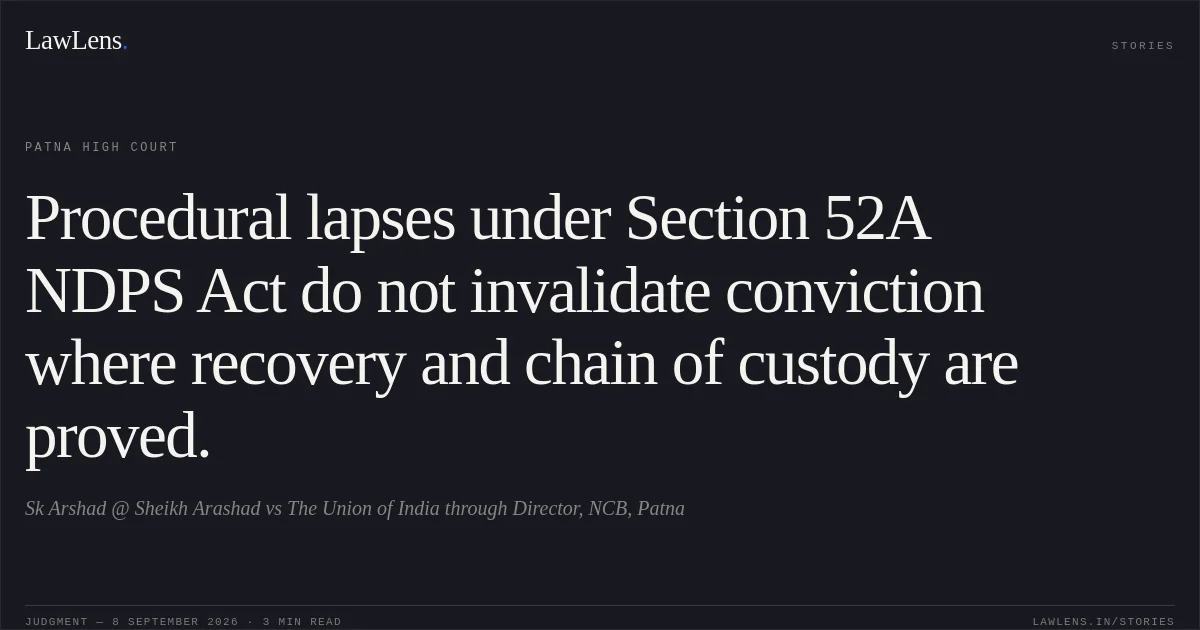
The Court upheld the appellants’ convictions under Sections 20(b)(ii)(C) and 23(c) of the NDPS Act, holding that the prosecution had proved recovery and conscious possession beyond reasonable doubt and that the alleged violations of Sections 50 and 52A were not fatal.
The sentence was modified from 11 years’ rigorous imprisonment to 10 years’ rigorous imprisonment for each offence, with the sentences continuing to run concurrently. The fines and the remaining part of the sentence order were left undisturbed.
Source reference: paras. 55–57Acts & Sections Cited
21 provisions across 1 statute referred to in this judgment. Each provision opens on LawLens.
Original Court PDF
Sk Arshad @ Sheikh ArashadvsThe Union of India through Director, NCB, Patna
Click to open original judgment
Original judgment, available to read, download and summarize on LawLens.in