Facts
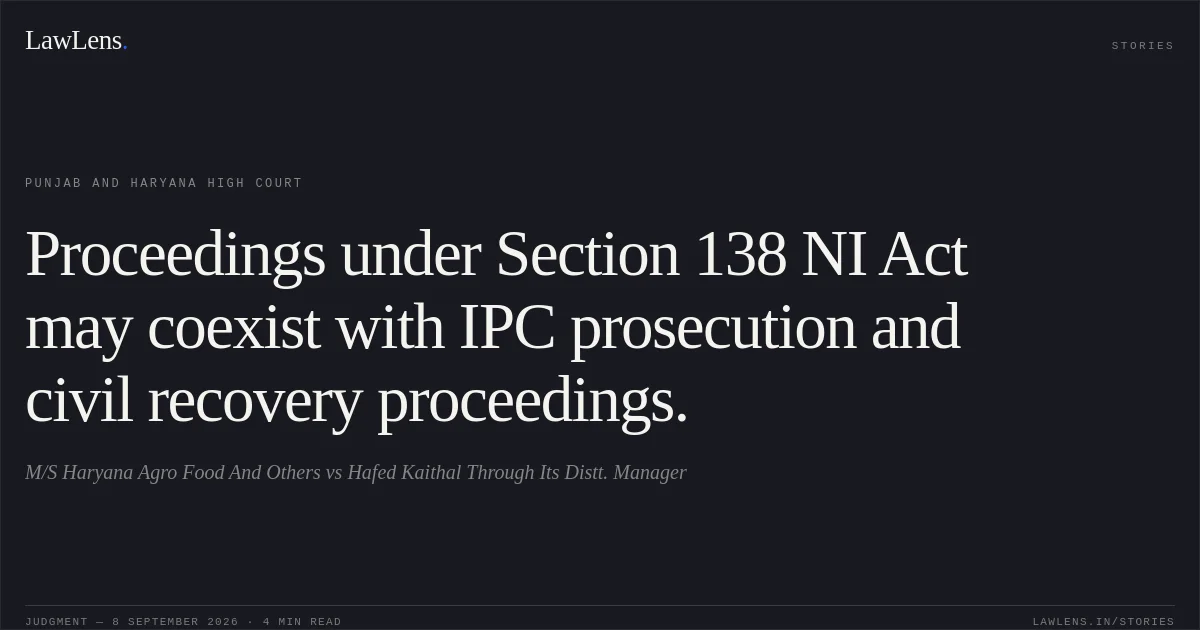
The petitioners sought quashing under Section 528 of the Bharatiya Nagarik Suraksha Sanhita, 2023 (“BNSS”) of Complaint Case No. NACT-1095 of 2019, pending before the Sub-Divisional Judicial Magistrate, Kaithal, and the summoning order dated 26.02.2021, concerning an offence under Section 138 of the Negotiable Instruments Act, 1881 (“NI Act”).
Source reference: p.2, para.1The petitioner-proprietor claimed that he had no prior experience in operating a rice sheller and that the business was actually managed by Ashok Kumar and other partners/sureties, while he was merely projected as the proprietor of M/s Haryana Agro Foods.
Source reference: p.2, para.2He alleged that the cheques in question were pre-signed blank security cheques, subsequently misused by HAFED.
Source reference: p.2, para.2An FIR under Sections 406, 409 and 420 IPC had also been registered, and HAFED had instituted a civil recovery suit for ₹7,02,91,001/- arising from the same transaction.
Source reference: pp.2–3, paras.2–3HAFED opposed quashing, contending that the cheques admittedly bore the petitioner’s signatures and that the pleas concerning security cheques, misuse and the petitioner’s limited role involved disputed questions of fact requiring trial.
Source reference: p.4, para.4Issues
Whether the complaint under Section 138 of the NI Act and the consequential summoning order should be quashed under the inherent jurisdiction preserved by Section 528 BNSS, on the grounds that the cheques were issued as security and that the petitioner had no actual role in the business?
Source reference: pp.3–4, paras.3–4; p.10, para.8.3Whether the pendency of an FIR for alleged misappropriation and a civil recovery suit arising from the same transaction bars or renders abusive the prosecution under Section 138 of the NI Act?
Source reference: pp.3–4, paras.3–4; pp.9–10, paras.8.1–8.2Whether the disputed questions concerning the character of the cheques, the underlying liability and the petitioner’s role could be adjudicated in proceedings under Section 528 BNSS?
Source reference: pp.5–8, paras.5.2, 6.1 and 7–8.3Law Applied
The Court applied Section 528 BNSS, corresponding to the inherent jurisdiction under Section 482 Cr.P.C., which may be exercised sparingly to prevent abuse of process or secure the ends of justice.
Source reference: pp.5–7, para.5.3Under State of Haryana v. Ch. Bhajan Lal, 1991 (1) RCR (Criminal) 383, quashing is justified only in exceptional categories, such as where the allegations do not disclose an offence, are inherently improbable, are legally barred, or are manifestly mala fide; the Court should not assess the reliability or genuineness of disputed allegations.
Source reference: pp.5–7, para.5.3Relying on M/s Neeharika Infrastructure Pvt. Ltd. v. State of Maharashtra, (2021) 19 SCC 401, and R.P. Kapur v. State of Punjab, AIR 1960 SC 866, the Court reiterated that the High Court should not conduct a mini-trial, appreciate evidence, or adjudicate disputed questions of fact while exercising inherent jurisdiction.
Source reference: pp.7–8, para.6.1Under Section 138 NI Act, a signed cheque may attract criminal liability if, on the date of presentation, it represented a legally enforceable debt or liability and the other statutory conditions were satisfied; whether a cheque was issued as security is ordinarily a factual matter.
Source reference: p.9, para.8Proceedings under Section 406 IPC and Section 138 NI Act may coexist because they involve distinct offences, and civil and criminal remedies may be pursued simultaneously where the criminal ingredients are prima facie disclosed.
Source reference: pp.9–10, paras.8.1–8.2Reasoning
The Court found that the petitioner’s status as proprietor and his signatures on the cheques were admitted, while the allegations that the cheques were blank security instruments, were misused, or did not represent a legally enforceable liability were disputed factual matters requiring evidence.
Source reference: p.9, para.8; p.10, para.8.3The mere description of the cheques as “security” did not justify quashing because such a cheque may attract Section 138 NI Act if it represented a legally enforceable liability when presented.
Source reference: p.9, para.8The existence of the FIR and civil recovery suit did not extinguish HAFED’s independent statutory remedy under Section 138 NI Act, as the offences and remedies operated in distinct legal fields.
Source reference: pp.9–10, paras.8.1–8.2Since the complaint did not, at the preliminary stage, appear manifestly mala fide, frivolous, vexatious or legally barred, the case did not fall within the Bhajan Lal or Neeharika categories warranting interference.
Source reference: pp.8–10, paras.7–8.3Holding
The High Court dismissed the petition and declined to quash Complaint Case No. NACT-1095 of 2019 or the summoning order dated 26.02.2021.
It held that the pleas concerning security cheques, misuse, the petitioner’s actual role and the existence or extent of liability must be adjudicated by the trial Court after appreciation of evidence.
Source reference: p.10, para.8.3The Court clarified that its observations were confined to the quashing petition and would not influence the trial on merits.
Source reference: p.10, para.8.4The connected miscellaneous application for placing the zimni orders on record was allowed, and all pending miscellaneous applications were disposed of.
Source reference: p.1, paras.1–2.1; p.11, para.9Acts & Sections Cited
8 provisions across 4 statutes referred to in this judgment. Each provision opens on LawLens.
Bharatiya Nagarik Suraksha Sanhita, 20231
Code of Criminal Procedure, 19733
Negotiable Instruments Act, 18811
Indian Penal Code, 18603
Original Court PDF
M/S Haryana Agro Food And OthersvsHafed Kaithal Through Its Distt. Manager
Click to open original judgment
Original judgment, available to read, download and summarize on LawLens.in