Facts
Respondent No. 2/complainant filed a private complaint against the petitioner under Sections 323 and 341 IPC, alleging that on 27 August 2023 the petitioner, accompanied by several persons, assaulted him and his son after a dispute regarding construction of a steel structure, and restrained the complainant from proceeding to his home
Source reference: para. 2The police had earlier initiated preventive proceedings by submitting a kalandra under Sections 107/150 CrPC before the Sub-Divisional Magistrate.
Source reference: para. 3The learned Trial Court recorded preliminary evidence and summoned the petitioner on 19 February 2024; the petitioner appeared and furnished bail bonds on 5 October 2024
Source reference: para. 3The petitioner approached the High Court on 21 July 2026 seeking quashing of the complaint, summoning order and consequential proceedings, contending that the complaint was barred by double jeopardy, arose from a civil dispute, and constituted an abuse of process
Source reference: paras. 4, 6, 17Issues
Whether the filing and continuation of the private complaint after initiation of proceedings under Sections 107/150 CrPC amounted to double jeopardy or was otherwise legally impermissible
Source reference: paras. 6, 13–16Whether the complaint disclosed a prima facie commission of offences under Sections 323 and 341 IPC, notwithstanding the pendency of civil litigation between the parties
Source reference: para. 19Whether the High Court should exercise its inherent jurisdiction to quash the proceedings in view of the unexplained delay of more than two years after the summoning order
Source reference: paras. 17–18Whether continuation of the complaint amounted to an abuse of the process of the Court warranting exercise of inherent jurisdiction
Source reference: paras. 9–12, 19–22Law Applied
The Court applied the principles governing quashing of criminal proceedings under the inherent jurisdiction preserved by Section 482 CrPC, particularly the categories in State of Haryana v. Ch. Bhajan Lal, 1992 Supp (1) SCC 335, including cases where the allegations do not constitute an offence, proceedings are legally barred, or the prosecution is manifestly mala fide
Source reference: para. 9It relied on B.N. John v. State of U.P., 2025 SCC OnLine SC 7, Ajay Malik v. State of Uttarakhand, 2025 SCC OnLine SC 185, and Rajendra Bihari Lal v. State of U.P., 2025 SCC OnLine SC 2265, for the rule that inherent powers must be exercised sparingly to prevent abuse of process or secure the ends of justice
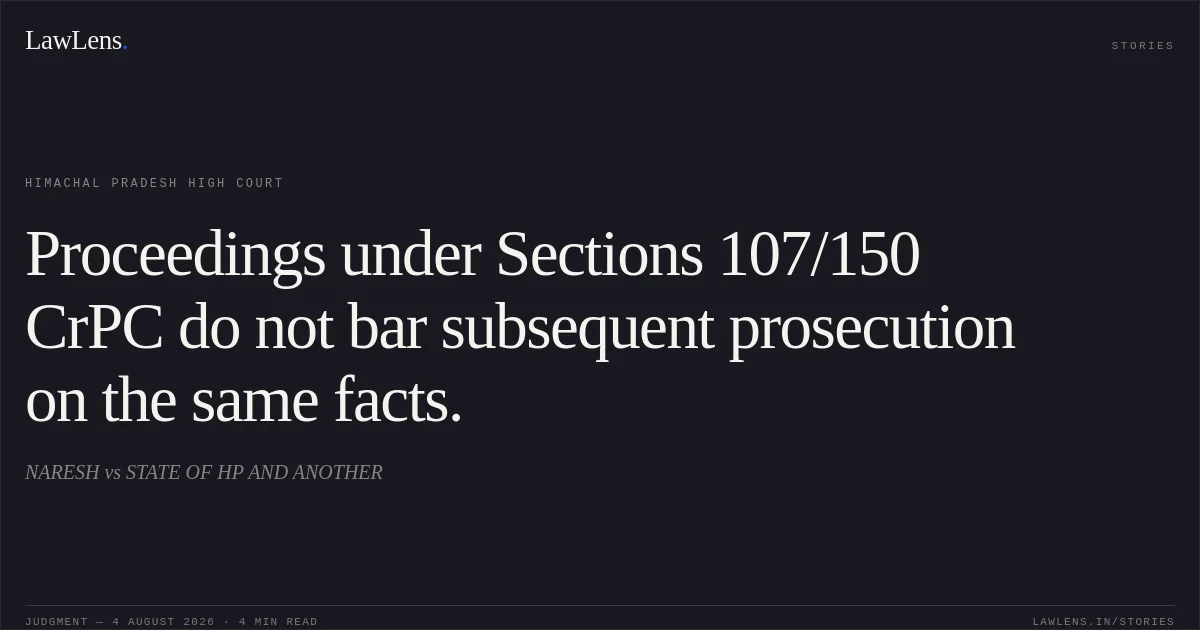
Source reference: paras. 9–12Proceedings under Sections 107/117 CrPC are preventive security proceedings and do not result in conviction or acquittal; consequently, the protection against double jeopardy under Section 300 CrPC does not bar a subsequent prosecution for substantive offences arising from the same facts, as held in Muthia Moopan v. State, Emperor v. Bhagwat Singh, AIR 1926 All 403, and Narinder Singh v. Shiv Kumar, 2023 SCC OnLine J&K 791
Source reference: paras. 13–16The Court also applied the principle that unexplained and inordinate delay disentitles a petitioner to discretionary inherent relief, relying on Ajit Kumar Gola v. State (NCT of Delhi), 2026 SCC OnLine Del 1398, and Gopal Chauhan v. Smt. Satya, 1979 Cri LJ 446
Source reference: paras. 17–18The pendency of civil litigation does not bar criminal proceedings where the allegations independently disclose criminal offences
Source reference: para. 19Reasoning
The Court rejected the double-jeopardy argument because the kalandra under Sections 107/150 CrPC constituted preventive security proceedings, not a criminal trial resulting in conviction or acquittal; therefore, Section 300 CrPC was inapplicable
Source reference: paras. 13–16The allegations that the petitioner assaulted the complainant and his son and restrained the complainant from proceeding to his home, if accepted at face value, prima facie satisfied Sections 323 and 341 IPC
Source reference: para. 19The existence of civil litigation concerning the property or construction dispute did not erase the independent criminal allegations.
Source reference: no citationThe Court further noted that the petitioner had waited over two years after the summoning order and had offered no explanation for the delay, making the discretionary exercise of inherent jurisdiction inappropriate
Source reference: paras. 17–18Since the complaint was neither legally barred nor devoid of prima facie criminality, and the matter was pending before the Trial Court, no ground for quashing under the Bhajan Lal principles was established
Source reference: paras. 19–20Holding
The High Court held that the private complaint was not barred by double jeopardy merely because preventive proceedings under Sections 107/150 CrPC had been initiated.
It further held that the complaint prima facie disclosed offences under Sections 323 and 341 IPC and that the pendency of civil litigation did not justify quashing.
Source reference: paras. 22–23In view of the unexplained delay and absence of grounds warranting interference under Section 482 CrPC, the petition was dismissed; the observations were confined to disposal of the quashing petition and were not to affect the merits of the trial
Source reference: paras. 22–23Acts & Sections Cited
11 provisions across 2 statutes referred to in this judgment. Each provision opens on LawLens.
Indian Penal Code, 18604
Code of Criminal Procedure, 19737
Original Court PDF
NARESHvsSTATE OF HP AND ANOTHER
Click to open original judgment
Original judgment, available to read, download and summarize on LawLens.in