Facts
Respondent No. 3, a 28-year-old widow with two children, alleged that she became acquainted with the applicant through Facebook in November 2020. She alleged that on 9 November 2020 the applicant forcibly established physical relations with her and thereafter promised to marry her and adopt her children.
Source reference: paras. 2(i)–(ii); pp. 1–3At the applicant’s instance, she shifted with her children from Jainti, Almora, to Haldwani in 2021 and resided near the applicant’s changing residences. She further alleged that the physical relationship continued and that, when she questioned the applicant in August 2022 about postponing the marriage, he assaulted and threatened her and her children.
Source reference: paras. 2(i)–(ii); pp. 1–3An FIR was registered on 6 December 2022 at Police Station Mukhani under Sections 376, 323 and 506 of the IPC. Following investigation, the police filed Charge-sheet No. 45/23 dated 3 February 2023. The Judicial Magistrate took cognizance and issued summons on 14 March 2023 in Criminal Case No. 1243 of 2023.
Source reference: para. 3; pp. 3–4The applicant invoked Section 482 Cr.P.C. seeking quashing of the charge-sheet and the cognizance/summoning order, contending that the relationship was consensual, continued for approximately two years, and that the FIR was lodged only after his alleged disinclination to marry respondent No. 3.
Source reference: paras. 4–11; pp. 3–6Issues
Whether the allegations in the FIR, the charge-sheet and the statement under Section 164 Cr.P.C. disclosed an offence under Sections 376, 323 and 506 IPC, or whether the proceedings constituted an abuse of the process of law warranting interference under Section 482 Cr.P.C.?
Source reference: paras. 17–19, 24–28; pp. 7–12Whether the alleged sexual relationship, maintained for approximately two years after the first incident and accompanied by the complainant’s relocation near the applicant, indicated consensual participation rather than consent vitiated by a false promise to marry?
Source reference: paras. 18–25; pp. 7–11Whether the alleged initial forcible sexual act, viewed in the context of the parties’ subsequent conduct, could justify continuation of the criminal proceedings?
Source reference: paras. 20, 27–28; pp. 8–12Law Applied
The Court exercised its inherent jurisdiction under Section 482 Cr.P.C. to prevent abuse of the process of court and secure the ends of justice.
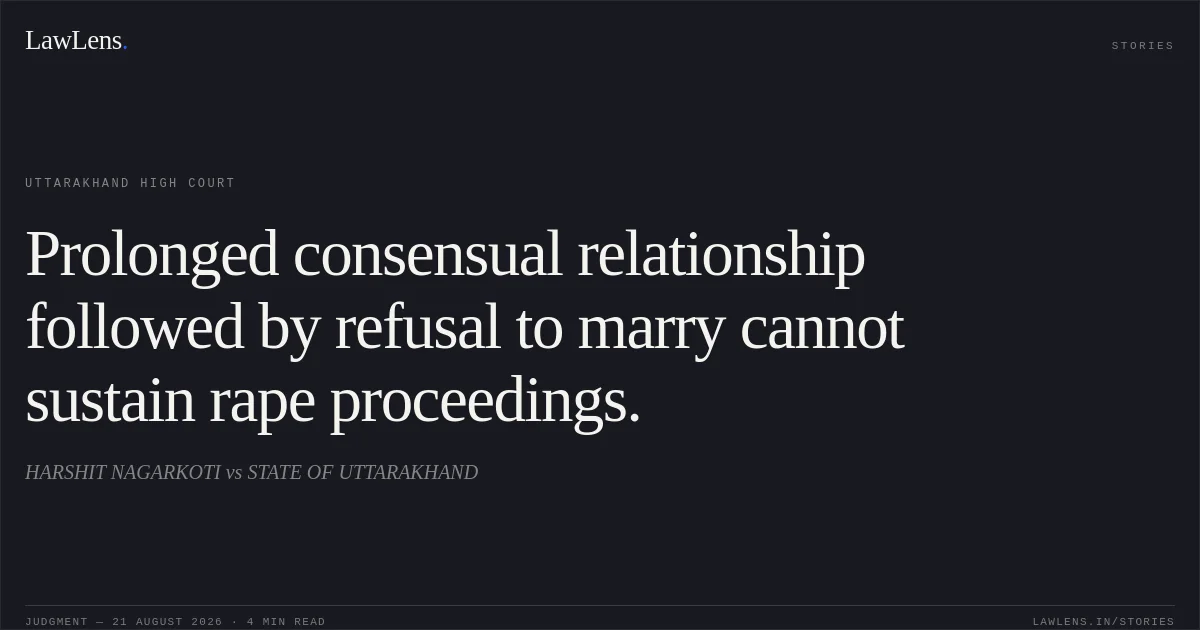
Source reference: paras. 28–29; pp. 11–12Relying on Sonu alias Subhash Kumar v. State of Uttar Pradesh, (2021) 18 SCC 517, and Pramod Suryabhan Pawar v. State of Maharashtra, (2019) 9 SCC 608, the Court applied the principle that a false promise to marry vitiates consent only where the promise was false from the inception and was made with no intention of being honoured; a subsequent failure or refusal to marry does not, by itself, establish rape.
Source reference: para. 10; pp. 4–6It also relied on Jothiragawan v. State, 2025 SCC OnLine SC 628, for the proposition that the parties’ repeated conduct and the complainant’s voluntary participation may demonstrate consensual relations and render continuation of proceedings abusive.
Source reference: para. 20; pp. 8–9Further, relying on Ravish Singh Rana v. State of Uttarakhand, 2025 SCC OnLine SC 1055, the Court held that a prolonged live-in or intimate relationship between consenting adults may give rise to an inference of voluntary participation, particularly where the relationship continued despite the alleged promise of marriage not being fulfilled.
Source reference: paras. 21–22; pp. 9–10Reasoning
The Court examined the FIR, charge-sheet and the complainant’s Section 164 Cr.P.C. statements. Although the first incident in November 2020 was alleged to have been forcible, the Court noted that the complainant did not immediately report it, later moved with her children to Haldwani at the applicant’s instance, lived near him from August 2021, and continued the relationship for nearly two years.
Source reference: paras. 17–19, 23; pp. 7–8, 11The FIR was lodged only in December 2022, after the applicant allegedly expressed unwillingness to marry her.
Source reference: paras. 19, 25; pp. 8, 11Applying the principles in Sonu, Jothiragawan and Ravish Singh Rana, the Court treated the parties’ prolonged association and subsequent conduct as indicative of a consensual relationship and considered the alleged refusal to marry to be a later breach rather than proof that the promise was fraudulent from the outset.
Source reference: paras. 20–27; pp. 8–12It consequently held that continuation of the prosecution would amount to an abuse of the process of law.
Source reference: para. 28; p. 12Holding
The Court allowed the application under Section 482 Cr.P.C., holding that the relationship between the applicant and respondent No. 3 appeared consensual and that the criminal proceedings were an abuse of the process of law.
Accordingly, it quashed Charge-sheet No. 45/23 dated 3 February 2023 arising from FIR No. 0298 of 2022, as well as the cognizance and summoning order dated 14 March 2023 in Criminal Case No. 1243 of 2023 under Sections 376, 323 and 506 IPC.
Source reference: para. 29; p. 12Pending applications, if any, were disposed of.
Source reference: para. 30; p. 12Acts & Sections Cited
5 provisions across 2 statutes referred to in this judgment. Each provision opens on LawLens.
Code of Criminal Procedure, 19732
Indian Penal Code, 18603
Original Court PDF
HARSHIT NAGARKOTIvsSTATE OF UTTARAKHAND
Click to open original judgment
Original judgment, available to read, download and summarize on LawLens.in