01Facts
The petitioner sought bail under Section 483 of the Bharatiya Nagarik Suraksha Sanhita, 2023 (“BNSS”) in connection with Tamando P.S. Case No. 218 of 2024, corresponding to C.T. Case No. 514 of 2024, pending before the JMFC-I, Bhubaneswar.
p. 1 · ¶ 1She was charge-sheeted for offences under Sections 420, 467, 468 and 471 of the Indian Penal Code (“IPC”).
p. 1 · ¶ 1The allegation was that the petitioner had obtained ₹1,20,00,000 from the informant by falsely representing that two houses/flats would be sold and by entering into an agreement for sale of another flat.
pp. 1–2 · ¶ 2The informant subsequently discovered that the petitioner had been arrested by the Economic Offences Wing in another cheating case and lodged the present FIR.
pp. 1–2 · ¶ 2The petitioner had remained in custody since 26 July 2024.
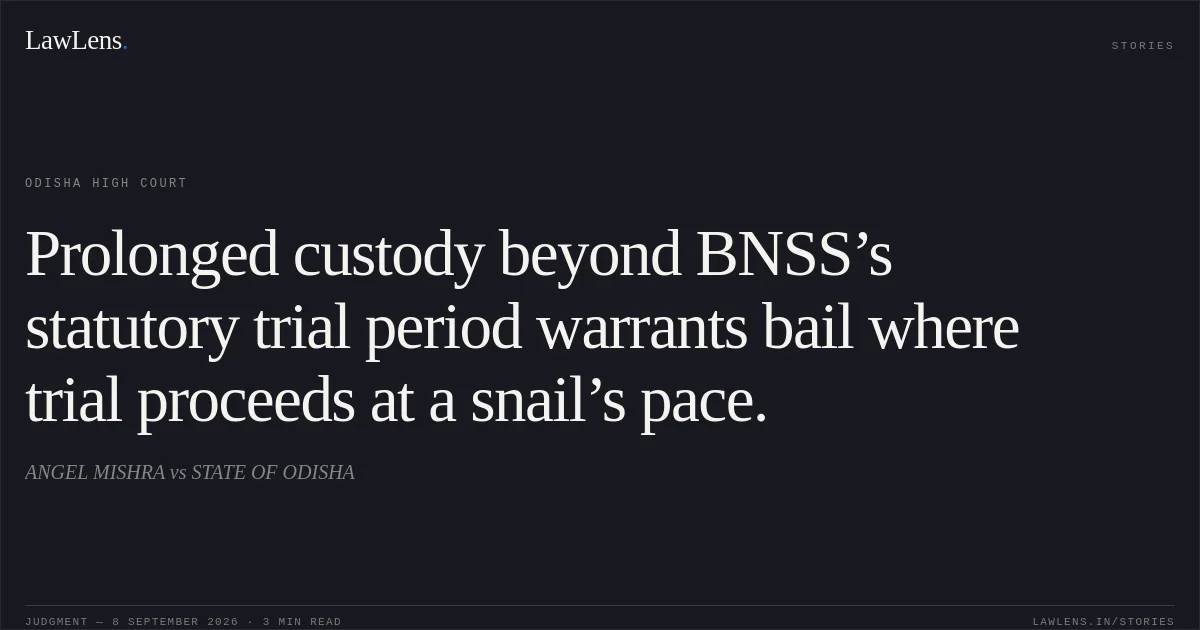
p. 2 · ¶ 4Charges were framed on 5 May 2025, and the first date for evidence was fixed for 14 May 2025; however, the trial remained incomplete despite the expiry of the statutory period referred to under Section 480(6) of the BNSS.
p. 2 · ¶ 4The case was pending before a Magistrate competent to impose a maximum sentence of three years.
pp. 2–3 · ¶ 402Issues
i.1. Whether the petitioner was entitled to bail in view of her prolonged incarceration and the delay in completing the Magistrate-triable trial beyond the period contemplated under Section 480(6) of the BNSS?
pp. 2–3 · ¶ 4–5ii.2. Whether the petitioner’s status as a woman and the first proviso to Section 480 of the BNSS supported the grant of bail?
p. 3 · ¶ 5iii.3. Whether continued incarceration, when the petitioner had already undergone more than two years in custody in a case carrying a maximum punishment of three years, would be inconsistent with Article 21 of the Constitution?
p. 3 · ¶ 503Law Applied
The Court exercised its bail jurisdiction under Section 483 of the BNSS.
p. 1 · ¶ 1It considered Section 480(6) of the BNSS, which provides the statutory framework concerning completion of trial within the prescribed period in Magistrate-triable cases and was treated as appearing more mandatory than discretionary, though not creating an absolute and unconditional right to bail.
p. 3 · ¶ 5The Court also relied on the first proviso to Section 480 of the BNSS, which permits special consideration for a woman accused.
p. 3 · ¶ 5The Court applied the constitutional guarantee of personal liberty and fair, expeditious procedure under Article 21, holding that indefinite incarceration merely on the expectation that the trial may conclude at some future date is impermissible.
p. 3 · ¶ 5Provisions in the judgment · 6 · Linked ones open on LawLens
Bharatiya Nagarik Suraksha Sanhita, 2023 Section 483Section 480
Indian Penal Code, 1860 Section 420Section 467Section 468Section 471
04Reasoning
The Court found that the petitioner had been in custody for more than two years, whereas the Magistrate before whom the trial was pending could impose a maximum sentence of only three years.
pp. 2–3 · ¶ 4–5Although the trial had commenced with framing of charge, it had not concluded even after the statutory period contemplated by Section 480(6) of the BNSS, demonstrating substantial delay.
pp. 2–3 · ¶ 4The Court treated the provision as strongly favouring timely completion of the trial, while recognising that it did not confer an automatic right to release.
p. 3 · ¶ 5Balancing the seriousness of the allegations against the prolonged pre-trial detention, the slow progress of the trial, the relatively limited sentencing jurisdiction of the trial court, the petitioner’s status as a woman, and the Article 21 concern against indefinite incarceration, the Court held that the petitioner had made out a case for bail.
p. 3 · ¶ 505Holding
The bail application was allowed, without any expression of opinion on the merits of the case.
p. 3 · ¶ 5The petitioner was directed to be released on bail upon furnishing a property surety of ₹5,00,000, free from encumbrance, in addition to a bail bond of ₹1,00,000 with two solvent sureties for the like amount, to the satisfaction of the trial court.
pp. 3–4 · ¶ 6She was required to cooperate with the further trial and was prohibited from leaving India without prior permission of the trial court.
p. 4 · ¶ 6She was also directed to surrender her passport, if not already surrendered or seized, or to file an affidavit stating that she did not possess one.
p. 4 · ¶ 6The BLAPL was accordingly disposed of, and the order was directed to be communicated to the concerned court and jail authorities.
p. 4 · ¶ 7Original Court PDF
ANGEL MISHRAvsSTATE OF ODISHA
Click to open original judgment
Original judgment, available to read, download and summarize on LawLens.in