01Facts
The petitioner married the informant on 07.11.2005 according to Santhal customary rites. The informant alleged that, after the marriage, the petitioner and his family demanded a motorcycle, subjected her to abuse, assault, deprivation of food, and ultimately ousted her from the matrimonial home. A village settlement allegedly failed, and a further incident occurred on 30.03.2007. On the informant’s written report, Potka P.S. Case No. 19 of 2007 was registered under Sections 498A, 323 and 34 of the IPC and Sections 3/4 of the Dowry Prohibition Act.
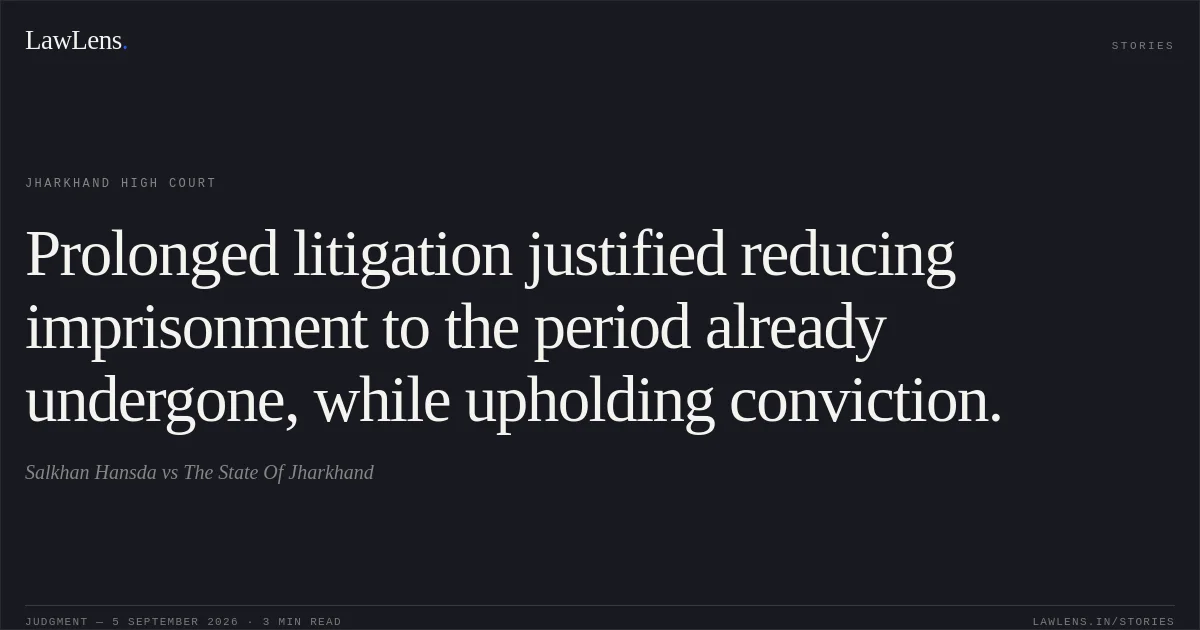
pp. 2–3 · ¶ 3–4The trial court acquitted four accused but convicted the petitioner and two co-accused under Section 498A IPC and Section 4 of the Dowry Prohibition Act, sentencing them to imprisonment and fines. The appellate court acquitted the two co-convicts but affirmed the petitioner’s conviction and sentence. In revision, the petitioner did not challenge the conviction on merits and sought reduction of sentence to the period already undergone, relying on the passage of nearly two decades and his period of custody of approximately three months.
pp. 3–5 · ¶ 5–7, 902Issues
i.Whether the concurrent findings convicting the petitioner under Section 498A IPC and Section 4 of the Dowry Prohibition Act required interference in revisional jurisdiction.
p. 5 · ¶ 11ii.Whether, considering the petitioner’s custody of approximately three months, the passage of nearly two decades since the occurrence, and the absence of any pending dispute or subsequent case between the parties, the substantive sentence should be reduced to the period already undergone.
pp. 5–6 · ¶ 12–1503Law Applied
The Court applied Section 498A of the Indian Penal Code, which penalises cruelty by a husband or his relatives towards a married woman, and Section 4 of the Dowry Prohibition Act, which penalises demanding dowry.
p. 5 · ¶ 11In revision, concurrent findings of fact will not ordinarily be disturbed where the courts below have properly appreciated the evidence and the findings are legal, correct, and supported by the record. The Court also applied the sentencing principle that, after affirming guilt, the sentence may be suitably modified in light of the period already undergone, the substantial lapse of time, the prolonged agony of criminal proceedings, and the overall circumstances of the case.
pp. 5–6 · ¶ 11–15Provisions in the judgment · 4 · Linked ones open on LawLens
Indian Penal Code, 1860 Section 323Section 34
04Reasoning
The High Court found that both the trial court and the appellate court had recorded concurrent findings of guilt under Section 498A IPC and Section 4 of the Dowry Prohibition Act, and that those findings were “correct, legal and proper”; accordingly, no interference with the conviction was warranted in revision.
p. 5 · ¶ 11However, while considering sentence, the Court noted that the petitioner had already undergone approximately three months’ imprisonment, the alleged occurrence dated back to 2006, nearly two decades had elapsed, and the parties had settled into their respective lives with no other case pending between them. On these considerations, the Court held that further incarceration was unnecessary and that the period already undergone constituted sufficient punishment.
pp. 5–6 · ¶ 12–1405Holding
The revision was dismissed on merits insofar as the conviction was concerned. The conviction under Section 498A IPC and Section 4 of the Dowry Prohibition Act was upheld, but the sentence was modified to imprisonment for the period already undergone.
p. 6 · ¶ 15–16Since the petitioner was on bail, he was discharged from the liability of his bail bond and the sureties were also discharged.
pp. 6–7 · ¶ 17Original Court PDF
Salkhan HansdavsThe State Of Jharkhand
Click to open original judgment
Original judgment, available to read, download and summarize on LawLens.in