Facts
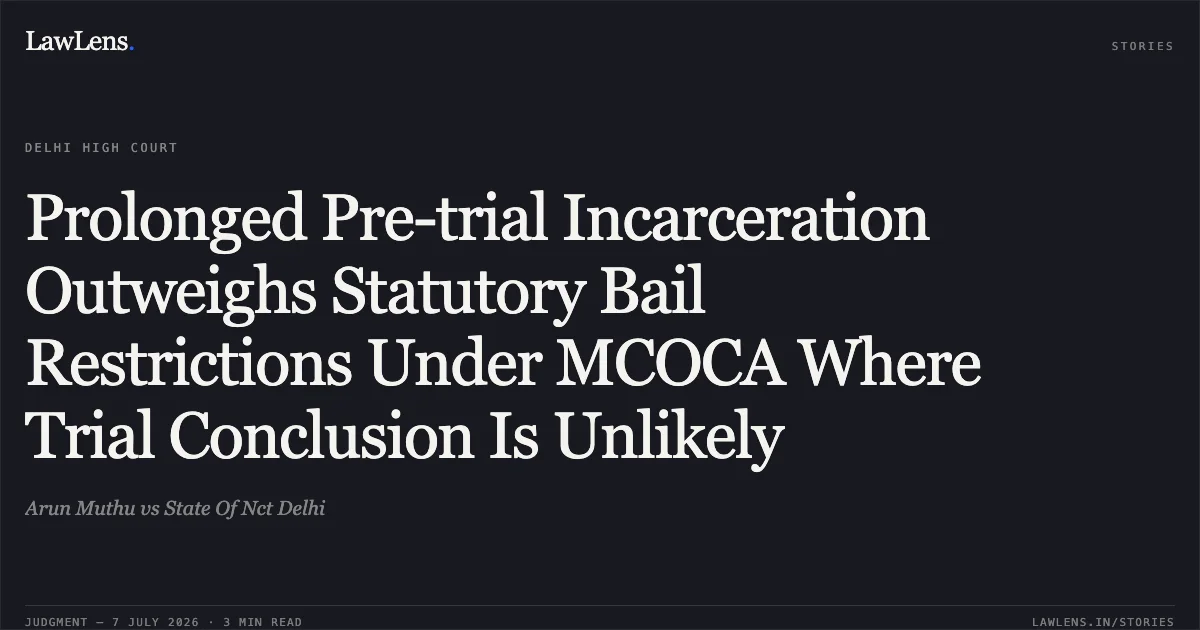
The petitioner, Arun Muthu, sought regular bail after being arrested on September 5, 2021, in connection with FIR No. 208/2021
Source reference: p. 1-4The prosecution alleged that the petitioner was part of an organized crime syndicate (OCS) headed by Sukesh Chandra Shekhar, which extorted approximately Rs. 217 crores from a complainant by impersonating government officials
Source reference: p. 3The specific role attributed to Muthu involved facilitating financial transactions, providing bank entries of approximately Rs. 3 crores, helping the accused purchase luxury cars and property, and managing the parking of cars to evade seizure by the ED
Source reference: p. 4-5Sections 3 and 4 of the Maharashtra Control of Organised Crime Act (MCOCA) were invoked against him
Source reference: p. 2Charges were framed on June 3, 2026
Source reference: p. 7By the time of the judgment, the petitioner had spent nearly 4 years and 10 months in custody
Source reference: p. 7Issues
1. Whether the statutory restrictions on bail under Section 21(4) of MCOCA can be overridden by the accused's right to a speedy trial under Article 21 of the Constitution in cases of prolonged incarceration
Source reference: p. 10-112. Whether the petitioner is entitled to bail based on his specific role in the OCS (financial management vs. primary extortion) and the likelihood of a prolonged trial
Source reference: p. 14-15Law Applied
The court primarily applied Section 21(4) of the MCOCA, which restricts bail unless the court is satisfied there are reasonable grounds that the accused is not guilty
Source reference: p. 10It relied on the precedent set in Union of India v. K.A. Najeeb, which established that statutory bars on bail do not preclude constitutional claims under Article 21 regarding prolonged pre-trial incarceration
Source reference: p. 11It further applied principles from Ranjitsingh Brahmajeetsing Sharma v. State of Maharashtra, noting that statutory restrictions should not be "pushed too far"
Source reference: p. 7the recent guidance in Gulfisha Fatima v. State (Govt. of NCT of Delhi) regarding the balancing of statutory limitations with the duration of custody and trial progress
Source reference: p. 11-12Reasoning
The Court balanced the stringent requirements of MCOCA Section 21(4) against the petitioner's Article 21 rights. It noted that the petitioner has been in custody for nearly five years, nearly reaching the minimum sentence for MCOCA offenses
Source reference: p. 14-15The Court observed that with 24 accused persons and 403 witnesses, the trial was unlikely to conclude expeditiously
Source reference: p. 15Analyzing the material on record and statements under Section 18 MCOCA, the Court found the petitioner’s alleged role was limited to "financial planning and handling" of funds and and did not involve the foundational offense of extortion
Source reference: p. 8, 14Following its own logic in Deepak Ramnani, the Court held that even if the prosecution case is taken at its highest, the further incarceration of the petitioner as an undertrial was "inappropriate" given the length of custody and the complexity of the trial
Source reference: p. 15Holding
While statutory restrictions are significant, they must be viewed through the lens of Article 21; where a trial is unlikely to end soon and the accused has undergone significant incarceration, bail may be granted
The Court allowed the bail application, granting regular bail to the petitioner. The petitioner was released on a personal bond of Rs. 2,50,000/- with two sureties, subject to conditions including surrendering his passport and not leaving the country without permission
Source reference: p. 15-16Acts & Sections Cited
5 provisions across 4 statutes referred to in this judgment. Each provision opens on LawLens.
Code of Criminal Procedure, 19731
Bharatiya Nagarik Suraksha Sanhita, 20231
Maharashtra Control of Organised Crime Act, 19992
Narcotic Drugs and Psychotropic Substances Act, 19851
Original Court PDF
Arun MuthuvsState Of Nct Delhi
Click to open original judgment
Original judgment, available to read, download and summarize on LawLens.in