01Facts
The petitioner had been in custody since 4 April 2025 in connection with ECIR No. KLZO-I/06/2025 registered by the Directorate of Enforcement (“ED”) under the Prevention of Money Laundering Act, 2002 (“PMLA”), arising from a cyber-fraud predicate offence involving approximately ₹47 lakh.
¶ 1–2He was not named in the initial FIR dated 17 June 2024 but was arrested following a search of his residence on 23 February 2025 pursuant to a co-accused’s statement.
¶ 1He was subsequently named in the predicate-offence charge-sheet and was granted bail in the scheduled offences.
¶ 1The petitioner contended that the seized articles were personal belongings and that the recovered cash had been withdrawn from his bank account for routine and medical expenses.
¶ 1The ED alleged that the petitioner was an active participant and principal coordinator in the laundering network, relying, inter alia, on independent evidence and statements recorded under Section 50 of the PMLA.
¶ 6The ED’s prosecution complaint identified Chirag Kapoor as the principal accused and alleged that the petitioner was a beneficiary.
¶ 2The petitioner had earlier challenged the legality of his arrest under Section 19 of the PMLA in WPA 8323 of 2025, but the challenge was dismissed after the Court found compliance with Section 19, without examining the merits of the prosecution case.
¶ 8At the time of the bail hearing, the case was at the pre-cognizance stage, involved voluminous documentary evidence and several witnesses, and was unlikely to conclude in the near future.
¶ 3, 9, 1102Issues
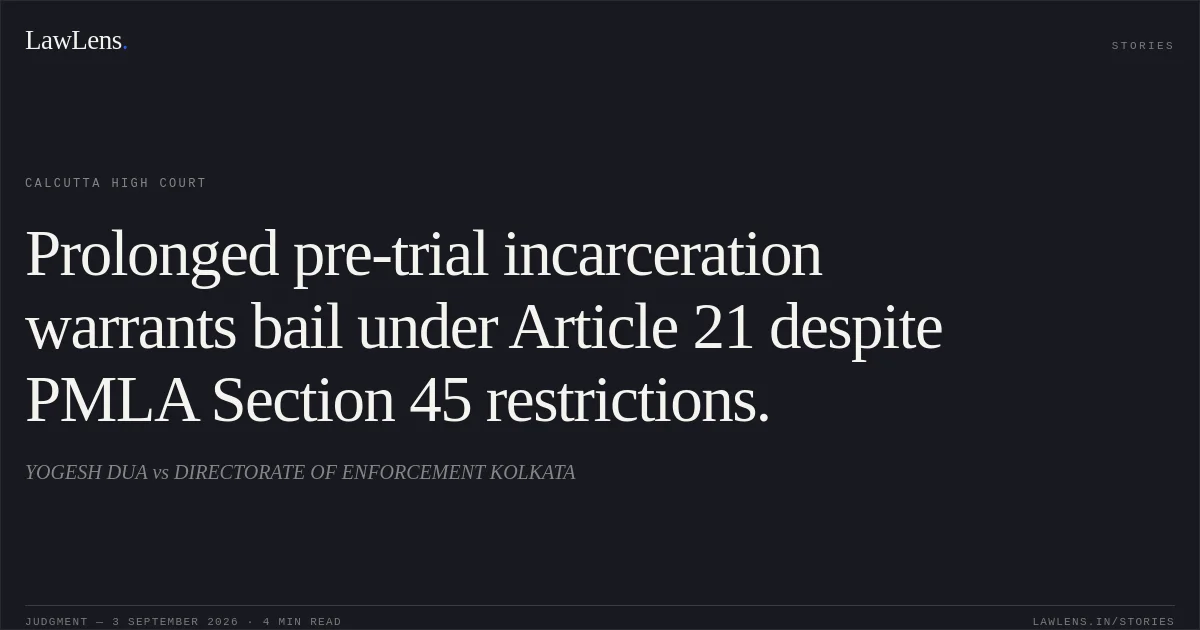
i.1. Whether the petitioner should be granted bail despite the rigours of Section 45 of the PMLA, in view of his prolonged incarceration and the absence of reasonable prospects of an early trial.
¶ 9–11ii.2. Whether continued pre-trial detention would violate the petitioner’s right to personal liberty under Article 21 of the Constitution.
¶ 10iii.3. Whether bail could be granted without adjudicating the merits of the prosecution case, subject to stringent conditions.
¶ 8, 11, 15–1603Law Applied
The Court applied Article 21 of the Constitution, holding that prolonged incarceration of an undertrial, particularly where the trial has not commenced or is unlikely to conclude within a reasonable time, cannot become punitive detention.
¶ 10It considered Section 45 of the PMLA, which imposes stringent conditions for bail, but held that its rigours may be suitably relaxed by a constitutional court where continued detention infringes the accused’s fundamental right to liberty.
¶ 10The Court relied on Arvind Dham v. Enforcement Directorate, 2026 SCC OnLine SC 30, concerning prolonged incarceration without commencement or reasonable progress of trial; Ramkripal Meena v. Enforcement Directorate, (2024) 12 SCC 682; Manish Sisodia v. Enforcement Directorate, (2024) 12 SCC 660; and V. Senthil Balaji v. Deputy Director, Directorate of Enforcement, 2024 SCC OnLine SC 2626, which recognise that constitutional courts may protect Article 21 liberty notwithstanding restrictive bail provisions.
¶ 10The Court also noted that compliance with Section 19 of the PMLA had already been upheld in the petitioner’s earlier writ proceedings, although that decision did not determine bail on merits.
¶ 8Provisions in the judgment · 3 · Linked ones open on LawLens
Prevention of Money-Laundering Act, 2002 Section 50Section 19Section 45
04Reasoning
The Court accepted that the petitioner had remained in custody for more than a year and had already secured bail in the scheduled offences.
¶ 9Although the ED alleged active involvement and relied on statements under Section 50 of the PMLA, the Court did not undertake a merits determination, particularly because the earlier arrest challenge had expressly left the merits open.
¶ 8The prosecution case was substantially documentary, the relevant documents were in the ED’s custody, and the Court therefore found limited scope for the petitioner to tamper with the evidence.
¶ 11Since the matter remained at the pre-cognizance stage and involved voluminous documents and numerous witnesses, an early conclusion of trial was considered unlikely.
¶ 3, 11Balancing the statutory restrictions under Section 45 of the PMLA against the petitioner’s prolonged incarceration and Article 21 rights, the Court concluded that conditional liberty should be granted without expressing any opinion on the merits.
¶ 1105Holding
The Court allowed the bail application and directed that the petitioner be released on a bond of ₹10,00,000 with adequate sureties of like amount, including two local sureties, to the satisfaction of the trial court.
¶ 13The bail was subject to conditions including surrender of the passport, restriction on leaving the trial court’s territorial jurisdiction without permission, disclosure of residential address, appearance on every hearing date, non-tampering with evidence, non-intimidation or contact with witnesses, abstention from criminal activity, and furnishing and maintaining his mobile number with the court and investigating agency.
¶ 13The trial court was authorised to cancel bail upon violation of the conditions.
¶ 14The Court clarified that its observations were limited to the bail application and would not affect the merits of the case or the trial court’s independent assessment.
¶ 15–16Original Court PDF
YOGESH DUAvsDIRECTORATE OF ENFORCEMENT KOLKATA
Click to open original judgment
Original judgment, available to read, download and summarize on LawLens.in