Facts
The parties were married in 1984. The appellant-wife alleged that she was subjected to physical and mental harassment by the respondent-husband and was consequently compelled to live separately. She contended that the parties later entered into a settlement and resumed cohabitation. The respondent-husband subsequently instituted a petition under Section 13 of the Hindu Marriage Act, 1955, seeking dissolution of marriage.
Source reference: paras. 6–8The Additional District Judge, Pratappur, allowed the petition and granted a decree of divorce on 1 March 2024 in Civil Suit No. 6A/2021. The wife challenged that decree under Section 28 of the Hindu Marriage Act.
Source reference: paras. 6–8During the appeal, the wife withdrew her application under Section 24 of the Hindu Marriage Act, with liberty to file an appropriate application for enhancement of maintenance before the concerned Family Court; the husband raised no objection. The application was dismissed as withdrawn with liberty to pursue available remedies.
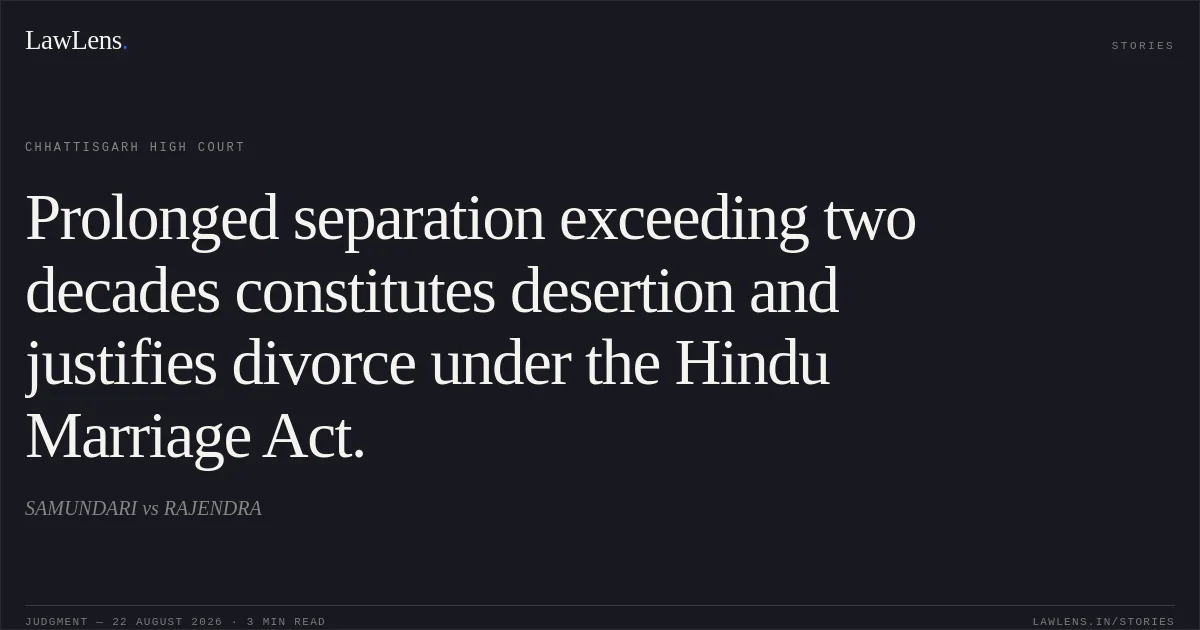
Source reference: paras. 1–4The High Court noted that the wife had admitted in her deposition that she began living separately approximately two years after the marriage. Although she claimed that the parties had resumed cohabitation after a maintenance proceeding, the maintenance application was disposed of by order dated 28 July 2005. The Court further found that the parties had again separated and that the wife had lived apart from the husband for more than two decades.
Source reference: para. 9Issues
Whether the wife’s withdrawal of her application under Section 24 of the Hindu Marriage Act should be permitted with liberty to seek enhancement of maintenance before the competent Family Court.
Source reference: paras. 1–4Whether the evidence established that the wife had deserted the husband so as to justify the decree of divorce granted under Section 13 of the Hindu Marriage Act.
Source reference: paras. 6–10Whether the appeal against the decree of divorce disclosed sufficient grounds for admission and further hearing.
Source reference: paras. 5–10Law Applied
The Court applied Section 13 of the Hindu Marriage Act, 1955, under which desertion constitutes a statutory ground for divorce when one spouse has abandoned the other without reasonable cause and against the wishes of the other spouse for the legally prescribed period.
Source reference: paras. 1–10It applied Section 24 of the Hindu Marriage Act concerning interim maintenance and litigation expenses, permitting the appellant to withdraw the pending application with liberty to seek enhancement before the competent Family Court. The appeal was brought under Section 28 of the Hindu Marriage Act, which provides for appeals from decrees and orders passed under the Act.
Source reference: paras. 1–10Reasoning
The Court accepted that the wife had initially alleged harassment and claimed that the parties had resumed cohabitation pursuant to a settlement. However, her own deposition established that she had lived separately for substantial periods after the marriage.
Source reference: para. 9The maintenance proceedings culminating in the order dated 28 July 2005 indicated that the parties had again ceased cohabiting even after the alleged settlement. The Court found that the wife had remained separate from the husband for more than two decades. This prolonged and continued separation, viewed together with the documentary and oral evidence, was held to constitute desertion and to provide a valid basis for divorce under Section 13. The wife’s contention that desertion had not been proved was therefore rejected, and the appeal was found insufficient to warrant admission.
Source reference: para. 9As to maintenance, since interim maintenance had already been granted, the Court permitted withdrawal of the Section 24 application while preserving the wife’s liberty to seek enhancement before the appropriate Family Court.
Source reference: paras. 1–4Holding
The High Court dismissed I.A. No. 3/2024 as withdrawn, granting the appellant liberty to pursue an appropriate application for enhancement of maintenance before the concerned Family Court.
On the merits, the Court held that the wife’s separation from the husband for more than two decades constituted desertion and justified the decree of divorce. Finding no ground to admit the appeal, the Court dismissed FA(MAT) No. 199 of 2024 at the motion stage and directed that any pending interlocutory applications stand disposed of.
Source reference: paras. 9–11Acts & Sections Cited
3 provisions across 1 statute referred to in this judgment. Each provision opens on LawLens.
Hindu Marriage Act, 19553
Original Court PDF
SAMUNDARIvsRAJENDRA
Click to open original judgment
Original judgment, available to read, download and summarize on LawLens.in