Facts
The prosecution alleged that the informant, Janardhan Singh, and other employees of an industrial establishment received repeated telephone calls demanding ₹5,00,000 as extortion money.
Source reference: para. 3, pp. 1–2The callers threatened to kill the employees and attack the factory if the demand was not met.
Source reference: para. 3, pp. 1–2On the basis of the informant’s written report, Sadar (M) P.S. Case No. 430 of 2013 was registered under Sections 386 and 387 of the Indian Penal Code against unknown persons.
Source reference: para. 4, p. 2After investigation, a charge-sheet was filed against the petitioners, and charges were framed under Sections 386/34 and 387/34 IPC.
Source reference: para. 4, p. 2The prosecution examined seven witnesses and produced documentary evidence; the defence adduced no evidence.
Source reference: paras. 5–7, p. 2The learned Chief Judicial Magistrate convicted the petitioners under Section 387 IPC and sentenced each of them to two years’ rigorous imprisonment and a fine of ₹2,000, with a default stipulation.
Source reference: para. 2, p. 1Their criminal appeal was dismissed by the Additional Sessions Judge-XII, Hazaribag, on 29 March 2016.
Source reference: para. 2, p. 1In revision, the petitioners did not challenge the finding of guilt and sought reduction of sentence on the ground that they had already undergone approximately one year, eleven months and some days in custody, while the occurrence dated back to 2013.
Source reference: para. 8, p. 2Issues
Whether the concurrent findings of conviction of the petitioners for the offence under Section 387 IPC warranted interference in revision?
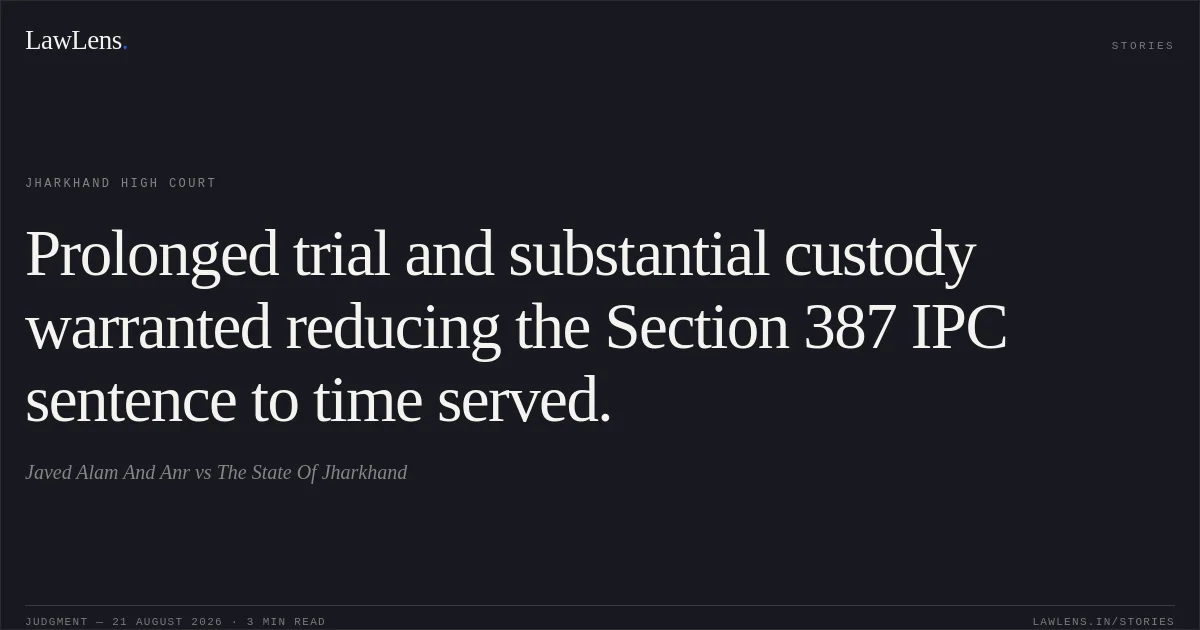
Source reference: paras. 9–11, pp. 2–3Whether, having regard to the period already undergone, the prolonged pendency of the proceedings and the circumstances of the case, the sentence of two years’ rigorous imprisonment should be reduced to the period already undergone?
Source reference: paras. 8–9, 12–14, pp. 2–4Law Applied
The Court applied Section 387 of the Indian Penal Code, which penalises putting or attempting to put a person in fear of death or grievous hurt in order to commit extortion; the provision was the basis of the petitioners’ conviction.
Source reference: paras. 2, 4, 11, p. 1–3The Court also exercised its revisional jurisdiction to examine the correctness of the concurrent findings and the proportionality of the sentence.
Source reference: paras. 10–14, pp. 3–4Although no precedent was cited, the Court applied the sentencing principle that the punishment may be modified in light of the period of incarceration already undergone, the length of the proceedings, and the overall circumstances of the case.
Source reference: paras. 10–14, pp. 3–4Reasoning
The High Court found that the trial court and appellate court had concurrently recorded findings establishing the petitioners’ guilt under Section 387 IPC.
Source reference: paras. 8, 10–11, pp. 2–3Since the petitioners did not challenge the conviction on merits and the record disclosed no reason to disturb the concurrent findings, the Court declined to interfere with the conviction.
Source reference: paras. 8, 10–11, pp. 2–3On sentence, however, the Court considered that the occurrence was from 2013, the petitioners had faced the proceedings for more than twelve years, and they had already undergone approximately one year, eleven months and some days of the two-year sentence.
Source reference: para. 12, p. 3In view of these circumstances, and the State’s absence of serious objection to reduction of sentence, the Court exercised its discretion to modify the sentence to the period already undergone.
Source reference: paras. 9, 12–14, pp. 2–4Holding
The revision petition was dismissed on merits insofar as the conviction under Section 387 IPC was concerned.
However, the sentence of two years’ rigorous imprisonment imposed on each petitioner was reduced to the period already undergone, while the fine and default stipulation remained subject to the order of the trial court.
Source reference: paras. 12–14, p. 4As the petitioners were on bail, they were discharged from the liabilities of their bail bonds and their sureties were also discharged.
Source reference: para. 15, p. 4Pending interlocutory applications, if any, were disposed of, and the records were directed to be returned to the concerned court.
Source reference: paras. 16–17, p. 4Acts & Sections Cited
3 provisions across 1 statute referred to in this judgment. Each provision opens on LawLens.
Indian Penal Code, 18603
Original Court PDF
Javed Alam And AnrvsThe State Of Jharkhand
Click to open original judgment
Original judgment, available to read, download and summarize on LawLens.in