Facts
Dr. Dhurjati Prasad Das, predecessor of the petitioners, joined the Indian Council of Agricultural Research (“ICAR”) as a scientist on 28 September 1976. He availed study leave from 28 September 1981 to 27 September 1983, but subsequent requests for extension and extraordinary leave were refused. He thereafter remained absent for various periods, including from 1 January 1986 to 22 June 1986 and from 21 November 1987 to 15 November 1990. The latter period was treated as dies non following disciplinary proceedings
Source reference: para. 3Dr. Das challenged the treatment of his absence as dies non before the Central Administrative Tribunal (“CAT”) in OA No. 1197 of 1996. The application was dismissed on 30 November 2004, and the dismissal was upheld by the High Court in WPCT No. 189 of 2006. Although the High Court initially observed that Dr. Das had abandoned his service, that observation was subsequently deleted in review
Source reference: para. 5; para. 19Meanwhile, ICAR issued an office order dated 23 April 2003 treating Dr. Das as having deemed to have resigned from service with effect from 29 December 1991 on account of his continuous absence. His representation against that order was rejected. Dr. Das later sought pensionary benefits, but ICAR rejected the claim by a reasoned order dated 18 January 2018
Source reference: paras. 4, 6–7After Dr. Das’s death on 17 January 2022, the present petitioners challenged the office order dated 23 April 2003 and the pension-rejection order dated 18 January 2018 before the CAT in OA No. 738 of 2023. The CAT dismissed the application on 4 September 2025. The petitioners challenged that decision before the High Court
Source reference: para. 7Issues
Whether ICAR could treat Dr. Das as having deemed to have resigned in 2003 by relying on the five-year limitation on continuous leave under Rule 12(2) of the CCS (Leave) Rules, 1972, notwithstanding that the express deemed-resignation provision was introduced or substituted subsequently.
Source reference: paras. 8, 12, 18, 23Whether the office order dated 23 April 2003 was issued without jurisdiction by an authority other than the President of ICAR, who was alleged to be the appointing and disciplinary authority.
Source reference: paras. 8–9, 23Whether Dr. Das was denied natural justice because he was not given a further opportunity of hearing before the deemed-resignation and pensionary consequences were imposed.
Source reference: paras. 10, 21, 24Whether the petitioners were entitled to pensionary or family-pension benefits despite Dr. Das’s prolonged unauthorised absence, the order treating the period as dies non, and the deemed-resignation order.
Source reference: paras. 10–11, 19–25Whether the challenge was barred by res judicata or otherwise stood concluded by the earlier proceedings concerning the treatment of Dr. Das’s absence as dies non.
Source reference: paras. 13–15, 18–24Law Applied
The Court applied Rule 30 of the ICAR Rules and By-laws, under which Central Government service and financial rules apply to ICAR personnel.
Source reference: para. 12; para. 23Rule 12(2) of the CCS (Leave) Rules, 1972 prohibited the grant of leave of any kind for a continuous period exceeding five years; the Court held that the five-year limitation existed even before the later substitution of the express deemed-resignation language.
Source reference: paras. 18, 21, 23The Court also considered Rule 26 of the CCS (Pension) Rules, 1972 concerning the pensionary consequences of resignation, and Rule 25(2) of the CCS (Leave) Rules concerning disciplinary action for absence after expiry of leave.
Source reference: paras. 8, 18Rule 7 of the All India Services (Leave) Rules, 1955 was treated as pari materia with Rule 12(2).
Source reference: para. 23The principles in D.K. Yadav v. JMA Industries, (1993) 3 SCC 259, require an opportunity of hearing before termination carrying civil consequences, while Krushnakant B. Parmar v. Union of India, (2012) 3 SCC 178, requires consideration of whether absence was wilful or caused by compelling circumstances.
Source reference: paras. 10, 24The Court distinguished Puja Ferro Alloys Pvt. Ltd. v. State of Goa, 2025 INSC 217, on res judicata, and Ashok Kumar Dabas v. Delhi Transport Corporation, 2025 INSC 1404, because that case concerned actual resignation rather than deemed resignation.
Source reference: paras. 13–16, 24Reasoning
The Court held that although the express deemed-resignation provision had been introduced or substituted after the 2003 office order, the underlying statutory restriction against continuous leave exceeding five years was already in force.
Source reference: no citationDr. Das’s absence exceeded that period, and the
Source reference: no citationThe principles in D.K. Yadav v. JMA Industries, (1993) 3 SCC 259, require an opportunity of hearing before termination carrying civil consequences, while Krushnakant B. Parmar v. Union of India, (2012) 3 SCC 178, requires consideration of whether absence was wilful or caused by compelling circumstances.
Source reference: paras. 10, 24Holding
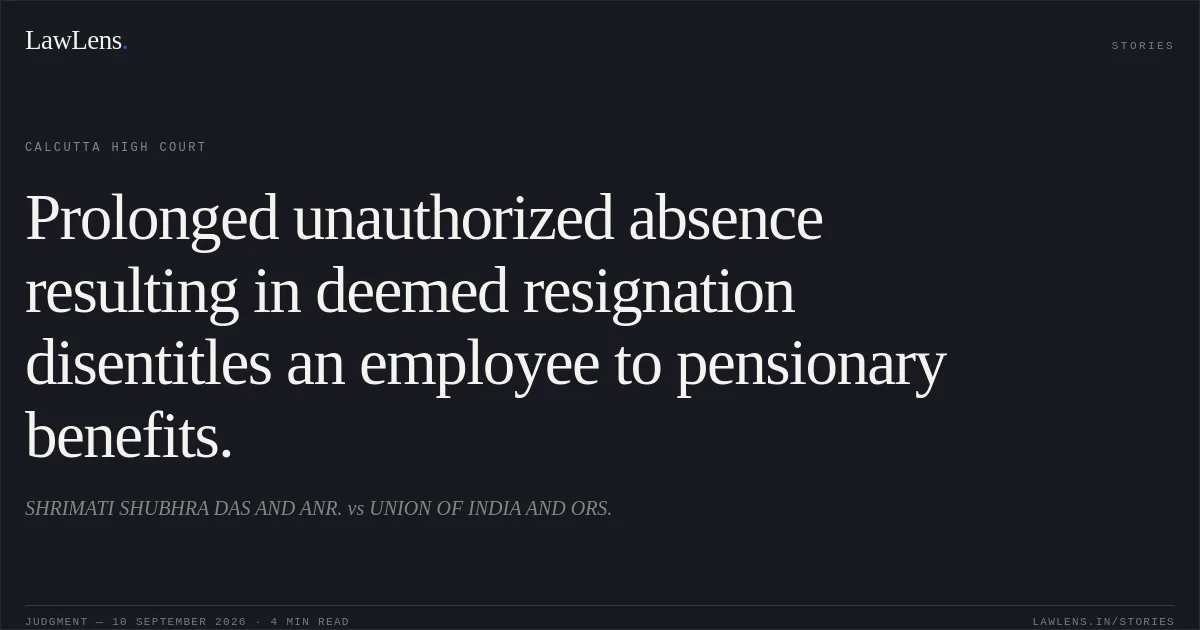
Prolonged unauthorized absence resulting in deemed resignation disentitles an employee to pensionary benefits.
The CAT dismissed the application on 4 September 2025.
Source reference: para. 7Original Court PDF
SHRIMATI SHUBHRA DAS AND ANR.vsUNION OF INDIA AND ORS.
Click to open original judgment
Original judgment, available to read, download and summarize on LawLens.in