Facts
The petitioners claimed continuous physical possession of 23 kanals and 07 marlas of land in Village Najla Chak for over three decades, leading to the attestation of Sehat Kasht Mutation No. 40 in 2007
Source reference: para. 02In 2014, a third party, Bansi Lal, challenged this mutation before the Collector, alleging the land was State-owned "Khad" (grazing land) and included temple property
Source reference: para. 04The Collector set aside the mutation on 13.06.2015 and ordered eviction
Source reference: para. 04Concurrent to these proceedings, the petitioners obtained a civil court decree in 2014 restraining private defendants from forcibly dispossessing them
Source reference: para. 03The petitioners filed a revision petition before the Divisional Commissioner, Jammu, which was dismissed on 06.03.2026
Source reference: para. 05The petitioners subsequently moved the High Court to quash the Divisional Commissioner’s order
Source reference: para. 01Issues
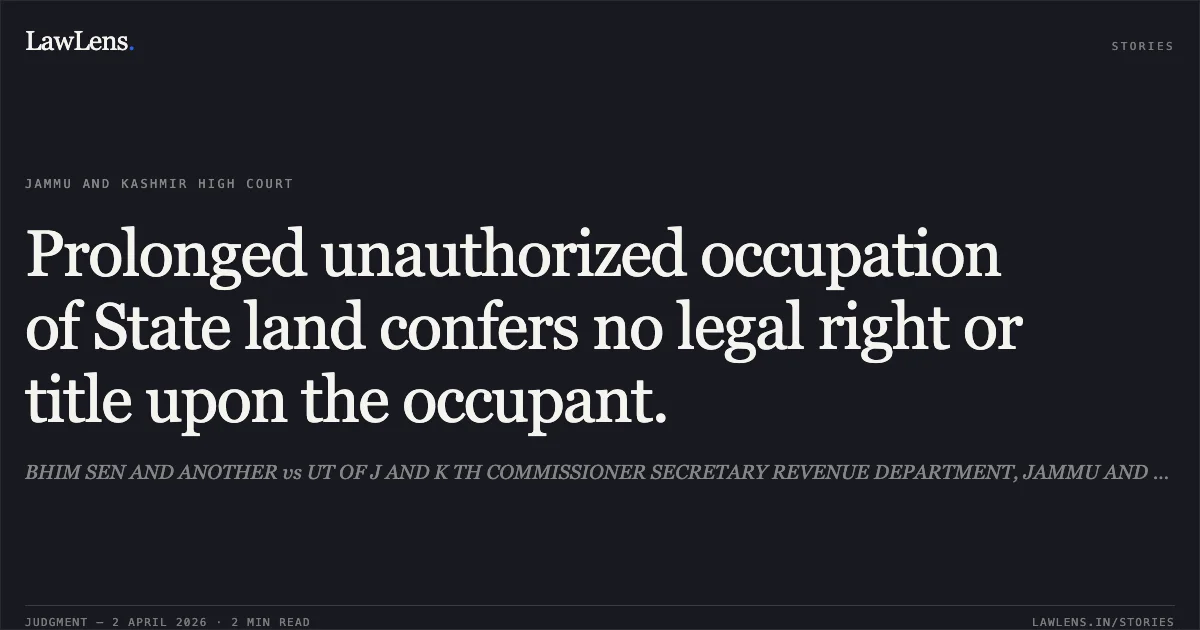
1. Whether long-term unauthorized possession of State land confers any legal right or title upon the occupants to hold the land
Source reference: para. 102. Whether the petitioners were denied a fair opportunity of hearing during the revision proceedings
Source reference: para. 113. Whether a civil court decree for permanent injunction against private parties validates an illegal mutation or prevents the State from asserting ownership
Source reference: para. 12Law Applied
The court applied the principle that no individual can occupy State land without a valid legal allotment
Source reference: para. 13It relied on the distinction between a possessory injunction and a declaration of title, noting that a civil decree restraining interference with possession does not adjudicate ownership or validate revenue mutations when the State is the owner
Source reference: para. 12Furthermore, the court adhered to the principle of estoppel, holding that a party who fails to avail themselves of adequate opportunities to present their case cannot later claim a violation of natural justice
Source reference: para. 11Reasoning
The Court observed that the revenue records (Khasra Girdawari Kharief 2007) explicitly categorized the subject land as State land and the petitioners' possession as unauthorized
Source reference: para. 08The Court reasoned that the original mutating officer had illegally regularized this occupation via Mutation No. 40, which the lower authorities correctly set aside as "illegal possession... does not confer any rights"
Source reference: para. 09-10Regarding procedural fairness, the Court noted the Fard Ahkam proved the petitioners were granted multiple opportunities to be heard but failed to engage counsel; thus, the lack of representation was not attributable to the State
Source reference: para. 11Finally, the Court dismissed the reliance on the 2014 civil decree, clarifying that the decree only prohibited "forcible" dispossession by specific private individuals and did not vest title in the petitioners or bind the State’s right to evict encroachers from its property
Source reference: para. 12Holding
The High Court dismissed the writ petition in limine, upholding the order of the Divisional Commissioner
The Court held that the petitioners were encroachers with no legal right to State land
Source reference: para. 13It affirmed the direction to the Tehsildar to evict all illegal occupants and take necessary steps to prevent further encroachment of the State land in the village
Source reference: para. 14Original Court PDF
BHIM SEN AND ANOTHERvsUT OF J AND K TH COMMISSIONER SECRETARY REVENUE DEPARTMENT, JAMMU AND OTHERS
Click to open original judgment
Original judgment, available to read, download and summarize on LawLens.in