Facts
The Petitioner was appointed as an Assistant on 17.05.1980 and served until his retirement on 28.02.2018
Source reference: para 3In the final seniority lists published in 1991, 1996, and 2002, the Petitioner was consistently ranked senior to private Respondents 5, 6, and 7
Source reference: para 3Following the bifurcation of the State of Bihar in 2000, the Petitioner was posted in Jharkhand from 14.11.2000 to 09.05.2005, though he remained part of the Bihar Secretariat Cadre
Source reference: para 6, 8During this period, his juniors (Respondents 5-7) were promoted to Under Secretary in 2004/2005, whereas the Petitioner was promoted only in 2008
Source reference: para 3Subsequently, the juniors were promoted to Deputy Secretary in 2011, while the Petitioner reached the same post in 2013
Source reference: para 4The State excluded the Petitioner from the zone of consideration for the post of Director (Joint Secretary Level), citing his delayed promotions and a general stay on departmental promotions
Source reference: para 4, 8, 11Issues
1. Whether the Petitioner is entitled to have his promotion dates for the posts of Under Secretary and Deputy Secretary shifted to the dates when his juniors were promoted
Source reference: para 2, 142. Whether the Petitioner’s service period in Jharkhand can be excluded when determining his seniority and promotion eligibility in the Bihar Secretariat Service
Source reference: para 6, 143. Whether the Petitioner is entitled to notional promotion and consequential benefits for the post of Director (Joint Secretary Level)
Source reference: para 16Law Applied
The Court applied the principle of seniority-cum-merit and the doctrine of "notional promotion" to rectify administrative lapses that caused a senior employee to be superseded by juniors
Source reference: para 15, 16It specifically relied on the precedent from Birendra Kumar Rai & Ors v. State of Bihar & Others (CWJC No. 16366 of 2015), which quashed the State's stay on promotions (Memo No. 11218 dated 12.08.2014)
Source reference: para 14The court also emphasized that an employee cannot be penalized for administrative arrangements post-bifurcation if they were never formally allocated to the other State's cadre
Source reference: para 6, 14Reasoning
The Court observed that the Petitioner’s seniority over Respondents 5-7 was undisputed in all official lists until 2002
Source reference: para 14The delay in his promotion was solely attributable to the State's failure to account for his service while he was posted in Jharkhand post-bifurcation
Source reference: para 14The Court found the State's refusal to grant retrospective benefits to be legally unsustainable, especially since a co-ordinate bench had already quashed the executive order staying promotions
Source reference: para 14Furthermore, the Court noted that Respondent 5 (the Petitioner's junior) had already received a court-directed promotion to the Director level; thus, denying the same to the Petitioner would violate the principle of parity
Source reference: para 15The Court reasoned that since the Petitioner remained a member of the Bihar Cadre, his seniority must be protected, and his promotion dates must be adjusted to match his juniors to ensure he is not disadvantaged by administrative delays
Source reference: para 14, 16Holding
The writ petition was allowed
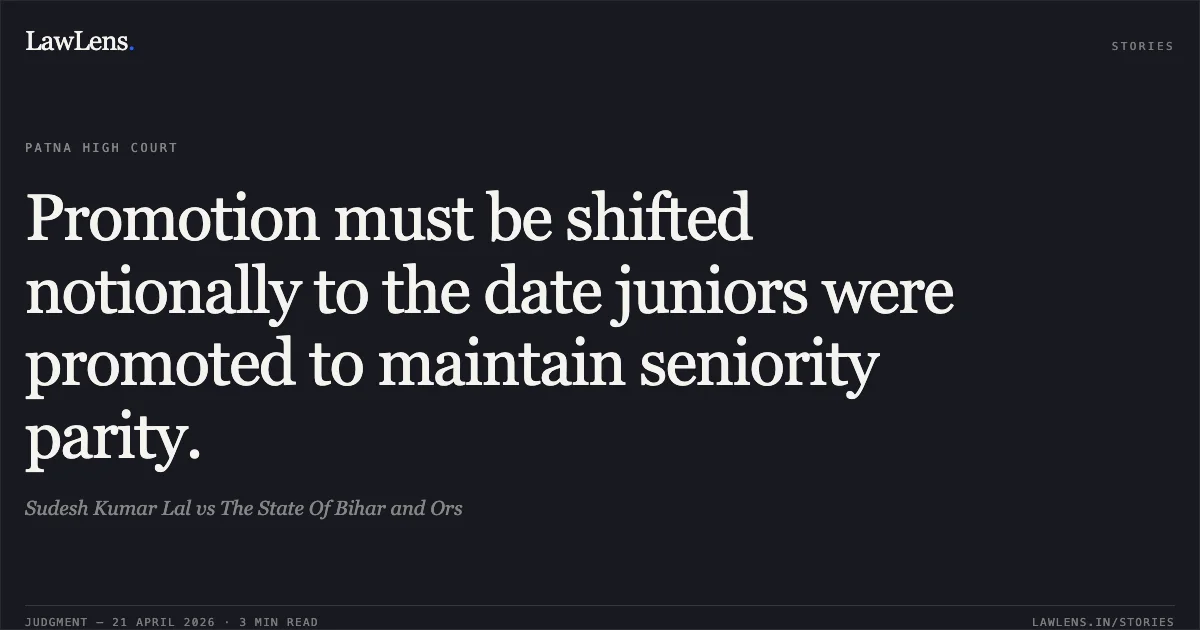
The Court directed the respondent authorities to: (i) shift the Petitioner’s promotion date to Under Secretary to 03.09.2004; (ii) shift the promotion date to Deputy Secretary to 31.01.2011; and (iii) shift the promotion date to Director (Joint Secretary Level) to 27.02.2013, coinciding with the dates his juniors were promoted
Source reference: para 16The Petitioner is entitled to all consequential benefits arising from these shifted dates on a notional basis
Source reference: para 16The State was ordered to complete this exercise within three months
Source reference: para 16Original Court PDF
Sudesh Kumar LalvsThe State Of Bihar and Ors
Click to open original judgment
Original judgment, available to read, download and summarize on LawLens.in