Facts
The appellant, an Accountant in the office of the District Education Officer, Surajpur, was prosecuted under Sections 7 and 13(1)(d) read with Section 13(2) of the Prevention of Corruption Act, 1988. The complainant alleged that the appellant demanded ₹15,000 as illegal gratification for facilitating recognition of a school and subsequently demanded ₹8,000. On 30 June 2014, the Anti-Corruption Bureau conducted a trap after treating sixteen ₹500 currency notes with phenolphthalein powder. The prosecution alleged that the appellant accepted the money and kept it in his trouser pocket, from which ₹8,000 was recovered along with ₹1,000 allegedly paid towards another purpose.
Source reference: paras. 1–5; pp. 1–4The Special Judge convicted the appellant and sentenced him to three years’ rigorous imprisonment under Section 7 and four years’ rigorous imprisonment under Section 13(1)(d) read with Section 13(2), with fines; the sentences were directed to run concurrently. In appeal, the appellant contended that the complainant and accompanying witness had not supported the prosecution, and that the alleged electronic conversation was inadmissible and unauthenticated. The State relied principally on the recovery of the tainted currency and the trap witnesses.
Source reference: paras. 1, 7–8; pp. 1, 4–6Issues
1. Whether the prosecution proved, beyond reasonable doubt, the essential ingredients of demand and acceptance or obtainment of illegal gratification so as to sustain conviction under Sections 7 and 13(1)(d) read with Section 13(2) of the Prevention of Corruption Act, 1988?
Source reference: paras. 17–21; pp. 12–172. Whether the alleged electronic conversation and its transcript could establish the demand when no Section 65-B certificate, voice sample, or forensic voice authentication had been produced?
Source reference: paras. 14.1, 16, 23; pp. 10–12, 17–183. Whether recovery of the phenolphthalein-treated currency from the appellant, by itself, was sufficient to establish the offences in the absence of reliable proof of demand and voluntary acceptance?
Source reference: paras. 20–24; pp. 16–18Law Applied
The Court applied Sections 7 and 13(1)(d) read with Section 13(2) of the Prevention of Corruption Act, 1988, holding that proof of demand and acceptance or obtainment of illegal gratification is the foundational requirement for conviction.
Source reference: para. 18; pp. 13–15Relying on the Constitution Bench decision in Neeraj Dutta v. State (Government of NCT of Delhi), (2023) 4 SCC 731, the Court held that demand and acceptance may be proved by direct, documentary, or circumstantial evidence, but mere recovery or receipt of money is insufficient unless the foundational facts are established.
Source reference: para. 18; pp. 13–15The Court further relied on P. Somaraju v. State of Andhra Pradesh, 2025 SCC OnLine SC 2291, and Rajesh Gupta v. State through CBI, 2022 INSC 359, for the principle that the statutory presumption under Section 20 of the PC Act arises only after demand and acceptance are proved, and that mere recovery of currency cannot constitute an offence under Section 7.
Source reference: para. 20; p. 16The Court also treated the absence of a certificate under Section 65-B of the Indian Evidence Act and the absence of voice identification or forensic authentication as material deficiencies affecting reliance on the electronic recording.
Source reference: paras. 14.1, 23; pp. 10–12, 17–18Reasoning
The Court found that the complainant, the principal witness regarding demand, had completely resiled from the prosecution case and stated that the appellant had neither demanded nor received any bribe.
Source reference: para. 10; p. 6The accompanying witness stated that the complainant had forcibly placed the money in the appellant’s pocket and that the appellant immediately asked him to take it back.
Source reference: para. 12; pp. 9–10The panch witnesses supported the mechanics of the trap and recovery but had not witnessed the conversation or transaction inside the appellant’s office.
Source reference: paras. 11.2, 13, 15; pp. 8–12Although the prosecution relied on the transcript of the alleged conversation, the investigating officer admitted that no Section 65-B certificate had been obtained, no voice sample of the appellant had been taken, and no forensic examination had established that the voice was his.
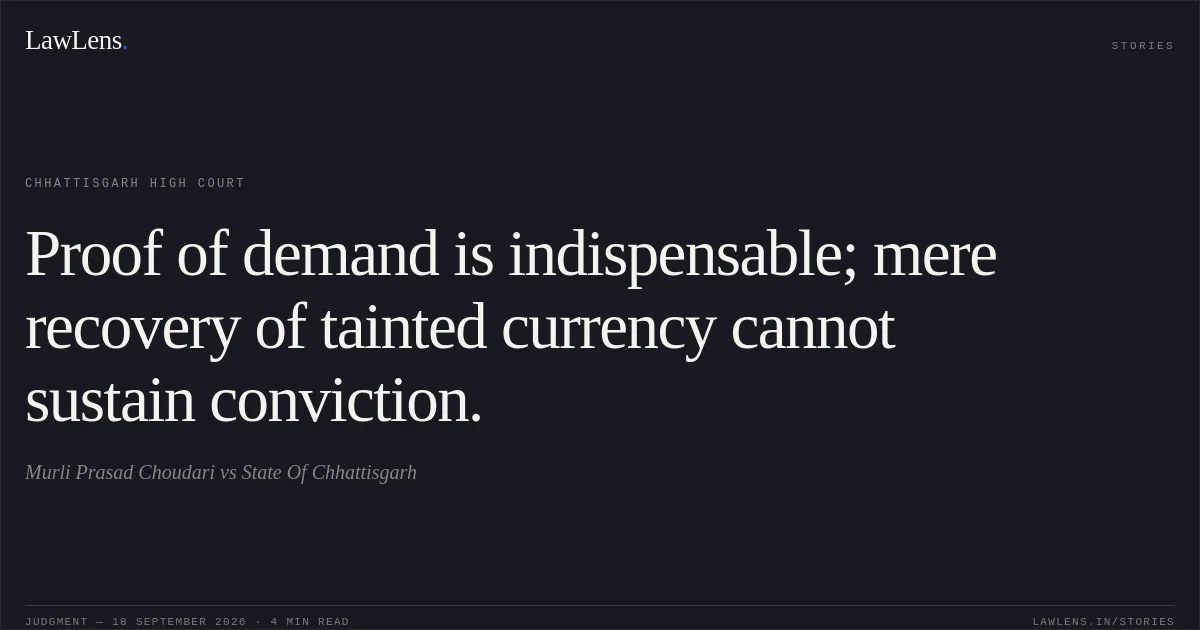
Source reference: paras. 14.1, 16, 23; pp. 10–12, 17–18Consequently, the Court held that the recovery of ₹8,000 and positive phenolphthalein tests could not substitute for proof that the appellant demanded or voluntarily accepted illegal gratification.
Source reference: paras. 19–24; pp. 15–18Since the foundational fact of demand was not proved, the presumption under Section 20 could not arise and the convictions under Sections 7 and 13(1)(d) were unsustainable.
Source reference: paras. 19–24; pp. 15–18Holding
The High Court allowed the appeal and set aside the judgment of conviction and order of sentence dated 30 March 2017.
The appellant was acquitted of the offences under Sections 7 and 13(1)(d) read with Section 13(2) of the Prevention of Corruption Act, 1988, on the ground that demand of illegal gratification had not been proved beyond reasonable doubt and that mere recovery of tainted currency was insufficient.
Source reference: paras. 24–28; pp. 17–19The appellant’s bail bond was ordered to stand discharged, subject to remaining operative for six months under Section 481 of the Bharatiya Nagarik Suraksha Sanhita; any deposited fine was directed to be refunded in accordance with law.
Source reference: para. 26; p. 18Acts & Sections Cited
7 provisions across 3 statutes referred to in this judgment. Each provision opens on LawLens.
Code of Criminal Procedure, 19732
Prevention of Corruption Act, 19884
Bharatiya Nagarik Suraksha Sanhita, 20231
Original Court PDF
Murli Prasad ChoudarivsState Of Chhattisgarh
Click to open original judgment
Original judgment, available to read, download and summarize on LawLens.in