Facts
The petitioner, the legally wedded wife of the respondent, filed a complaint under Section 200 of the CrPC alleging that the respondent contracted a second marriage with one Kiran without her consent
Source reference: para. 2The petitioner claimed she discovered the marriage and the existence of two children from said union during a visit to her in-laws’ house in 2015
Source reference: para. 2After the police refused to register an FIR, she initiated a complaint case where pre-charge evidence was recorded from the petitioner (PW-1) and another witness (PW-2)
Source reference: para. 2-3On 11.07.2018, the Judicial Magistrate First Class, Raipur, discharged the respondent, citing a lack of material evidence to establish the second marriage beyond oral statements
Source reference: para. 3This discharge was upheld by the Sessions Court in a revision petition on 10.01.2019
Source reference: para. 4The petitioner then moved the High Court under Section 482 CrPC
Source reference: para. 1Issues
1. Whether the lower courts erred in discharging the respondent at the stage of framing charges despite an alleged admission of the second marriage in a reply to a legal notice
Source reference: para. 52. Whether oral testimony regarding a second marriage is sufficient to establish a prima facie case of bigamy without proof of essential religious ceremonies
Source reference: para. 7Law Applied
The Court examined the standards for discharge and framing of charges under Sections 227 and 228 of the CrPC, noting that while a "strong suspicion" is sufficient to frame a charge, the court must evaluate if the facts disclose the ingredients of the offence
Source reference: para. 5It relied on the precedent Central Bureau of Investigation, Hyderabad v. K. Narayana Rao (2012) regarding the "prima facie" standard
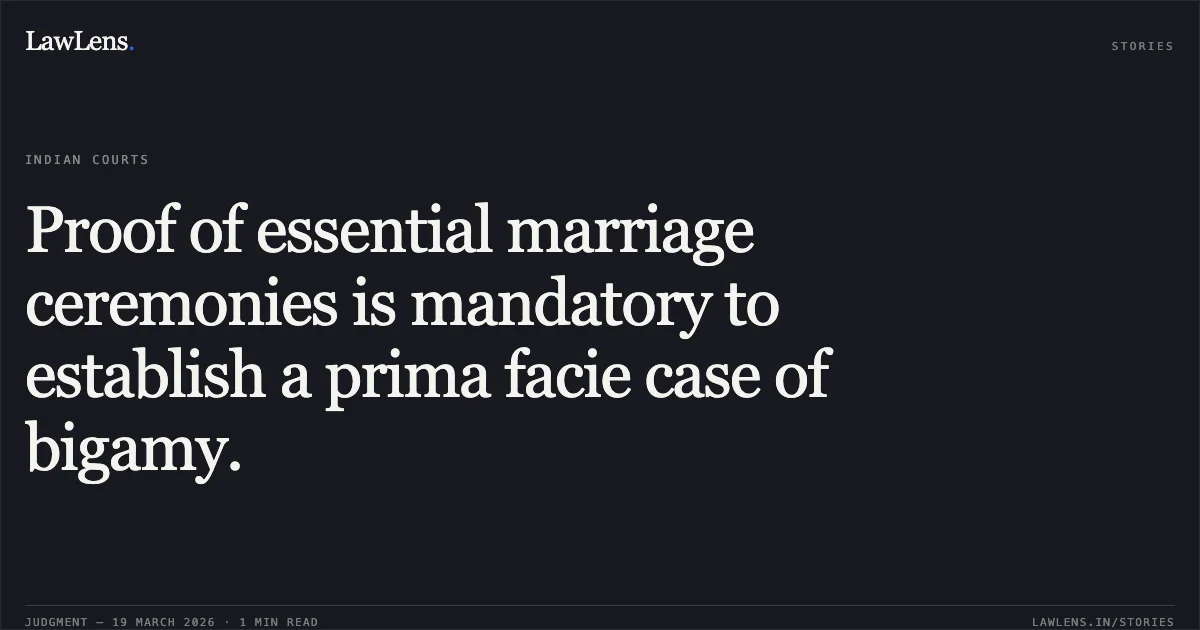
Source reference: para. 5Substantively, the Court applied Section 7 of the Hindu Marriage Act, 1955, which requires proof of solemnization of marriage through essential rites and ceremonies, such as Saptapadi, to sustain a charge of bigamy
Source reference: para. 7Reasoning
The petitioner contended that at the stage of framing charges, the court should not meticulously examine evidence and that the respondent’s admission in a legal notice reply created a strong suspicion
Source reference: para. 5The High Court observed that the testimonies of PW-1 and PW-2 were vague, failing to provide the date, time, or location of the alleged second marriage
Source reference: para. 7The Court reasoned that for the offence of bigamy, the mere fact of living together is insufficient; the law requires strict proof that the second marriage was solemnized in accordance with Hindu rites, specifically Saptapadi
Source reference: para. 7Since no evidence regarding these ceremonies was presented, the Court found that the petitioner failed to establish a prima facie case
Source reference: para. 7The Court concluded that the lower courts did not commit any jurisdictional error or illegality, as the standard of proof for the existence of a second marriage was not met even at the preliminary stage
Source reference: para. 8Holding
The High Court held that the petition was devoid of merit as the petitioner failed to demonstrate a prima facie case of bigamy under the Hindu Marriage Act
The Court affirmed the orders of the Trial Court and the Revisional Court, declining to exercise its inherent powers under Section 482 CrPC
Source reference: para. 7-8The petition was dismissed
Source reference: para. 9Acts & Sections Cited
1 provisions across 1 statute referred to in this judgment. Each provision opens on LawLens.
Hindu Marriage Act, 19551
Original Court PDF
SMT. ANUSUIYA BAIvsSUKHNANDAN DAS VAISHNAV
Click to open original judgment
Original judgment, available to read, download and summarize on LawLens.in