Facts
Baljit Kaur was married to Sarmukh Singh, a Head Constable, and resided with him and their two children in a police-lines quarter. Sarmukh Singh returned home after duty on the night of 08.08.2003, consumed dinner and went to sleep; he was found dead the next morning.
Source reference: pp.2–3; para. 2Initially, his death was treated as natural and no foul play was suspected, resulting only in inquest proceedings and a Daily Diary Report.
Source reference: pp.2–3; paras. 2, 28The viscera preserved during post-mortem examination was sent for chemical analysis. The Chemical Examiner detected ethyl alcohol and a chloro-compound group of insecticide, and the doctor subsequently opined that death was caused by their cumulative effect.
Source reference: pp.3, 13–14; paras. 2, 18–20A formal FIR was registered on 22.10.2003, approximately 74 days after the death, alleging that Baljit Kaur, her father Kashmir Singh and Daljit Kaur had conspired to poison Sarmukh Singh.
Source reference: pp.3–8; paras. 3–7The prosecution relied on alleged matrimonial discord, illicit relations, a financial dispute, the appellant’s presence in the house, and an alleged extra-judicial confession. The independent neighbours did not support the prosecution, and the alleged extra-judicial confession was rejected by the trial court.
Source reference: pp.3–8; paras. 3–7The Sessions Court acquitted Kashmir Singh and Daljit Kaur but convicted Baljit Kaur under Section 302 IPC and sentenced her to life imprisonment with a fine of ₹2,000. She appealed against the conviction.
Source reference: p.1; para. 1Issues
Whether the prosecution proved that Sarmukh Singh’s death was unnatural and caused by poisoning, rather than by natural causes or another explanation.
Source reference: pp.12–14; paras. 17–21Whether the prosecution proved beyond reasonable doubt that Baljit Kaur administered the poisonous substance to Sarmukh Singh or participated in a conspiracy to cause his death.
Source reference: pp.14–15, 22–24; paras. 22, 34–38Whether the prosecution could invoke Section 106 of the Evidence Act merely on the basis of the appellant’s alleged presence in the house, despite failing to establish foundational facts connecting her with the poisoning.
Source reference: pp.19–20; paras. 30–31Whether the delay of approximately 74 days in registering the FIR, together with the material change from an initial natural-death version to a poisoning and conspiracy case, materially weakened the prosecution case.
Source reference: pp.18–19; paras. 28–29Law Applied
The Court applied Section 302 IPC concerning the offence of murder and considered the allegation of conspiracy under Section 120-B IPC.
Source reference: no citationIn a case based on circumstantial evidence, every circumstance must be firmly established and the cumulative chain must be complete and inconsistent with every reasonable hypothesis of innocence.
Source reference: para. 36Section 106 of the Evidence Act does not shift the primary burden of proving the prosecution case; it operates only after the prosecution establishes foundational facts from which the accused’s involvement can reasonably be inferred.
Source reference: paras. 30–31The Court relied on State of Himachal Pradesh v. Gian Chand, 2001 (2) RCR (Criminal) 666, for the principle that delay in lodging an FIR is not invariably fatal if satisfactorily explained, but becomes significant where it creates a possibility of deliberation or embellishment.
Source reference: para. 29It also relied on Dhanapal v. State by Public Prosecutor, Madras, 2010 (5) RCR (Criminal) 353, for the fundamental rule that the prosecution must prove its own case and cannot use Section 106 to fill gaps in its evidence.
Source reference: para. 31Reasoning
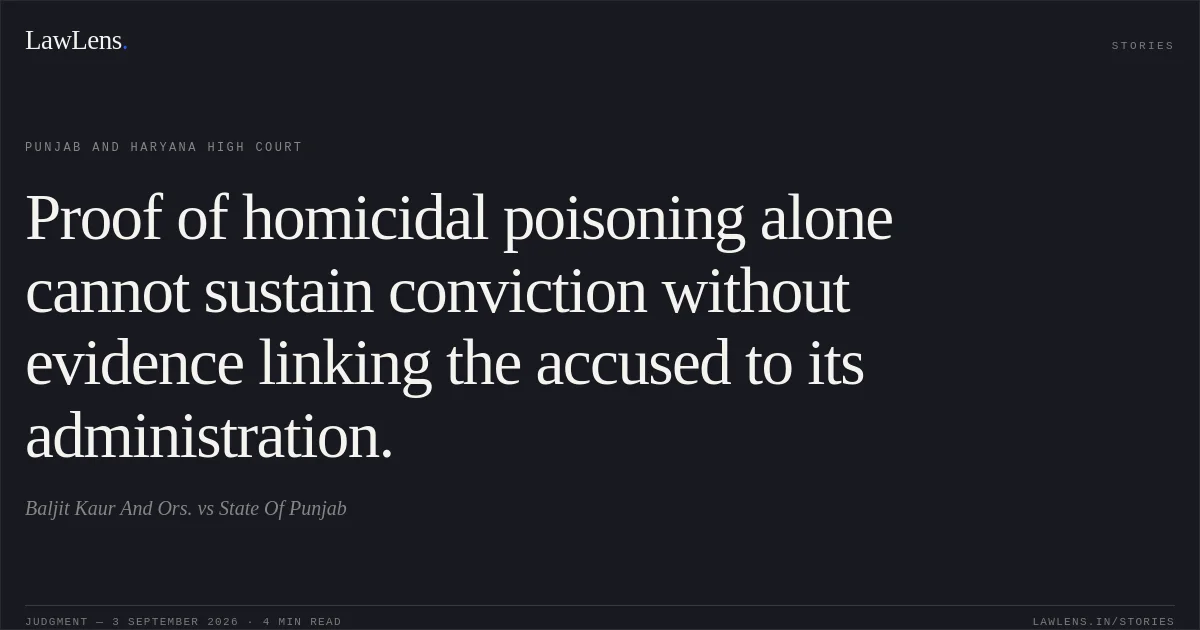
The Court accepted the medical and chemical evidence as establishing that Sarmukh Singh died from the cumulative effect of alcohol and chloro-compound insecticide; the preservation and transmission of the viscera were also found reliable.
Source reference: pp.13–14; paras. 18–21However, proof of poisoning did not establish who administered the poison.
Source reference: no citationThe alleged motive was not reliably proved because the independent neighbours turned hostile, while the evidence of the deceased’s relatives contained material inconsistencies and did not establish a convincing immediate motive.
Source reference: pp.15–17; paras. 23–26The alleged extra-judicial confession was considered unreliable, particularly because it was omitted from the complainant’s statement forming the basis of the FIR.
Source reference: pp.17–18; para. 27The initial version treated the death as natural and disclosed no suspicion of foul play; the unexplained delay even after receipt of the chemical report, coupled with the subsequent introduction of allegations of poisoning, motive and conspiracy, created a reasonable possibility of embellishment.
Source reference: pp.18–19; paras. 28–29The appellant’s presence in the house could not, by itself, justify an adverse inference under Section 106, since the prosecution failed to establish that she was the only person present or otherwise connect her with administration of the poison.
Source reference: pp.19–20; paras. 30–31The defence evidence concerning the deceased’s alcohol consumption and absence of matrimonial discord further rendered the prosecution theory uncertain.
Source reference: pp.20–21; para. 32As no poison was recovered from the appellant, no evidence showed that she procured it, and no independent scientific or eyewitness evidence connected her with its administration, the circumstantial chain remained incomplete.
Source reference: pp.21–24; paras. 34–37Holding
The Court held that the prosecution proved that Sarmukh Singh died an unnatural death caused by poisoning, but failed to prove beyond reasonable doubt that Baljit Kaur administered the poison or participated in a conspiracy to kill him.
The conviction under Section 302 IPC and the sentence of life imprisonment with fine were set aside.
Source reference: p.25; paras. 38–39Baljit Kaur was acquitted by extending to her the benefit of doubt, and all pending miscellaneous applications were disposed of.
Source reference: p.25; paras. 38–39Acts & Sections Cited
4 provisions across 2 statutes referred to in this judgment. Each provision opens on LawLens.
Indian Penal Code, 18601
Code of Criminal Procedure, 19733
Original Court PDF
Baljit Kaur And Ors.vsState Of Punjab
Click to open original judgment
Original judgment, available to read, download and summarize on LawLens.in