Facts
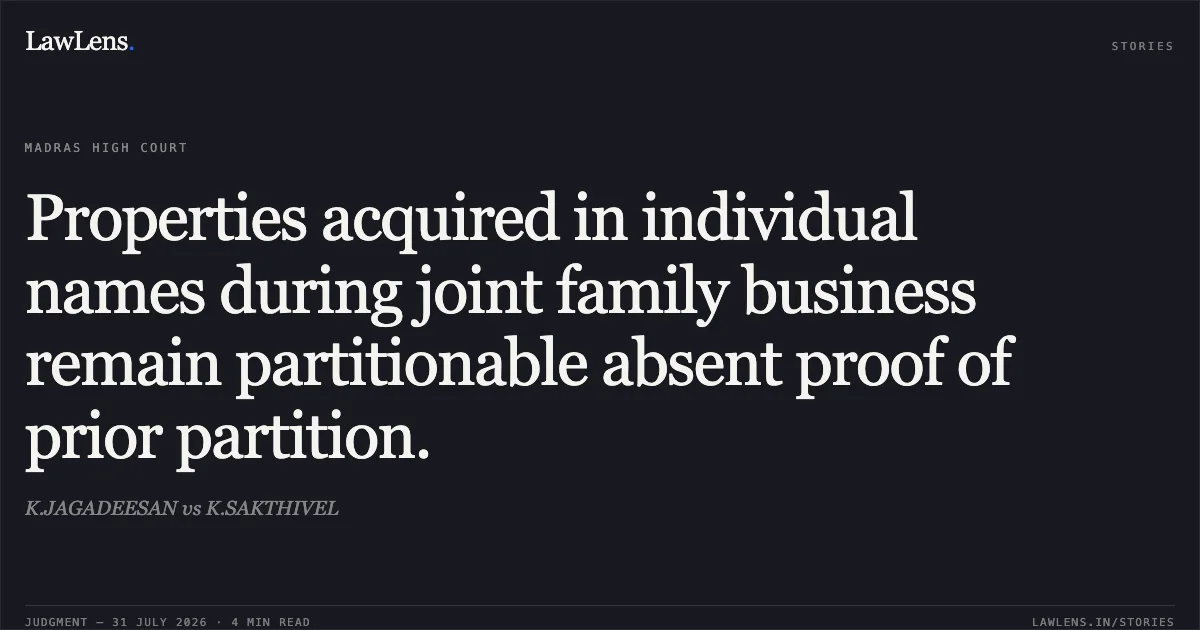
The appellant-plaintiff, the elder brother of respondents 1 and 2, instituted O.S. No. 177 of 2010 seeking partition, accounts, mesne profits and permanent injunction in respect of several properties and businesses allegedly acquired from joint family and business income.
Source reference: paras. 16–17The first item had originally been purchased in the plaintiff’s name during his minority and was subsequently treated by the parties as joint property.
Source reference: paras. 16–17The plaintiff contended that he had established and financed the family’s textile, cable television and road-roller businesses, while properties were purchased in the names of the brothers and their wives for the family’s benefit.
Source reference: paras. 2.1–2.5The defendants disputed the joint character of the properties and pleaded that the first item alone was common.
Source reference: paras. 3–6, 13–14They further alleged an oral partition in 1995, under which the second defendant received a road roller and the first defendant received the second item of the property.
Source reference: paras. 3–6, 13–14The II Additional District Judge, Salem dismissed the suit, principally holding that the mother was a necessary party, that several properties were self-acquired, and that the plaintiff had failed to prove acquisition from joint family funds.
Source reference: para. 9The plaintiff challenged that decree under Section 96 CPC.
Source reference: p. 1Issues
Whether the properties claimed by the plaintiff were jointly acquired or constituted joint family properties of the plaintiff and respondents 1 and 2?
Source reference: para. 15, Point No. 1Whether the plaintiff was entitled to a one-third share in Suit Items 1 to 6, 12, 14 to 22, 24, 25, 27 to 33, or in any subset thereof?
Source reference: para. 15, Point No. 2Whether the alleged oral partition of 1995 had been proved, thereby excluding the disputed properties from partition?
Source reference: paras. 21, 25–30What relief, including partition and consequential relief, was the plaintiff entitled to?
Source reference: para. 15, Point No. 3Law Applied
The appeal was examined under Section 96 of the Code of Civil Procedure, 1908, governing appeals from original decrees.
Source reference: p. 1The Court applied the principle that the character of property is determined by the source of consideration and the surrounding conduct and documentary evidence, rather than merely by the name appearing in the sale deed, where the evidence establishes acquisition from common family or business resources.
Source reference: paras. 21, 27–31, 40It further applied the evidentiary rule that a plea of oral partition must be established by cogent and reliable evidence, including sufficiently specific proof of the time, place, terms, allotments and subsequent conduct; vague testimony without supporting records is inadequate.
Source reference: paras. 25–26The Court also relied on admissions and contemporaneous documents, including joint mortgages, discharge receipts and business records, to determine whether the parties continued to hold and utilise the properties jointly.
Source reference: paras. 27–30, 40Reasoning
The Court found that the defendants’ plea of a 1995 oral partition was not proved.
Source reference: paras. 24–26The testimony of DW3 did not identify the date, place, specific allotments or the parties’ subsequent possession, while DW1 and DW2 made admissions showing that the business income continued to be dealt with jointly and that the properties had not been formally divided.
Source reference: paras. 24–26, 30The joint mortgages of Item No. 1 by the plaintiff, respondents 1 and 2 and their mother in 1995 and 1997, together with the joint discharge of those liabilities, demonstrated continued common financial dealings inconsistent with the alleged partition.
Source reference: paras. 27–28, 40The evidence of the mother, DW4, also supported the plaintiff’s case that he had initiated the textile and cable businesses, that the brothers assisted him, and that properties and road rollers were acquired while the family was residing and functioning jointly.
Source reference: para. 29Consequently, Items 1 to 6 were treated as available for partition, notwithstanding that some stood in the name of respondent 1 or related to businesses managed by respondents 1 and 2.
Source reference: paras. 20–24, 31The Court similarly treated Items 12, 14, 17 and 28 to 33 as available for partition because their acquisition was linked to the continuing joint arrangement and the defendants failed to establish a prior division.
Source reference: paras. 35–37, 41Conversely, the plaintiff failed to prove that properties standing in the name of respondent 3 were purchased from joint family or business funds.
Source reference: para. 39Items 21, 25 and 27 were also excluded because they were purchased in the name of respondent 4 after the institution of the suit and the plaintiff did not establish their acquisition from joint income.
Source reference: para. 34Items abandoned by the plaintiff and the property already sold by the mother were likewise held unavailable for partition.
Source reference: paras. 32–33Holding
The appeal was partly allowed, and the trial court’s judgment and decree dated 9 March 2015 were set aside.
The High Court passed a preliminary decree declaring that the plaintiff was entitled to a one-third share in Suit Items 1 to 6, 12, 14, 17 and 28 to 33.
Source reference: para. 42The plaintiff was denied partition in respect of the remaining suit items.
Source reference: para. 42Considering the familial relationship between the parties, there was no order as to costs.
Source reference: para. 42Acts & Sections Cited
1 provisions across 1 statute referred to in this judgment. Each provision opens on LawLens.
Code of Civil Procedure, 19081
Original Court PDF
K.JAGADEESANvsK.SAKTHIVEL
Click to open original judgment
Original judgment, available to read, download and summarize on LawLens.in