Facts
The plaintiff was the daughter of Vinodbhai Jashbhai Patel and Shardaben, whose marriage was solemnized on 5 December 1949. During the subsistence of that marriage, Vinodbhai entered into a second marriage with Kalpanaben on 25 June 1973; defendants 1–3 were born from that relationship and were treated as children of a void marriage.
Source reference: para. 5–5.2The suit properties originally belonged to Jashbhai Mathurbhai Patel, the plaintiff’s grandfather, and were treated by the parties as his self-acquired properties. Jashbhai died intestate after 1956, whereupon the properties devolved upon his son Vinodbhai under Section 8 of the Hindu Succession Act, 1956 (“HSA”).
Source reference: para. 5.1, 8.1, 8.5Vinodbhai subsequently died intestate on 26 February 2005.
Source reference: para. 5.2The plaintiff claimed that the properties were ancestral/coparcenary properties and that defendants 1–3, being illegitimate children, had no right or share in them.
Source reference: para. 5.2, 7–7.2The Trial Court declared the plaintiff, defendants 1–3, and defendant 4—the first legally wedded wife of Vinodbhai—entitled to equal one-fifth shares. The First Appellate Court dismissed the plaintiff’s Regular Civil Appeal No. 45 of 2023 and confirmed the decree dated 4 March 2023; the present second appeal was filed under Section 100 CPC.
Source reference: para. 2, 5.3, 6Issues
1. Whether the suit properties were ancestral/coparcenary properties in which the plaintiff acquired rights by birth, thereby excluding defendants 1–3 from claiming a share.
Source reference: para. 7–7.2, 10–11.12. Whether properties inherited by Vinodbhai from his father’s self-acquired estate after 1956 became Vinodbhai’s separate/self-acquired property under Section 8 of the HSA.
Source reference: para. 8.1, 9.1, 123. Whether defendants 1–3, as children born from Vinodbhai’s void second marriage, were entitled to inherit from Vinodbhai’s property upon his intestate death.
Source reference: para. 8.3–8.4, 9.1, 124. Whether the appeal raised any substantial question of law warranting interference under Section 100 CPC.
Source reference: para. 15–17Law Applied
The Court applied Sections 4, 6 and 8 of the HSA, holding that, after the commencement of the HSA, intestate succession to a Hindu’s property is governed by the statutory scheme and that property inherited by a son from his father’s self-acquired estate under Section 8 is held by the son as his separate/self-acquired property, absent an applicable coparcenary succession.
Source reference: para. 9–12Section 6 applies to coparcenary property, whereas a grandson or granddaughter does not acquire a birthright in the self-acquired property of a grandfather.
Source reference: para. 9–12The Court also relied on Sections 5, 11 and 16 of the Hindu Marriage Act, 1955, treating children born from a void marriage as entitled to inherit from their parents, though not to claim rights in the property of grandparents or other relatives.
Source reference: para. 8.3, 9.1, 12Reliance was placed on Arshnoor Singh v. Harpal Kaur, Yudhishter v. Ashok Kumar, CWT v. Chander Sen, Revanasiddappa v. Mallikarjun, Hemiben Limbabhai Pipariya v. Rasilaben Limbabhai Pipariya, and Nachiketa Kantibhai Patel v. Kantibhai Ishwarbhai Patel, particularly on the distinction between ancestral/coparcenary property and property inherited under Section 8 of the HSA.
Source reference: para. 12The Court further applied the limited scope of second appeals under Section 100 CPC, as recognized in Russi Fisheries (P) Ltd. v. Bhavna Seth and Jaichand v. Sahnulal.
Source reference: para. 15Reasoning
The Court found that the properties were the self-acquired properties of Jashbhai and that the plaintiff produced no evidence showing that Jashbhai had inherited them from a paternal ancestor.
Source reference: para. 8.1, 8.5, 10Since Jashbhai died intestate after 1956, the properties devolved upon Vinodbhai under Section 8 of the HSA and became his separate property; they did not remain ancestral or coparcenary property in the hands of Vinodbhai or the plaintiff.
Source reference: para. 9.1, 12–13Accordingly, the plaintiff could not claim a birthright under Section 6.
Source reference: para. 12–13Upon Vinodbhai’s intestate death, the plaintiff and his first legally wedded wife were entitled to inherit, and defendants 1–3 were also entitled to inherit from Vinodbhai as his children under the law governing children of a void marriage.
Source reference: para. 8.2–8.4, 12–13The Court therefore upheld the equal one-fifth shares declared by the courts below and found no perversity, gross error of law, or substantial question of law justifying interference in second appeal.
Source reference: para. 13–16Holding
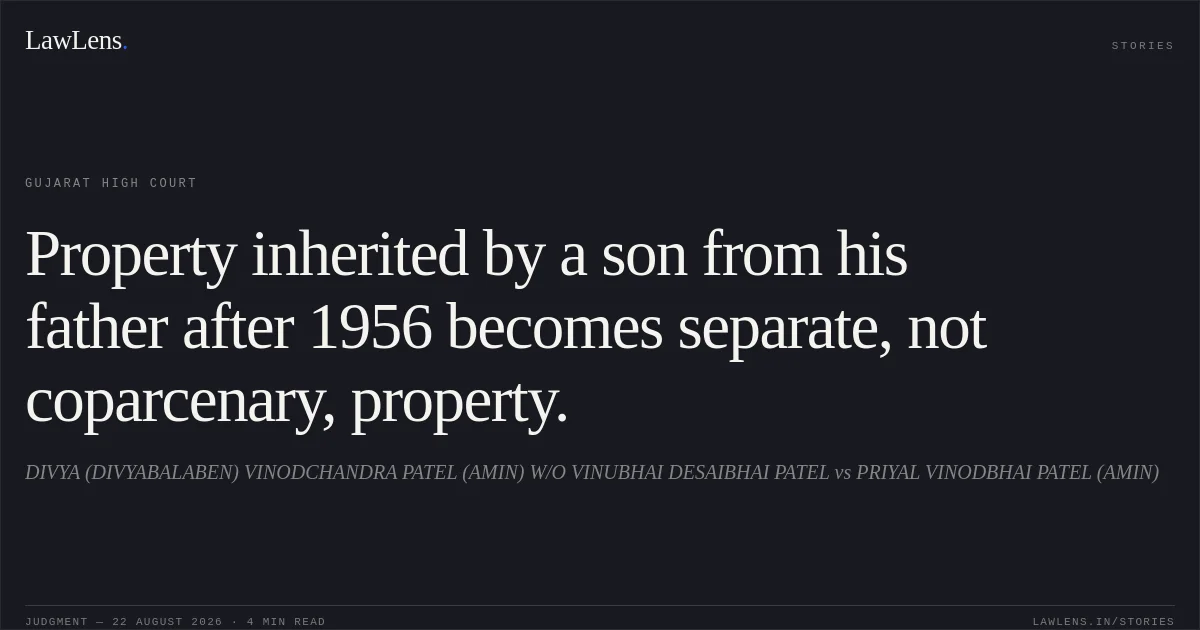
The High Court held that the suit properties were not ancestral/coparcenary properties but Vinodbhai’s separate property, having devolved upon him from Jashbhai under Section 8 of the HSA.
The plaintiff was therefore not exclusively entitled to the properties, and defendants 1–3 were entitled to inherit from Vinodbhai along with the plaintiff and defendant 4.
Source reference: para. 16–17The Second Appeal was dismissed in limine for want of any substantial question of law; the connected Civil Application for stay was disposed of as infructuous, with no order as to costs.
Source reference: para. 16–17Acts & Sections Cited
7 provisions across 3 statutes referred to in this judgment. Each provision opens on LawLens.
Code of Civil Procedure, 19081
Hindu Succession Act, 19564
Hindu Marriage Act, 19552
Original Court PDF
DIVYA (DIVYABALABEN) VINODCHANDRA PATEL (AMIN) W/O VINUBHAI DESAIBHAI PATELvsPRIYAL VINODBHAI PATEL (AMIN)
Click to open original judgment
Original judgment, available to read, download and summarize on LawLens.in