Facts
The appellant (Mahipal) was convicted by the Sessions Judge, Rampur, under Section 302 IPC for the murder of his wife, Mamta.
Source reference: para. 1The prosecution alleged that Mamta was married to the appellant three years prior and was subjected to continuous harassment and demands for dowry by her in-laws.
Source reference: para. 2On August 14/15, 2017, the informant was notified of Mamta's death; upon arrival at the matrimonial home, her body was found on a cot with injuries to the neck and head, while the family had fled.
Source reference: para. 2, 5The post-mortem attributed death to asphyxia via ante-mortem throttling, though doctors noted the hyoid bone was intact and suicide by hanging was a possibility.
Source reference: para. 3, 10While the trial court acquitted the father-in-law and mother-in-law, it convicted the appellant primarily based on the fact that the death occurred within the matrimonial home.
Source reference: para. 18Issues
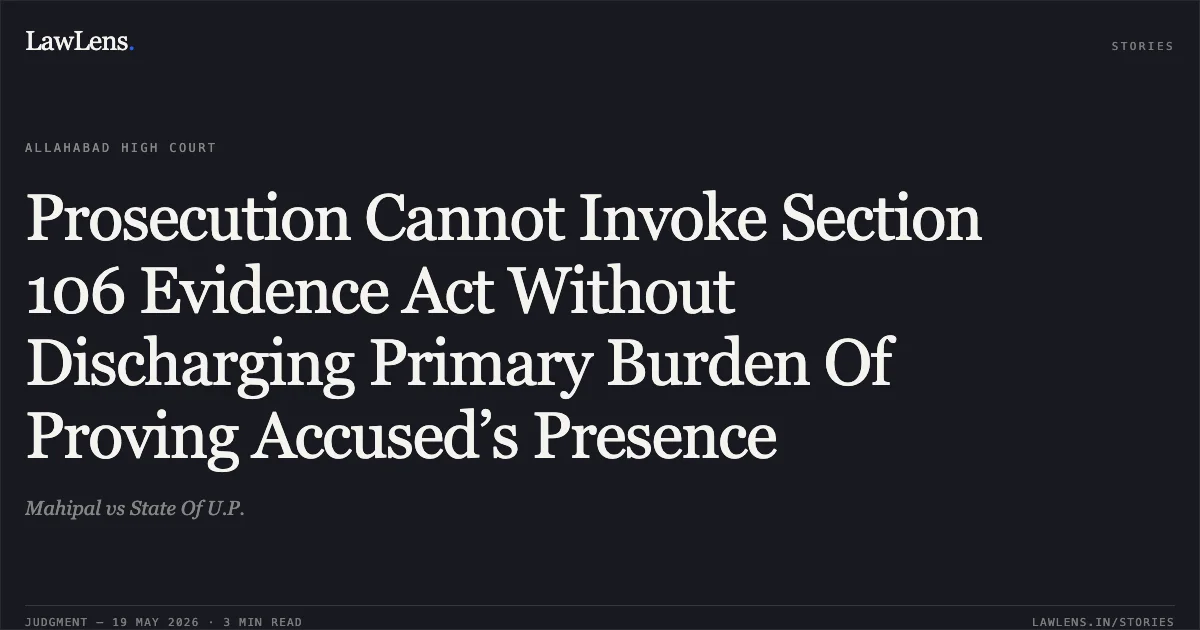
1. Whether the prosecution discharged its primary burden of proving the appellant’s presence at the scene of the crime to invoke the presumption under Section 106 of the Evidence Act.
Source reference: para. 20, 242. Whether the circumstantial evidence and medical testimony were sufficient to establish a conviction for murder under Section 302 IPC beyond a reasonable doubt.
Source reference: para. 24, 27Law Applied
Section 302 of the IPC regarding the punishment for murder.
Source reference: para. 1Section 106 of the Indian Evidence Act, which places the burden of proving facts "especially within knowledge" on the person possessing that knowledge.
Source reference: para. 20The precedent of Smt. Gargi v. State of Haryana (2019), which established that Section 106 does not absolve the prosecution of its primary burden to prove a prima facie case, and mere companionship or staying under the same roof does not automatically trigger a presumption of guilt.
Source reference: para. 21The "last seen theory" requires a time gap so small that any other perpetrator is rendered improbable.
Source reference: para. 21.3Reasoning
The High Court found that the prosecution failed to establish a prima facie case against the appellant before shifting the burden of proof under Section 106. Specifically, the prosecution provided no evidence that the appellant, a driver by profession who was often away for work, was actually present in the house at the time of the incident.
Source reference: para. 20, 24The court noted major contradictions: PW-1 and PW-2 provided conflicting accounts regarding who informed them of the death and who paid for the deceased’s medical expenses.
Source reference: para. 25The prosecution failed to examine "Guddi," the deceased’s sister living in the same village, who would have been a vital witness to the alleged cruelty.
Source reference: para. 24Medically, the court observed the absence of fingernail marks on the neck and the intact hyoid bone, lending weight to the defense witnesses' claims (DW-1 to DW-3) that the deceased committed suicide by hanging.
Source reference: para. 10, 26The court held that since the parents-in-law were acquitted on the same set of evidence, the appellant could not be singled out for conviction simply because of his status as the husband.
Source reference: para. 27Holding
The Court answered the issues in the negative, holding that the prosecution failed to prove the charges beyond reasonable doubt and that Section 106 cannot be used to fill gaps in the prosecution's case when the husband's presence at the scene was not established.
The appeal was allowed, and the judgment of the Sessions Judge, Rampur, dated April 7, 2023, was set aside. The appellant was honourably acquitted of all charges and ordered to be released forthwith.
Source reference: para. 28, 29, 30Acts & Sections Cited
6 provisions across 3 statutes referred to in this judgment. Each provision opens on LawLens.
Indian Penal Code, 18602
Code of Criminal Procedure, 19732
Original Court PDF
MahipalvsState Of U.P.
Click to open original judgment
Original judgment, available to read, download and summarize on LawLens.in