Facts
The informant alleged that the petitioner obtained ₹4 lakh from him on the assurance that he would be made a partner in a business operated under the name M/s Lady Fashion Zone.
Source reference: p. 2After that business failed, the petitioner and others allegedly commenced another business, M/s Fashion Mart.
Source reference: p. 2The petitioner issued two cheques of ₹2 lakh each towards repayment, but the cheques were dishonoured for “Insufficient Fund”.
Source reference: p. 2The police registered Muzaffarpur Town P.S. Case No. 422 of 2014, investigated the matter, and submitted a charge-sheet under Sections 420 and 34 of the Indian Penal Code and Section 138 of the Negotiable Instruments Act, 1881 (“NI Act”).
Source reference: p. 2By order dated 12 May 2015, the learned Magistrate took cognizance of those offences.
Source reference: p. 1The petitioner consequently invoked the High Court’s jurisdiction to quash the cognizance order.
Source reference: p. 1Issues
Whether an FIR and police investigation could validly be instituted for an offence punishable under Section 138 of the NI Act, instead of proceeding through a written complaint in accordance with Section 142 of the NI Act?
Source reference: pp. 3–5, paras. 5–7Whether the cognizance order dated 12 May 2015, based on the police case and charge-sheet alleging offences under Sections 420 and 34 IPC and Section 138 of the NI Act, was liable to be quashed?
Source reference: pp. 1, 5–6, paras. 2, 4, 9Law Applied
Section 138 of the NI Act creates criminal liability for dishonour of a cheque subject to the statutory conditions in clauses (a), (b), and (c) of its proviso, including timely presentation, issuance of a written demand notice within the prescribed period, and failure by the drawer to make payment within fifteen days of receiving notice.
Source reference: pp. 4–5, para. 7Section 142(1)(a) of the NI Act mandates that cognizance of an offence under Section 138 can be taken only upon a written complaint made by the payee or holder in due course, while Section 142(1)(b) prescribes the limitation period, subject to condonation for sufficient cause.
Source reference: p. 4, para. 7Relying on N. Harihara Krishnan v. J. Thomas, (2018) 13 SCC 663, the Court held that the statutory scheme does not contemplate registration of an FIR for an offence under Section 138 and requires prosecution by way of a complaint after compliance with the prescribed procedure.
Source reference: pp. 3–5, paras. 6–7The Court also referred to MSR Leathers v. S. Palaniappan, (2013) 1 SCC 177, for the proposition that the conditions under the proviso to Section 138 are prerequisites for commission of the offence.
Source reference: pp. 4–5, para. 7Reasoning
The prosecution case substantially arose from the dishonour of the two cheques issued for repayment of ₹4 lakh.
Source reference: p. 2Since the alleged cheque dishonour was pursued through an FIR, police investigation, and charge-sheet, rather than through the written-complaint procedure mandated by Section 142 of the NI Act, the Court found that the statutory mode of taking cognizance under Section 138 had not been followed.
Source reference: pp. 3–5, paras. 5–8Applying N. Harihara Krishnan, the Court concluded that an FIR could not validly constitute the basis for prosecution under Section 138.
Source reference: pp. 3–5, paras. 6–8The State did not dispute this legal position.
Source reference: p. 5, para. 8On that basis, the Court set aside the impugned cognizance order, without separately sustaining the cognizance taken under Sections 420 and 34 IPC.
Source reference: p. 5, para. 9Holding
The High Court allowed the petition and quashed the order dated 12 May 2015 by which cognizance had been taken under Sections 420 and 34 IPC and Section 138 of the NI Act.
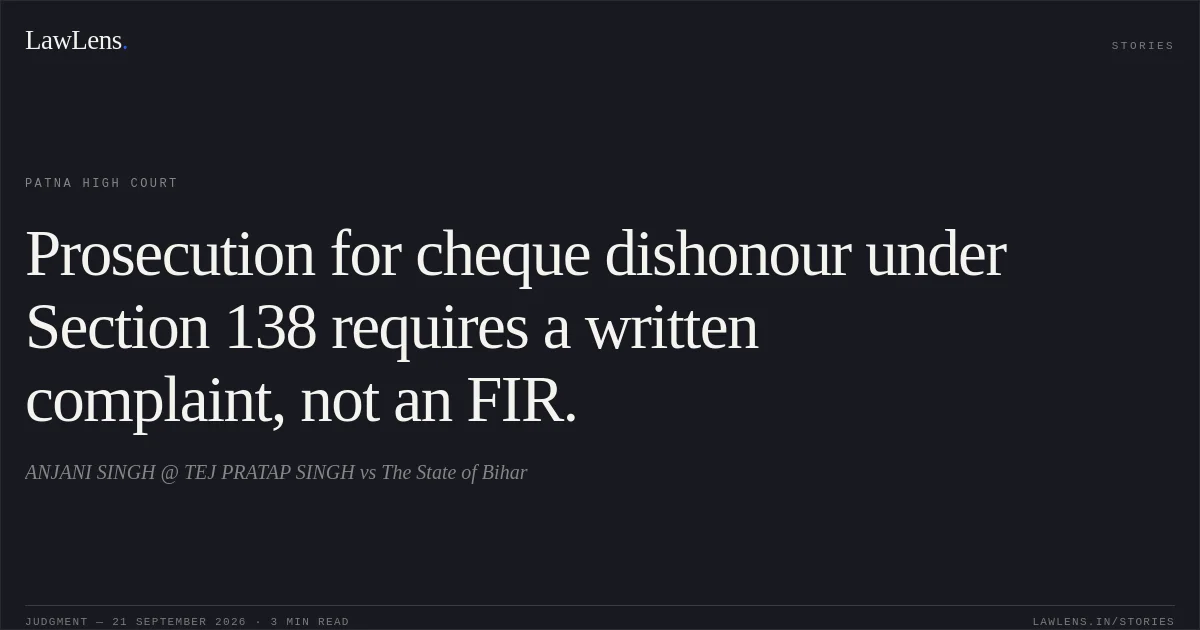
The Court held that prosecution for cheque dishonour under Section 138 could not be initiated through an FIR and police charge-sheet, as Section 142 requires a written complaint following compliance with the statutory conditions under Section 138.
Source reference: pp. 4–5, paras. 7, 9The Court clarified that quashing the cognizance order would not prevent the opposite party from pursuing any other appropriate legal remedy for recovery of ₹4 lakh or any other relief permissible in law.
Source reference: p. 6, para. 10Acts & Sections Cited
4 provisions across 2 statutes referred to in this judgment. Each provision opens on LawLens.
Indian Penal Code, 18602
Negotiable Instruments Act, 18812
Original Court PDF
ANJANI SINGH @ TEJ PRATAP SINGHvsThe State of Bihar
Click to open original judgment
Original judgment, available to read, download and summarize on LawLens.in