Facts
On 18 October 2022, police intercepted an i20 vehicle bearing registration no. AS-01-AR-2221 at Dillai Tiniali, Karbi Anglong, and allegedly recovered 29,800 YABA tablets from the dickey and music box of the vehicle.
Source reference: pp. 2–4, paras. 1–2.3The three appellants were found inside the vehicle and were arrested. Samples were drawn, sealed, produced before the Magistrate on 19 October 2022, and forwarded to the Forensic Science Laboratory.
Source reference: pp. 2–4, paras. 1–2.3The FSL report identified methamphetamine in the sample. The appellants were charged under Sections 22(c) and 29 of the NDPS Act; the trial court acquitted them of conspiracy under Section 29 but convicted them under Section 22(c), sentencing each to 12 years’ rigorous imprisonment and a fine of ₹1,00,000, with one year’s simple imprisonment in default.
Source reference: pp. 2–4, paras. 1–2.3The appellants challenged the conviction on the grounds of absence of independent witnesses, contradictions regarding CRPF presence and tablet-counting, failure to establish commercial quantity and vehicle ownership, and non-compliance with Section 52-A of the NDPS Act.
Source reference: pp. 5–6, para. 3Issues
1. Whether the prosecution proved that the seized tablets contained a psychotropic substance, namely methamphetamine, and were connected with the material allegedly recovered from the vehicle?
Source reference: pp. 8–9, paras. 5–5.12. Whether the absence or limited examination of independent witnesses, and the discrepancy regarding the presence of CRPF personnel, rendered the search and seizure unreliable?
Source reference: pp. 9–11, paras. 6–73. Whether the prosecution established that the seized contraband was of commercial quantity despite the sample weighing only approximately 14.9 grams and despite discrepancies concerning the counting process?
Source reference: pp. 11–13, paras. 8–9.14. Whether failure to establish ownership of the vehicle and the appellants’ denial of being occupants created reasonable doubt regarding possession and liability under Section 22(c) of the NDPS Act?
Source reference: pp. 13–16, paras. 10–11.15. Whether the prosecution substantially complied with Section 52-A of the NDPS Act and established an unbroken chain of custody?
Source reference: pp. 16–17, paras. 12–12.26. Whether the conviction and sentence imposed by the trial court warranted appellate interference?
Source reference: pp. 17–19, paras. 13–16Law Applied
The Court applied Section 22(c) of the NDPS Act, which criminalises possession, sale, purchase, transport or use of a psychotropic substance in commercial quantity and prescribes a minimum sentence of ten years’ imprisonment with fine; Sections 35 and 54, which permit statutory presumptions regarding culpable mental state and possession once foundational facts are proved; and Section 52-A, which prescribes safeguards concerning inventory, certification, sampling, sealing and custody of seized contraband.
Source reference: pp. 16–18, paras. 12–13, 15The Court held that testimony of official witnesses is not inadmissible merely because they are police personnel, although it must be scrutinised with care, relying on Surinder Kumar v. State of Punjab and Jarnail Singh v. State of Punjab, as quoted in Jothi @ Nagajothi v. State.
Source reference: pp. 9–10, para. 6It further relied on Bharat Aambale v. State of Chhattisgarh for the principle that substantial, rather than mechanical, compliance with Section 52-A is required and that procedural irregularity is not fatal absent demonstrated prejudice or doubt regarding sample identity and integrity.
Source reference: pp. 11–12, para. 8.1; pp. 16–17, paras. 12–12.2The Court distinguished Avtar Singh v. State of Punjab and Gangadhar alias Gangaram v. State of Madhya Pradesh, holding that mere proximity to contraband is insufficient, but that the present case involved occupants of a vehicle from which a substantial quantity was recovered.
Source reference: pp. 14–16, paras. 10.2–11.1Reasoning
The Court found that the FSL expert established that the sample contained methamphetamine and that the sample was received in a sealed condition; consequently, the witnesses’ inability to identify the tablets by colour or brand did not undermine the scientific evidence.
Source reference: pp. 8–9, paras. 5–5.1The absence of additional civilian witnesses was not fatal because PW-1 and the police witnesses gave materially corroborative evidence, and PW-8, the requisitioned vehicle driver, was treated as an independent witness.
Source reference: pp. 9–10, para. 6.1The discrepancy concerning CRPF personnel and the varying estimates of time taken to count the tablets were considered peripheral and unrelated to the essential ingredients of the offence.
Source reference: pp. 10–12, paras. 7–8The Court treated the total seized quantity—not merely the representative sample weighing approximately 14.9 grams—as relevant, relying on the seizure documents, inventory, Magistrate’s certification and evidence that approximately 3.1 kilograms of material had been seized.
Source reference: pp. 12–13, paras. 9–9.1Although the vehicle’s ownership was not investigated, several witnesses consistently placed all three appellants inside the vehicle, with contraband concealed in its dickey and music box. Their unsupported Section 313 CrPC explanation that they were merely seeking employment did not rebut the presumptions under Sections 35 and 54.
Source reference: pp. 13–18, paras. 10.1–13Production before the Magistrate, certification of inventory, sampling, sealing, Malkhana custody and receipt by the FSL in sealed condition established substantial compliance with Section 52-A and the chain of custody.
Source reference: pp. 16–17, paras. 12.1–12.2Holding
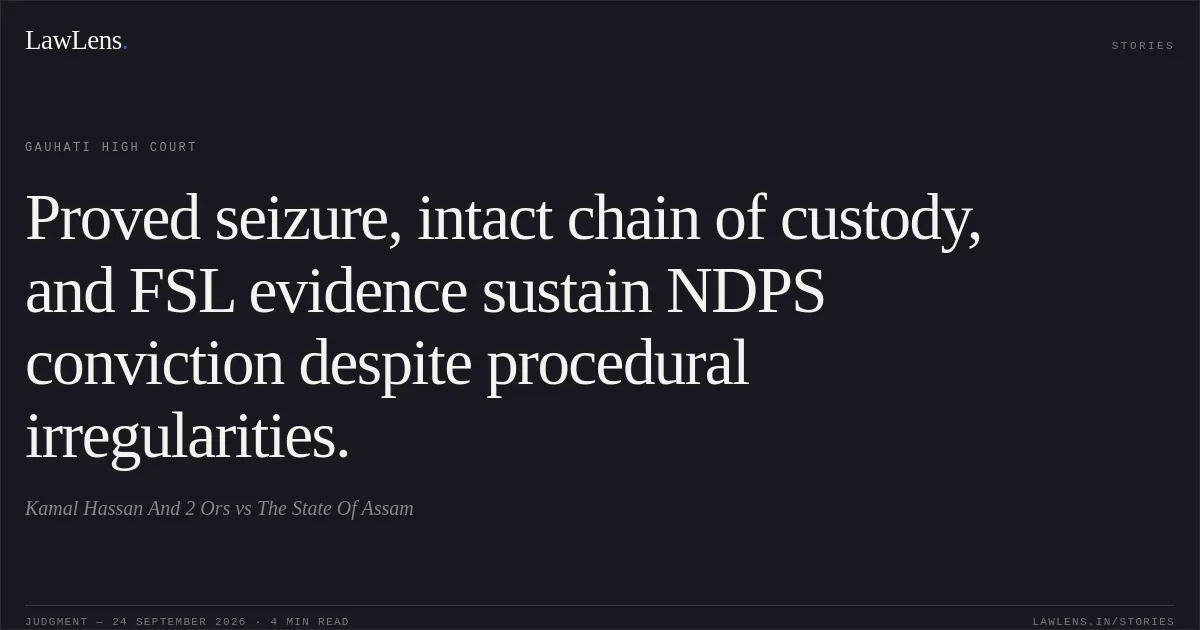
The Court answered the issues against the appellants. It held that the prosecution proved the identity of the substance as methamphetamine, the commercial quantity, the appellants’ possession or conscious connection with the contraband, and substantial compliance with Section 52-A of the NDPS Act.
The appeal was dismissed, and the conviction under Section 22(c) of the NDPS Act was affirmed.
Source reference: p. 18, para. 15The sentences of 12 years’ rigorous imprisonment and a fine of ₹1,00,000 for each appellant, with one year’s simple imprisonment in default, were also affirmed.
Source reference: p. 18, para. 15The period of detention already undergone was directed to be set off in accordance with law, and the trial court records were ordered to be transmitted to the trial court.
Source reference: p. 19, paras. 16–17Acts & Sections Cited
6 provisions across 3 statutes referred to in this judgment. Each provision opens on LawLens.
Narcotic Drugs and Psychotropic Substances Act, 19854
Bharatiya Nagarik Suraksha Sanhita, 20231
Code of Criminal Procedure, 19731
Original Court PDF
Kamal Hassan And 2 OrsvsThe State Of Assam
Click to open original judgment
Original judgment, available to read, download and summarize on LawLens.in