Facts
On 30 May 2006, Mohanlal Chunilal Prajapati and his brother visited the premises of the Narmada Water Resources, Water Supply and Kalpasar Department at Lakhtar, Surendranagar, in connection with inspection of scrap material offered for public auction.
Source reference: pp.2–3An old manual gantry crane, allegedly under the control and supervision of the State authorities, collapsed and fell upon Mohanlal, causing serious spinal and chest injuries. He was treated at Viramgam Civil Hospital and thereafter shifted to a private hospital at Ahmedabad, where he died the same day.
Source reference: pp.2–3, 15–16The plaintiffs—Mohanlal’s widow and minor son, along with his parents—filed Special Civil Suit No. 9 of 2008 claiming compensation of Rs.50 lakhs, alleging negligence in maintaining the gantry and failing to take adequate safety precautions.
Source reference: pp.3–4The State denied negligence, contending that Mohanlal had entered the premises unauthorisedly and had contributed to the accident by sitting on the gantry despite warnings.
Source reference: p.4The trial court held that the death resulted from the collapse of the gantry, applied the doctrine of res ipsa loquitur, rejected the plea of contributory negligence and limitation, and awarded Rs.12,79,372 with interest at 9% per annum from the date of the suit.
Source reference: pp.6–7The State preferred the present first appeal under Section 96 CPC. The plaintiffs filed cross-objections under Order XLI Rule 22 CPC seeking enhancement of compensation.
Source reference: p.1Issues
Whether the State authorities were liable in tort for the death of Mohanlal caused by the collapse of the gantry maintained or controlled by them?
Source reference: para. 16(1); pp.17–22Whether the doctrine of res ipsa loquitur applied to the collapse of the gantry?
Source reference: para. 16(2); pp.19–22Whether the deceased was guilty of contributory negligence or had entered the premises as a trespasser, thereby relieving the defendants of liability?
Source reference: para. 16(3); pp.17–22Whether the suit was barred by limitation?
Source reference: p.22, para. 25Whether the compensation awarded by the trial court required enhancement, including on account of future prospects and conventional heads of damages?
Source reference: para. 16(4); pp.23–25Law Applied
The Court applied Section 96 of the Code of Civil Procedure governing first appeals and Order XLI Rule 22 CPC governing cross-objections.
Source reference: p.1Under the law of torts, a public authority or occupier exercising control over premises owes a duty of reasonable care to persons who are lawfully or reasonably present and may foreseeably be affected by its acts or omissions.
Source reference: pp.17–19The doctrine of res ipsa loquitur permits an inference of negligence where the accident is of a kind that ordinarily would not occur without negligence and the instrumentality causing the injury was under the defendant’s control; the Court relied on Municipal Corporation of Delhi v. Subhagwanti, AIR 1966 SC 1750.
Source reference: pp.19–21For limitation, the Court applied Article 82 of the Limitation Act, prescribing two years for a suit for compensation for wrongful death.
Source reference: p.22, para. 25In assessing compensation under the Fatal Accidents Act, the Court applied the multiplier method developed in General Manager, Kerala SRTC v. Susamma Thomas, AIR 1994 SC 1631, standardised in Sarla Verma v. Delhi Transport Corporation, 2010 (1) GLR 17, and supplemented by National Insurance Co. Ltd. v. Pranay Sethi, (2017) 16 SCC 680, including 40% addition for future prospects for a self-employed person below 40 years of age and standard amounts under conventional heads.
Source reference: pp.23–25Reasoning
The Court found that the deceased and his brother had entered the premises for the auction-related inspection after paying the prescribed tender fee; therefore, they could not be treated as trespassers.
Source reference: pp.17–18The evidence established that the gantry was an old structure situated within premises controlled by the defendants and that it collapsed during the inspection process, causing the fatal injuries.
Source reference: pp.15–16, 19–21Since the State failed to produce reliable evidence of regular inspection, maintenance, effective restriction of access or a specific warning, the collapse itself raised a prima facie inference of negligence under res ipsa loquitur.
Source reference: pp.19–22The defence that the deceased had sat on the gantry despite warnings was rejected because the defendants’ witnesses had not personally witnessed the incident, no independent evidence supported the alleged warning, and the alleged conduct was not corroborated by any contemporaneous complaint or reliable evidence.
Source reference: pp.20–22The absence of a post-mortem and the delay in registration of the FIR did not defeat the civil claim because the medical records, death certificate, police records and surrounding circumstances sufficiently established the causal connection between the gantry collapse, the injuries and the death on a balance of probabilities.
Source reference: pp.15–16The suit, filed on 8 February 2008 for an incident occurring on 30 May 2006, was within the two-year period under Article 82 of the Limitation Act.
Source reference: p.22, para. 25On quantum, the Court accepted the annual income of Rs.1,18,000, added 40% for future prospects, deducted one-third towards personal expenses and applied a multiplier of 16; it also revised the conventional damages in accordance with Pranay Sethi.
Source reference: pp.23–25Holding
The appeal filed by the State was dismissed.
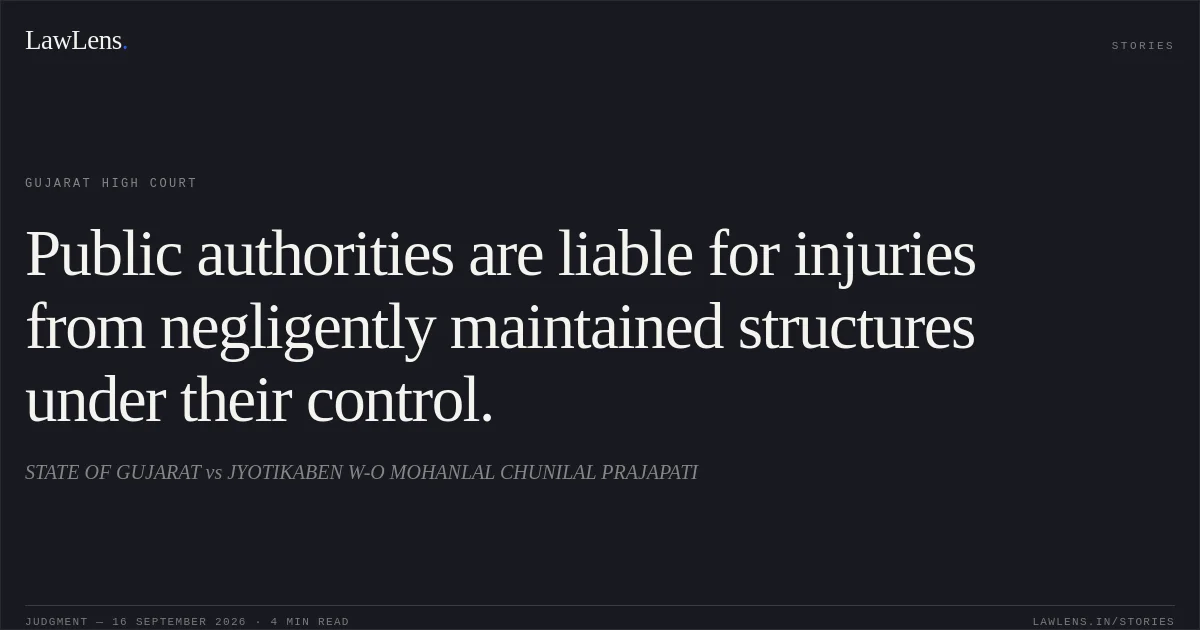
The Court affirmed that the State authorities were liable for the deceased’s death because the gantry was under their control, its collapse established a prima facie case of negligence, and contributory negligence was not proved.
Source reference: pp.21–22, 25The plaintiffs’ cross-objections were partly allowed, and the compensation was enhanced from Rs.12,79,372 to Rs.18,33,200, comprising Rs.17,63,200 for loss of dependency and Rs.70,000 under conventional heads.
Source reference: p.24, para. 28The plaintiffs were awarded 6% interest on the enhanced amount of Rs.5,53,828 from 31 January 2013, the date of disposal of the suit, until realization.
Source reference: p.25, para. 30The State was directed to deposit the entire compensation, interest and proportionate costs within three months, with liberty to the plaintiffs to withdraw the deposited amount.
Source reference: p.25, para. 30Acts & Sections Cited
4 provisions across 3 statutes referred to in this judgment. Each provision opens on LawLens.
Code of Civil Procedure, 19081
Limitation Act, 19631
Indian Penal Code, 18602
Original Court PDF
STATE OF GUJARATvsJYOTIKABEN W-O MOHANLAL CHUNILAL PRAJAPATI
Click to open original judgment
Original judgment, available to read, download and summarize on LawLens.in