Facts
Two workmen, Nagendra Rai and Hari Kishore Rai, sought regularization with the Food Corporation of India (FCI), relying on the FCI circular dated 6 May 1987.
Source reference: pp. 4–7, paras. 5–7The FCI maintained that they had worked only intermittently as casual labour—92 days and 58 days respectively—and had not been engaged directly by it after June 1985 or against sanctioned posts
Source reference: pp. 4–7, paras. 5–7The Central Government referred the dispute to the Central Government Industrial Tribunal, which awarded regularization.
Source reference: pp. 2–3, paras. 2–4The FCI challenged that award under Article 226.
Source reference: no citationThe High Court also considered whether the FCI had followed the Government’s screening procedure for public-sector undertakings challenging industrial awards
Source reference: pp. 18–26, paras. 14–18Issues
1. Whether the FCI had shown compliance with the Government’s screening procedure, including the required prior approval, before filing the writ petition challenging the Tribunal’s award
Source reference: pp. 18–26, paras. 14–182. Whether the Tribunal’s award directing regularization of the workmen warranted interference, having regard to their service and the FCI circular dated 6 May 1987
Source reference: pp. 26–28, para. 19Law Applied
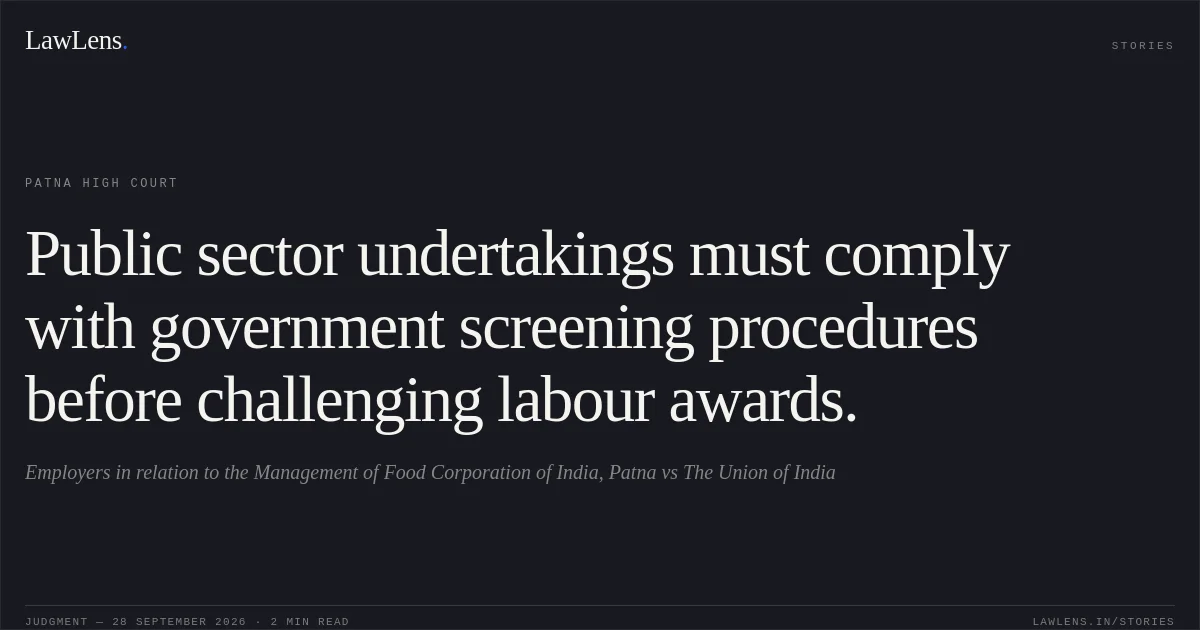
The Government instructions dated 8 August 1964 and 19 March 1999 required a public-sector undertaking seeking to challenge an industrial award to refer the matter to its administrative Ministry; the administrative Ministry was to consult the Law Ministry and the Ministry of Labour, with unresolved disagreement placed before the Committee of Economic Secretaries.
Source reference: pp. 19–24, paras. 15–16The Court also considered the FCI circular dated 6 May 1987, under which casual workers who had completed 90 days of service on or before 2 May 1986 were eligible for consideration for regularization against Class-IV posts.
Source reference: p. 27, para. 19Section 9A of the Industrial Disputes Act, 1947, was invoked in connection with the alleged change in the mode of wage payment.
Source reference: p. 27, para. 19Reasoning
The Court found that the writ petition did not plead or provide material showing that the FCI had followed the screening procedure or obtained the requisite approval before filing its challenge.
Source reference: p. 26, para. 18It further noted that the workmen had served for 92 and 58 days respectively during the relevant period and referred to the 1987 circular’s 90-day criterion.
Source reference: p. 27, para. 19The Court also accepted the position that routing wages through a transport contractor, without notice or consent, violated Section 9A, and concluded that the Tribunal had considered the relevant legal aspects in making its award.
Source reference: p. 27, para. 19On these grounds, it found no basis to interfere.
Source reference: no citationHolding
The High Court dismissed the writ petition, relying on the FCI’s failure to demonstrate compliance with the Government screening instructions and finding no sufficient reason to disturb the Tribunal’s award.
It directed the FCI to implement the award within three months of receiving or being presented with a copy of the order.
Source reference: p. 28, para. 20Acts & Sections Cited
4 provisions across 1 statute referred to in this judgment. Linked provisions open on LawLens.
Industrial Disputes Act, 19474
Original Court PDF
Employers in relation to the Management of Food Corporation of India, PatnavsThe Union of India
Click to open original judgment
Original judgment, available to read, download and summarize on LawLens.in