Facts
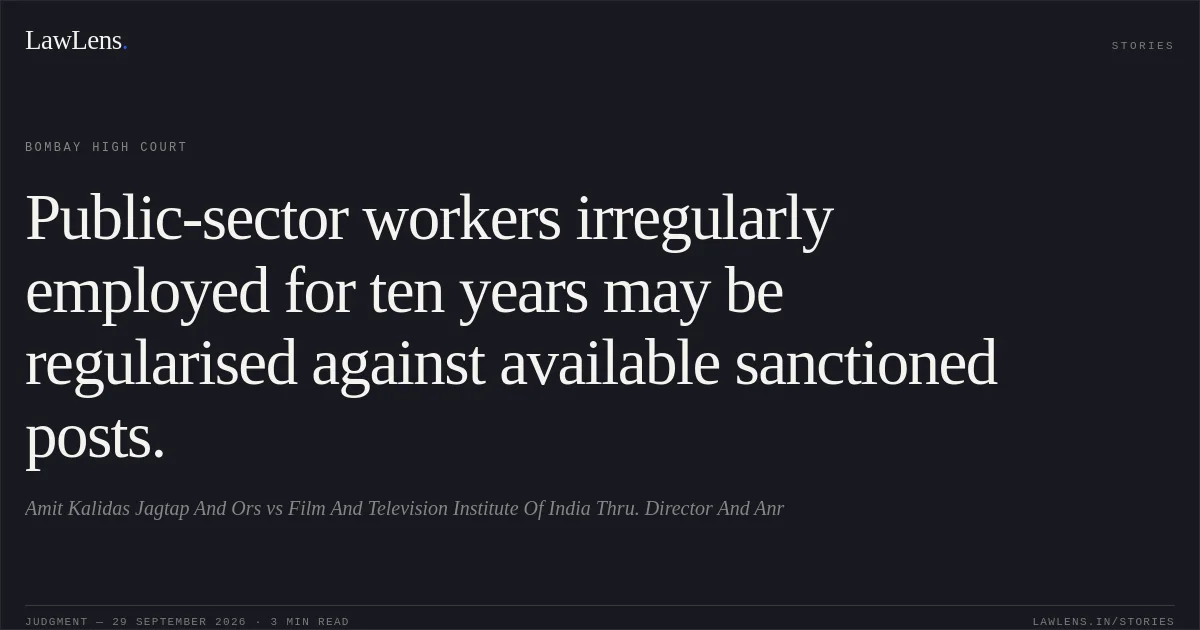
Seven workmen claimed continuous service with the Film & Television Institute of India (FTII) from 2003. FTII initially paid them directly, then from 2007 their services were routed through successive contractors; their services were terminated on 2 July 2018 while their permanency reference was pending.
Source reference: para. 2, 14, 30–31The Industrial Tribunal held that the arrangement was illegal and unjustified and directed permanency from January 2023, when FTII had advertised 15 Studio Assistant posts. FTII challenged the permanency award, while the workmen sought permanency from January 2003.
Source reference: para. 1, 13Issues
1. Whether the workmen were FTII employees notwithstanding the intervening contractor arrangements, and whether they qualified for regularisation/permanency against available posts.
Source reference: para. 30–352. Whether the Industrial Tribunal could grant permanency from January 2023, having regard to the rules governing regularisation in public employment and the existence of Studio Assistant posts.
Source reference: para. 15–21, 33–353. Whether the workmen were entitled to permanency from January 2003, including on the basis of the Central Standing Orders and the asserted 90-day rule.
Source reference: para. 10, 414. Whether the 2015 reference was barred by delay and whether the 2018 termination was unlawful.
Source reference: para. 38–39Law Applied
Under Secretary, State of Karnataka v. Umadevi (3), long service alone does not entitle a temporary or casual employee to regularisation; the recognised one-time exception concerns duly qualified persons irregularly appointed against sanctioned vacant posts who have served for ten years or more without court orders.
Source reference: para. 15–17MSRTC v. Casteribe and Hari Nandan Prasad v. Food Corporation of India recognise the industrial adjudicator’s power to grant regularisation in appropriate cases, but require available posts and do not permit creation of posts through an order of permanency.
Source reference: para. 18–20Municipal Council, Tirora v. Tulsidas Baliram Bindhade holds that completion of 240 days under Model Standing Order 4C does not, by itself, confer permanency in the absence of sanctioned vacancies.
Source reference: para. 20–21The employer–employee relationship is assessed by factors including appointment, payment, dismissal authority, discipline, continuity, and control and supervision. Section 33 of the Industrial Disputes Act restricts an employer’s action against workmen during pending proceedings; the judgment also refers to the statutory requirements applicable to termination.
Source reference: para. 31, 39Reasoning
The Court found that FTII initially engaged and paid the workmen, and that the same seven workers continued at FTII despite changes in contractors. This continuity, together with FTII’s control and its role in their termination, supported the finding that they were FTII’s workers routed through contractors.
Source reference: para. 31–32Their service exceeded ten years, and FTII had created 15 Studio Assistant posts by 2023; the posts remained vacant while recruitment was held pending. The Court therefore upheld regularisation from January 2023, when posts were available, consistently with Umadevi and the limits on directing creation of posts.
Source reference: para. 33–35, 40The claim from January 2003 failed: the Central Standing Orders did not establish an automatic 90-day entitlement, and service duration alone could not justify permanency or require creation of posts.
Source reference: para. 41The 2015 reference was not stale because the regularisation claim accrued after a period of service and the workmen were still working when the reference was made. FTII’s termination during the pending reference, without the applicable statutory safeguards and in breach of Section 33, was unlawful.
Source reference: para. 38–39Holding
Both writ petitions were dismissed.
FTII was directed to reinstate the seven workmen as regular employees on or before 31 October 2026. They were granted notional benefits from January 2023 to 1 April 2024 and actual arrears of pay, allowances, and other benefits from 2 April 2024 onward.
Source reference: para. 42–44No benefits were awarded for the period before January 2023 or for the period they were out of service following their termination on 2 July 2018.
Source reference: para. 42–44Acts & Sections Cited
2 provisions across 1 statute referred to in this judgment. Each provision opens on LawLens.
Maharashtra Recognition of Trade Unions and Prevention of Unfair Labour Practices Act, 19712
Original Court PDF
Amit Kalidas Jagtap And OrsvsFilm And Television Institute Of India Thru. Director And Anr
Click to open original judgment
Original judgment, available to read, download and summarize on LawLens.in