Facts
The original defendant, Bibhishan Kumar Singh (now represented by his legal heirs/appellants), was a Nazir at the Boarijore Block.
Source reference: para. 3He was entrusted with encashing government bills worth ₹75,628.60.
Source reference: para. 4On July 1, 1985, security guards were provided for the encashment, but the amount was not withdrawn that day.
Source reference: para. 4, 9On July 2, 1985, the defendant encashed the full amount in cash without requesting security guards or opting for a bank draft.
Source reference: para. 4, 9He subsequently claimed that ₹75,000 was stolen from a leather bag at a tea shop while he was washing his shirt.
Source reference: para. 5, 9A police investigation later found his allegation of theft to be false.
Source reference: para. 9The State filed Money Suit No. 1 of 1988 for recovery.
Source reference: para. 3The Trial Court decreed the suit in favor of the State, and the First Appellate Court subsequently dismissed the defendant's appeal, affirming the trial court’s judgment.
Source reference: para. 2-3Issues
1. Whether the defendant was responsible for the loss of government funds withdrawn from the State Bank of India.
Source reference: para. 7-82. Whether the concurrent findings of the lower courts were perverse or involved a substantial question of law warranting interference in a second appeal.
Source reference: para. 12Law Applied
The court primarily applied the statutory standard for Second Appeals under the Code of Civil Procedure (Section 100), which mandates that such appeals can only be admitted if they involve a "substantial question of law".
Source reference: para. 6, 12The court further relied on the principle that concurrent findings of fact by lower courts are binding unless they are demonstrated to be "perverse" or unsupported by evidence.
Source reference: para. 12Reasoning
The High Court scrutinized the evidence presented in the lower courts, noting that the defendant admitted to withdrawing the cash on July 2, 1985, despite having been provided security guards specifically for July 1, 1985.
Source reference: para. 9The court highlighted the testimony of P.W. 8 (a constable), which confirmed that guards were provided initially, and noted that the defendant failed to explain why he did not seek protection for the following day or use a bank draft for safety.
Source reference: para. 9-10The High Court found the defendant’s version of the "theft" at a tea shop to be unsubstantiated and noted that the police final report categorized the claim as false.
Source reference: para. 9Consequently, the court reasoned that the defendant failed to exercise "proper caution" regarding government money.
Source reference: para. 10Since the appellants could not demonstrate how the lower courts' appreciation of evidence was perverse, the court determined that no substantial question of law existed.
Source reference: para. 12Holding
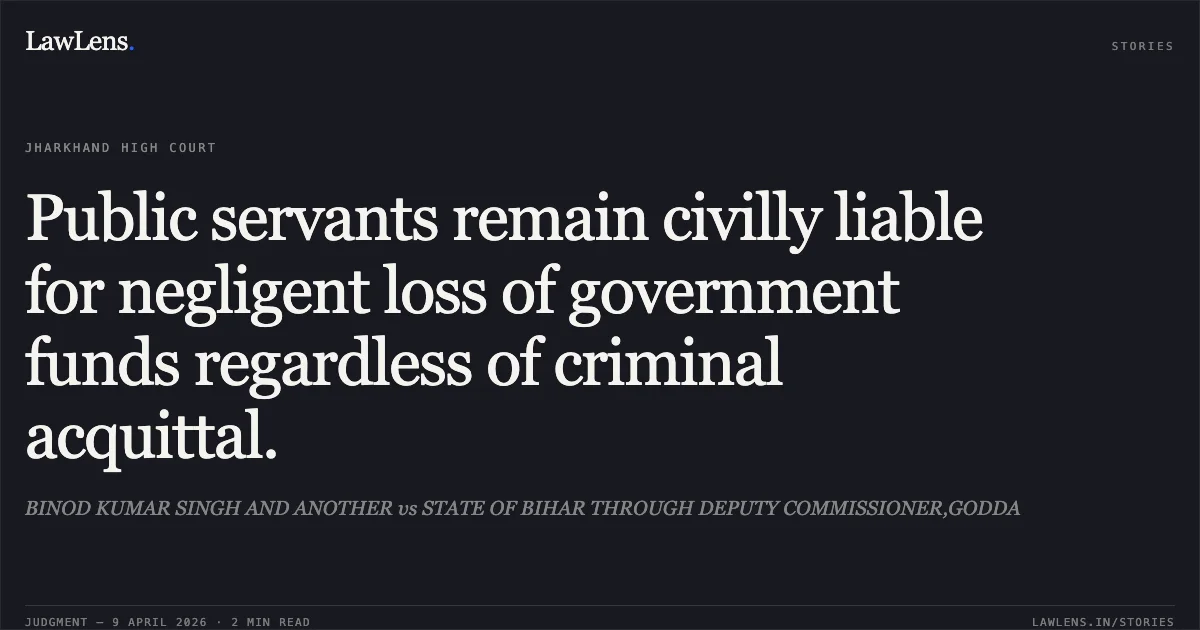
The court held that the defendant was liable for the recovery of the funds, as the loss occurred due to his negligence and lack of caution.
The court concluded that in the absence of a substantial question of law, concurrent findings of fact cannot be disturbed.
Source reference: para. 12-13The High Court dismissed the Second Appeal, affirming the judgments of the lower courts.
Source reference: para. 13Original Court PDF
BINOD KUMAR SINGH AND ANOTHERvsSTATE OF BIHAR THROUGH DEPUTY COMMISSIONER,GODDA
Click to open original judgment
Original judgment, available to read, download and summarize on LawLens.in