Facts
The appellant, A-1, was the former Secretary of Mullankolli Grama Panchayat; A-2 was its Lower Division Clerk.
Source reference: pp.3–5, paras.3, 9The prosecution alleged that, pursuant to a criminal conspiracy, they misappropriated Panchayat funds totalling Rs.35,321 through three transactions: (i) withdrawal of Rs.15,959 on 10 April 2002 for old-age pension, which was never disbursed; (ii) withdrawal of Rs.11,505 on 9 May 2002 towards the salary and allowances of Smt. Saramma, of which only Rs.7,143 was paid and Rs.4,362 was misappropriated; and (iii) withdrawal of Rs.15,000 on 10 May 2002 purportedly towards sand royalty and the River Management Fund, neither of which was remitted.
Source reference: pp.3–5, paras.3, 9A-2 allegedly made false entries in the Cash Book to show that the amounts had been properly disbursed or remitted.
Source reference: pp.3–5, paras.3, 9The Special Court convicted both accused under Sections 13(1)(c) and 13(1)(d) read with Section 13(2) of the Prevention of Corruption Act, 1988, and Sections 409, 420, 468, 477A and 120B of the IPC.
Source reference: pp.6–8, para.5A-1 appealed, contending principally that his individual role and his status as Secretary during the relevant period were not proved, and that the manipulation of records was attributable only to A-2.
Source reference: pp.8–10, paras.6–7Issues
Whether A-1 committed criminal misconduct under Sections 13(1)(c) and 13(1)(d) read with Section 13(2) of the Prevention of Corruption Act, 1988?
Source reference: p.10, para.8; p.64, para.43Whether A-1 committed criminal breach of trust as a public servant under Section 409 IPC?
Source reference: p.10, para.8; pp.53–57, paras.30–35Whether A-1 committed cheating under Section 420 IPC and forgery for the purpose of cheating under Section 468 IPC?
Source reference: p.11, para.8; pp.62–64, paras.41–42Whether the false Cash Book entries and related documents attracted Section 477A IPC concerning falsification of accounts?
Source reference: p.11, para.8; pp.57–61, paras.36–40Whether A-1 and A-2 had entered into a criminal conspiracy punishable under Section 120B IPC?
Source reference: p.11, para.8; p.64, para.43Whether the conviction and sentences imposed by the Special Court required appellate interference?
Source reference: p.11, para.8; pp.64–65, paras.43–45Law Applied
The Court applied Sections 13(1)(c) and 13(1)(d) read with Section 13(2) of the Prevention of Corruption Act, 1988, concerning dishonest or fraudulent misappropriation or conversion of property entrusted to a public servant and obtaining pecuniary advantage by corrupt or illegal means.
Source reference: pp.3–5, paras.3, 9Section 409 IPC requires proof that a public servant was entrusted with property or dominion over it and committed criminal breach of trust; criminal breach of trust under Section 405 IPC requires entrustment together with dishonest misappropriation, conversion or use to the detriment of the owner.
Source reference: pp.53–57, paras.30–35Section 477A IPC requires that a clerk, officer or servant wilfully falsify accounts or make or abet false entries with intent to defraud; “intent to defraud” involves deceit and actual or potential injury.
Source reference: pp.57–61, paras.36–40Section 468 IPC requires forgery committed with the intention that the forged document be used for cheating, while Section 420 IPC requires deception, dishonest inducement and delivery or alteration of property or a valuable security.
Source reference: pp.62–64, paras.41–42The Court also relied on Sadhupati Nageswara Rao v. State of Andhra Pradesh, (2012) 8 SCC 547 : AIR 2012 SC 3242, for the principles governing entrustment and dishonest intention under Section 409 IPC.
Source reference: pp.54–56, paras.32–35Reasoning
The Court found that the documentary and oral evidence established A-1’s direct participation in all three withdrawals.
Source reference: pp.33–42, paras.20–23The cheques for Rs.15,959, Rs.11,505 and Rs.15,000 bore A-1’s signatures, were issued from the Panchayat account and were encashed; A-2 had written the cheques and made the corresponding Cash Book entries.
Source reference: pp.33–42, paras.20–23PW2 and PW10 identified A-1’s signatures, while the bank evidence confirmed that the signatures matched the Secretary’s specimen signature.
Source reference: pp.35–42, paras.20–23A-1’s identity and status as Secretary were also supported by the evidence of PW2 and PW10.
Source reference: pp.9–10, para.7; pp.29–32, para.17The Court further held that the withdrawn amounts were not properly disbursed.
Source reference: no citationThe old-age pension payment lacked the President’s approval, an approved beneficiary list, pension-register entries, postal remittance records and acknowledgments; the Postmaster confirmed that the amount had not been sent through the relevant Post Office.
Source reference: pp.43–49, paras.24–27In the salary transaction, only Rs.7,143 was proved to have been paid to Smt. Saramma, leaving Rs.4,362 unaccounted for.
Source reference: pp.18–19, paras.10–11, 15With respect to the Rs.15,000 withdrawal, the treasury, Mining and Geology Department and River Management Fund records contained no corresponding remittances, establishing that the amounts were not paid as recorded in the Cash Book.
Source reference: pp.49–53, paras.28–29On this evidence, the Court concluded that A-1 had withdrawn Panchayat funds with the assistance of A-2, while A-2 falsified the records to conceal the misappropriation.
Source reference: pp.53–64, paras.30–43The coordinated issuance of cheques, preparation of bills and false Cash Book entries established the dishonest conversion of entrusted public funds, fraudulent conduct, falsification of accounts and conspiracy.
Source reference: pp.53–64, paras.30–43Holding
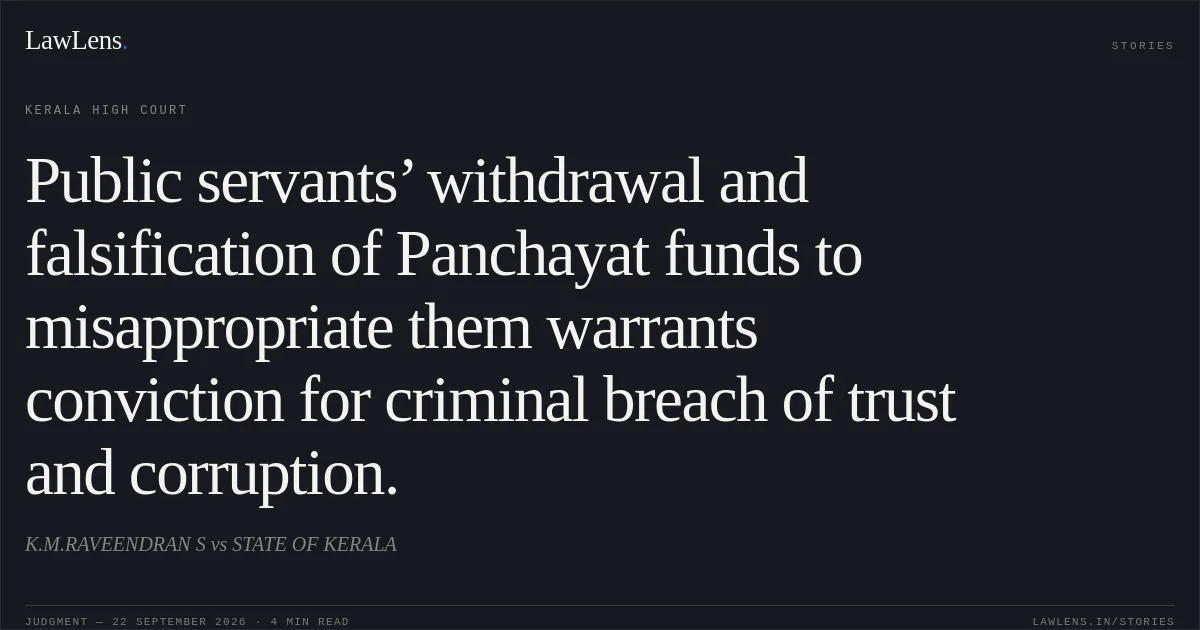
The Kerala High Court held that the prosecution proved A-1’s participation in the misappropriation of Rs.35,321 and established the offences under Sections 13(1)(c) and 13(1)(d) read with Section 13(2) of the Prevention of Corruption Act, 1988, and Sections 409, 420, 468, 477A and 120B IPC.
The conviction and sentences imposed by the Special Court were confirmed, and the criminal appeal was dismissed.
Source reference: pp.64–65, paras.43–44The order suspending sentence and granting bail was vacated, and A-1 was directed to appear before the Special Court forthwith to undergo the sentence; failing such appearance, the Special Court was directed to execute the sentence.
Source reference: p.65, para.45Acts & Sections Cited
10 provisions across 4 statutes referred to in this judgment. Each provision opens on LawLens.
Prevention of Corruption Act, 19881
Indian Penal Code, 18606
Code of Criminal Procedure, 19731
Bharatiya Nyaya Sanhita, 20232
Original Court PDF
K.M.RAVEENDRAN SvsSTATE OF KERALA
Click to open original judgment
Original judgment, available to read, download and summarize on LawLens.in